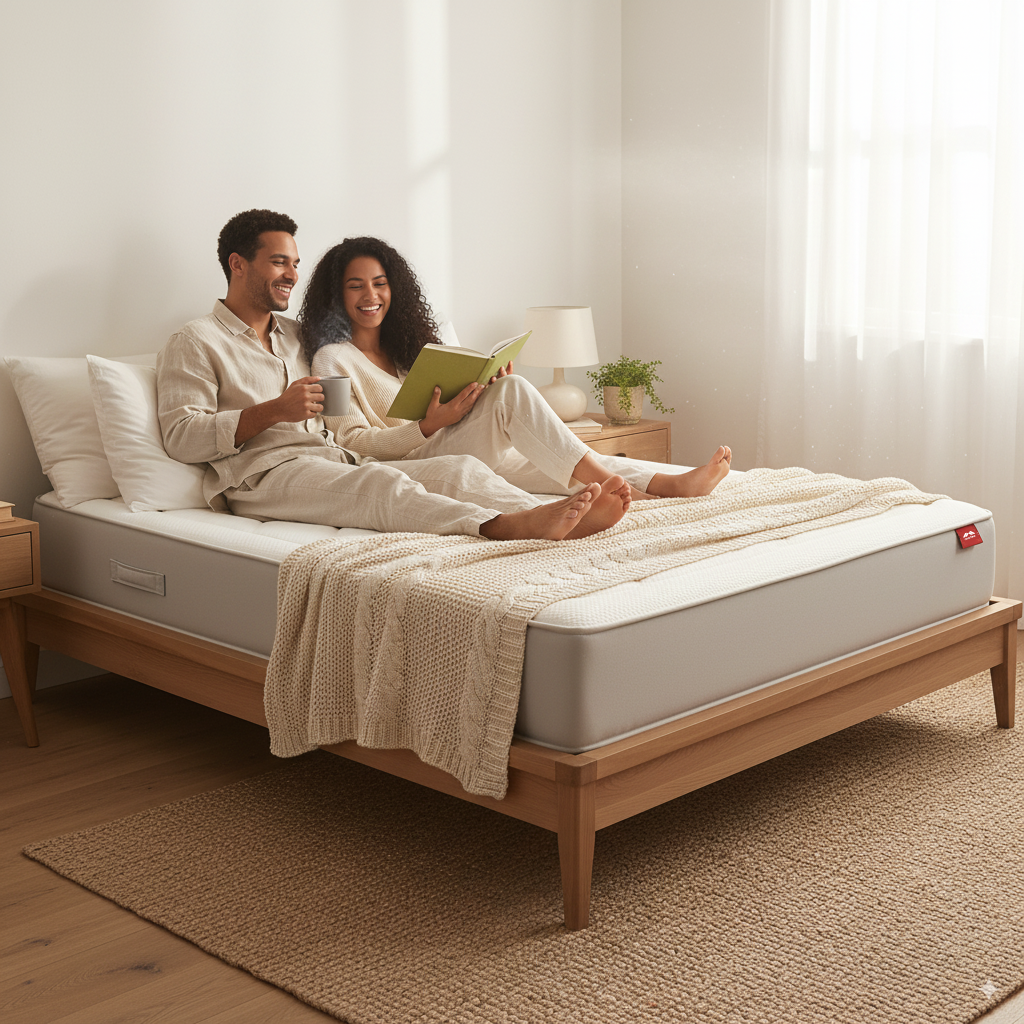

Mattress for fibromyalgia: guide to choosing the best 2026
You lie down with hope and wake up feeling like you haven't rested at all. Perhaps your shoulders hurt when you lie down, your hips can't seem to find a comfortable position, or you feel hot and wake up constantly even though you're exhausted. If you live with fibromyalgia, that scenario doesn't sound exaggerated. It sounds everyday.
You may also have been looking for a mattress for fibromyalgia for a while and always come across the same quick recommendation: "get a memory foam one" or "make sure it's not firm." The problem is that this doesn't go far enough. Not all nighttime discomfort feels the same, and not all mattresses respond the same way to every symptom.
Here, it's important to understand a simple idea. It's not just about buying a comfortable mattress, but about choosing a surface that responds well to your pain, your sensitivity to touch, your body temperature, and the way you sleep. When you connect each feature of the mattress with the symptom that affects you most, the choice stops being confusing.
The challenge of sleeping well with fibromyalgia
There are nights when your body asks for rest, but the pain won't negotiate. You lie on your side and your shoulder protests. You change positions and now your hip bothers you. You lie on your back to relieve pressure points and, after a while, lower back stiffness or the feeling of not finding support appears. This is how a very frustrating cycle begins: you sleep poorly because it hurts, and the next day everything hurts more because you slept poorly.
This wear and tear is not an individual rarity. In Spain, fibromyalgia has an estimated prevalence of around 2.4% of the adult population, with a clearly higher impact on women, around 4.2% compared to approximately 0.2% in men, according to the EPISER study by the Spanish Society of Rheumatology. Behind that figure are many people trying to solve the same domestic and silent problem: how to sleep without fighting the bed all night.
When the mattress stops being neutral
For someone who doesn't have widespread pain, a mattress can simply be "more or less comfortable." With fibromyalgia, the mattress stops being neutral. It becomes a surface that can increase pressure on sensitive areas or distribute the body's weight better.
Think of something very simple. If the mattress is too firm, bony prominences receive more direct pressure. If it's too soft, the body sinks unevenly and the spine loses alignment. In both cases, the result is usually the same: more awakenings, more muscle tension, and the feeling of unrefreshing sleep.
Sleeping better does not eliminate fibromyalgia on its own, but it can reduce some of the nighttime suffering that makes it worse.
What usually causes the most confusion
Many people look for "the softest mattress" thinking that will mean less pain. It makes sense, but it doesn't always work. Softness without support can make your back and hips work during the night instead of relaxing.
The opposite also happens. A high firmness is chosen "to support the back well," and the support ends up being too aggressive on the shoulders, ribs, pelvis, or knees. That's why, with fibromyalgia, the useful question is not "firm or soft?". The useful question is this:
- Where does it hurt when I lie down? Shoulders, hips, lower back, or several areas.
- What wakes me up most? Pressure, heat, your partner's movement, or stiffness.
- How do I wake up? With a feeling of numbness, with fatigue, or with pain upon contact.
- What position do I spend the most time in? On your side, on your back, or constantly changing.
When you answer that, the mattress stops being a generic purchase and becomes a real support tool.
Keys to a mattress for fibromyalgia
There is no magic model that works for everyone, but there are technical features that recur when a mattress really helps. The most consistent recommendation in Spanish sources focused on rest is a medium firmness, with viscoelastic adaptation and high breathability, because that combination helps distribute pressure and maintain alignment in delicate areas like the shoulders and hips, as reported in this technical guide on mattresses and pain in fibromyalgia.

Medium firmness that supports without being aggressive
Medium firmness usually works better because it avoids both extremes. It doesn't punish sensitive points like a firm mattress, but it also doesn't let the body sink uncontrollably.
If you have pain when resting your shoulders or hips, this point is very important. An intermediate support allows those areas to give just enough, while the back maintains a more stable line. The desired feeling is not "sinking" or "bouncing." It is feeling supported without noticing excessive resistance.
Adaptability to reduce pressure peaks
Adaptability is the mattress's ability to mold to the body's contours. In fibromyalgia, this is especially noticeable when touch or compression triggers pain.
An adaptable mattress distributes weight better. Instead of concentrating the load on a few points, it supports more of the body's surface. That can make a clear difference if you wake up due to discomfort in:
- Shoulders, when you sleep on your side.
- Hips, if you feel pressure when turning.
- Lower back, when the mattress does not fill the natural curve well.
- Knees or ribs, in people with high sensitivity to touch.
Practical rule: if when you lie down you immediately notice "hard points" under your body, the mattress is probably not relieving pressure as it should.
Breathability for hot or sweaty nights
There are people with fibromyalgia who describe a special discomfort with nighttime temperature. Sometimes it's not just heat. It's the feeling that the body does not regulate well and any excess worsens rest.
Here it is advisable to look for ventilated fabrics, cool materials, and designs that allow air circulation. A less hot mattress does not "cure" the pain, but it does avoid an extra layer of discomfort that favors awakenings and continuous changes of posture.
Bed independence if you sleep with a partner
This feature is usually overlooked until it is suffered. If every turn of the other person wakes you up, your sleep enters vigilance mode. And when sleep is already fragile, every micro-awakening counts.
Bed independence helps so that movement on one side of the bed is less noticeable on the other. If you also have sensitivity to movement or have difficulty falling back asleep, it deserves a lot of weight in the decision.
Material analysis: memory foam, hybrid, or latex?
Choosing a material is not about following trends. It's about understanding what sensation each one produces and how it fits with your dominant symptom. If what limits you most is pain upon contact, you won't look at a mattress the same way as if the worst thing for you is nighttime heat or the feeling of instability when turning.

Memory foam if the main problem is pressure points
Memory foam is usually the option that most people associate with pressure relief, and rightly so. Its way of adapting can reduce the feeling of "impact" in sensitive areas. If your shoulders, hips, or ribs hurt when you lie down, it is usually the first family of materials to try.
If you want to delve deeper into how this material works, this explanation on what a memory foam mattress is can help you.
Its possible drawback appears when you are looking for a more agile response or are very sensitive to heat. Some memory foam mattresses offer a more enveloping feeling, pleasant for some people and overwhelming for others.
Hybrid if you need balance between adaptation and ventilation
Hybrid mixes comfort layers with a core that provides more structure and airflow. It usually fits well when you want pressure relief, but do not want an overly slow or closed embrace.
Models oriented to fibromyalgia usually resort to multilayer structures and ventilation channels to combine support and pressure relief, allowing controlled sinking without losing alignment.
A quick way to compare sensations can be this:
| Material | Usually helps more if you notice | May not fit as well if you notice |
|---|---|---|
| Memory foam | Pain upon contact and localized pressure | Excess heat or a very marked hugging sensation |
| Hybrid | Need for balance between comfort, support, and ventilation | Preference for a very enveloping surface |
| Latex | Desire for quick response and good ventilation | Less affinity with elastic sensations |
This video can help you better visualize the differences in sensation between mattress types before trying them in person.
Latex if you prefer a more elastic response
Latex usually offers adaptability with a more immediate response. It does not have that slow sinking feeling that some people love in memory foam and others reject. It can be a good option if you change your posture a lot and value ease of moving in bed.
It will not always be the first choice in fibromyalgia, but it can work very well when you are looking for a mix of homogeneous support, adaptability, and ventilation. The key is how your body feels after several days, not just the first impression in the store.
Your sleeping posture makes the difference
The same person can try two correct mattresses and feel one clearly better. Many times the difference is not in the brand or the marketing. It is in the posture in which they spend the most hours asleep.

If you sleep on your side
Sleeping on your side usually demands more from the mattress on the shoulders and hips. Those areas need to give enough so that the spine does not remain tilted.
If the mattress is too firm, the shoulder bears too much load. If it is too soft, the torso falls and the waist becomes misaligned. The most sensible thing is usually an adaptable surface with stable support underneath. The pillow also matters here. It must fill the space between the head and shoulder without forcing the neck.
If you sleep on your back
In this posture, the mattress has to support the lumbar area without creating an uncomfortable arch or leaving the pelvis too sunken. Many people with fibromyalgia notice momentary relief on their back, but wake up stiff if the base does not properly support the natural curve of the back.
Look for a feeling of continuous support. The body must rest "supported," not suspended by loose areas. If you want to review how position influences sleep, this guide on sleeping postures can help you better observe your alignment.
If when looking at yourself in profile the head is very high or very low compared to the torso, the pillow is not collaborating with the mattress.
If you sleep on your stomach
It is usually not the most friendly posture for the neck and lumbar area, especially if there is already muscle pain and widespread sensitivity. Even so, many people use it because it is the only one with which they manage to fall asleep.
In that case, it is advisable to avoid mattresses that are too soft. When the pelvis sinks a lot, the lumbar area tenses more. A thinner pillow also usually helps, because it reduces cervical torsion. If you cannot completely change your posture, at least try to reduce the time you spend on your stomach.
How Morfeo responds to the needs of fibromyalgia
When a person looks for rest with widespread pain, they do not need grandiose promises. They need coherence between technology and a real feeling of use. That is where it makes sense to look at how a specific brand translates the principles of good rest into practical solutions.
When the dominant symptom is pressure
If the biggest problem is pain upon contact, viscoelastic proposals usually call attention first. In the case of Morfeo, the medium firmness model is the Nature Mattress, with natural latex that adapts to the body's contour and softens the feeling of pressure in delicate areas.
The important idea is not the name of the material itself, but what it does at night. If a comfort layer supports the shoulders, hips, and back without creating disorderly sinking, rest becomes more stable. That fits especially well with people who wake up due to sensitivity to touch.
When the problem is heat or the feeling of being trapped
Other people do not tolerate overly enveloping surfaces because they accumulate heat or make them feel trapped when changing posture. There, hybrid designs and solutions oriented to improve ventilation result more attractive.
In the Morfeo range, that response appears in the Altus, with linen outer fabric, and in the VisCool Mattress, with PCM thermoregulating fabric; the latter is high firmness, so it fits better if heat bothers you more than pressure. It does not mean that everyone should choose the same. It means that the material must follow the symptom, not the other way around.
When you look for balance and not extremes
The majority of those who have fibromyalgia do not need the softest mattress or the firmest. They need a well-resolved middle ground. Morfeo works precisely with that language of balance: ergonomics, breathability, and comfort combined, instead of a single isolated quality.
That can be useful if you recognize yourself in phrases like these:
- “It hurts when I lie down, but I also get overwhelmed by the heat.”
- “I want adaptability, but not to sink.”
- “I sleep with my partner and their movements wake me up.”
- “I need to try it at home, not decide in five minutes.”
A good mattress does not compete to be the most eye-catching. It competes to bother you less every night.
The smart and risk-free buying process
Buying a mattress with fibromyalgia should not be done in a hurry. The body needs time to tell the truth. A first lie-down can give you clues, but it does not always reveal how you will sleep after several consecutive nights.

What is advisable to check before buying
There are three elements that greatly reduce the risk of making a mistake: trial period, warranty, and easy return. In a purchase like this, they are not decorative extras. They are part of the product.
Morfeo offers 100 nights of trial on its mattresses (with free pickup if you decide to return it), 10 years of warranty, and free shipping on the mainland. That changes the type of decision you make. You no longer choose blindly. You choose with real room to observe if your body rests better at home.
How to make good use of the trial period
Do not try the mattress thinking only “is it comfortable?”. Ask yourself more precise questions for several days:
- Upon waking, is there less pain upon contact or less stiffness?
- During the night, do you turn over less to escape the pressure?
- With heat, does the thermal sensation interrupt you less?
- As a couple, do you notice the other person's movement less?
If you're comparing options, this guide on how to choose the right mattress can serve as a mental checklist.
Buy thoughtfully, not in a hurry
Smart buying is more like a clinical observation of your sleep than an impulsive purchase. You don't need an endless catalog. You need to rule out what worsens your symptoms and keep what makes for more stable nights.
A mattress may seem excellent in a store and leave you exhausted at home. The opposite can also happen. That's why, when there's persistent pain, the value lies in trying, adjusting, and deciding calmly.
Medium firmness and comfort
If you're looking for a mattress that distributes pressure
Medium firmness, a layer that adapts to the body and is breathable: that's the Nature. If you prefer something a notch firmer, the Altus.
 Nature Mattress
Medium firmness with natural latex and organic cotton over pocket springs: elastic comfort that distributes pressure and stable support underneath.
View the Nature Altus Mattress
Medium-firm, a notch firmer than the Nature: over 2,000 pocket springs and breathable linen outer fabric.
View the AltusIt's not a treatment: if the pain persists, consult your doctor or physical therapist.
100-night trial on mattresses · 10-year warranty · free shipping on the mainland · made in Spain
Frequently asked questions for worry-free sleep
Is there one best mattress for everyone with fibromyalgia?
No. And it's best to say it honestly. There is a lack of solid clinical evidence about “the best type of mattress” for fibromyalgia. Many recommendations come from commercial experience and general ergonomic principles, so personal testing remains decisive.
That doesn't mean going in blind. It means using sensible criteria. If pressure pain predominates, it usually makes sense to prioritize adaptation. If heat is the worst part, it's best to give more weight to ventilation. If movement wakes you up, bed independence takes center stage.
Can a topper help?
Yes, sometimes it can help. Especially if your current mattress is too firm and you need an extra layer of comfort to reduce surface pressure. It can be a transitional solution or a way to fine-tune sensations.
But it has limits. If the base mattress is already deformed, sunken, or provides poor support, a topper will not correct that structural problem. It adds comfort. It does not replace a core that no longer supports the body well.
Can a mattress cure fibromyalgia?
No. A mattress does not cure fibromyalgia. What it can do is reduce nighttime aggravating factors: excessive pressure, heat, movement interruptions, and poor alignment. And that, in practice, can translate into less difficult nights and slightly more manageable mornings.
How often should I check if my mattress is still suitable?
There's no need to wait until it's visibly broken. If you notice new discomforts when you lie down, that you're sinking more in one area, that you wake up feeling stiffer, or that you no longer sleep as you used to, it's worth checking if the mattress is still meeting your needs.
The best indicator is not the mattress label. It's how your body feels in the morning.
If you're looking for an option backed by a home trial, an extensive warranty, and designs intended to combine ergonomics, breathability, and comfort, you can discover the Morfeo mattresses, made in Spain. When you have fibromyalgia, choosing calmly and being able to try without risk is not a luxury. It's part of making the right decision.