
Why am I so sleepy and tired? Causes and what to do
Always feeling exhausted is one of those frustrating experiences that goes far beyond a simple yawn. We often lump tiredness and sleepiness together, but they're not the same: think of tiredness as your phone battery at 10%, desperately needing a slow, deep charge. Sleep, on the other hand, is the automatic shut-off timer your body activates to start that recharge. Understanding this difference is the first step toward regaining your vitality.
The silent epidemic of modern exhaustion
Living with that constant feeling of exhaustion has become so common that many of us have accepted it as normal. The fast pace of life, pressure at work, and being connected 24/7 push us to squeeze every minute out of the day, and we almost always do so by sacrificing hours of precious rest. But this state of chronic exhaustion is not, and should not be, your natural state.
This exhaustion goes beyond feeling a little sleepy in the afternoon. It manifests in many ways that directly impact your quality of life. And in Spain, for example, sleep deprivation is an everyday problem.
Sleep societies recommend that adults sleep between 7 and 9 hours per night, and many people in Spain habitually get less than that. When this deficit accumulates, persistent tiredness and lack of energy during the day are among the first consequences you'll notice.
Identifying the warning signs
It's essential to learn to listen to your body, because it sends very clear signals when something is wrong. Normalizing tiredness is like ignoring the warning light in your car. If you identify with any of these situations, it's time to pay attention:
- Waking up without energy: You feel like you haven't rested at all, even though you've slept for a few hours.
- Brain fog during the day: You find it hard to concentrate, make decisions, or remember simple things.
- Irritability and mood swings: Small setbacks affect you more than usual due to accumulated fatigue.
- Constant need for stimulants: You depend on coffee or energy drinks just to function.
These are just some of the 6 signs that you're not getting enough sleep and that your body is desperately crying out for help.
Consider this article your roadmap for figuring out where your fatigue comes from. We'll help you put a name to what you're feeling and give you an arsenal of practical solutions, from changes in your daily habits to the vital importance of a good sleep setup. The goal is clear: to help you regain control of your energy and feel fully fit again.
Identifying the hidden causes of your exhaustion
That constant exhaustion you feel doesn't appear out of thin air. In fact, it's a warning sign sent by your body, a clear message that something isn't working as it should. The causes can vary widely, and to solve the mystery of your fatigue, the best thing to do is get into detective mode and analyze the clues your daily life gives you.
The roots of that persistent tiredness and sleepiness usually fall into four major areas. And be careful, because often the culprit isn't a single factor, but a combination of several that become intertwined and reinforce each other.
This infographic helps you visualize how the factors that rob you of your energy are organized, from the most common, such as lifestyle habits, to conditions that may need more attention.
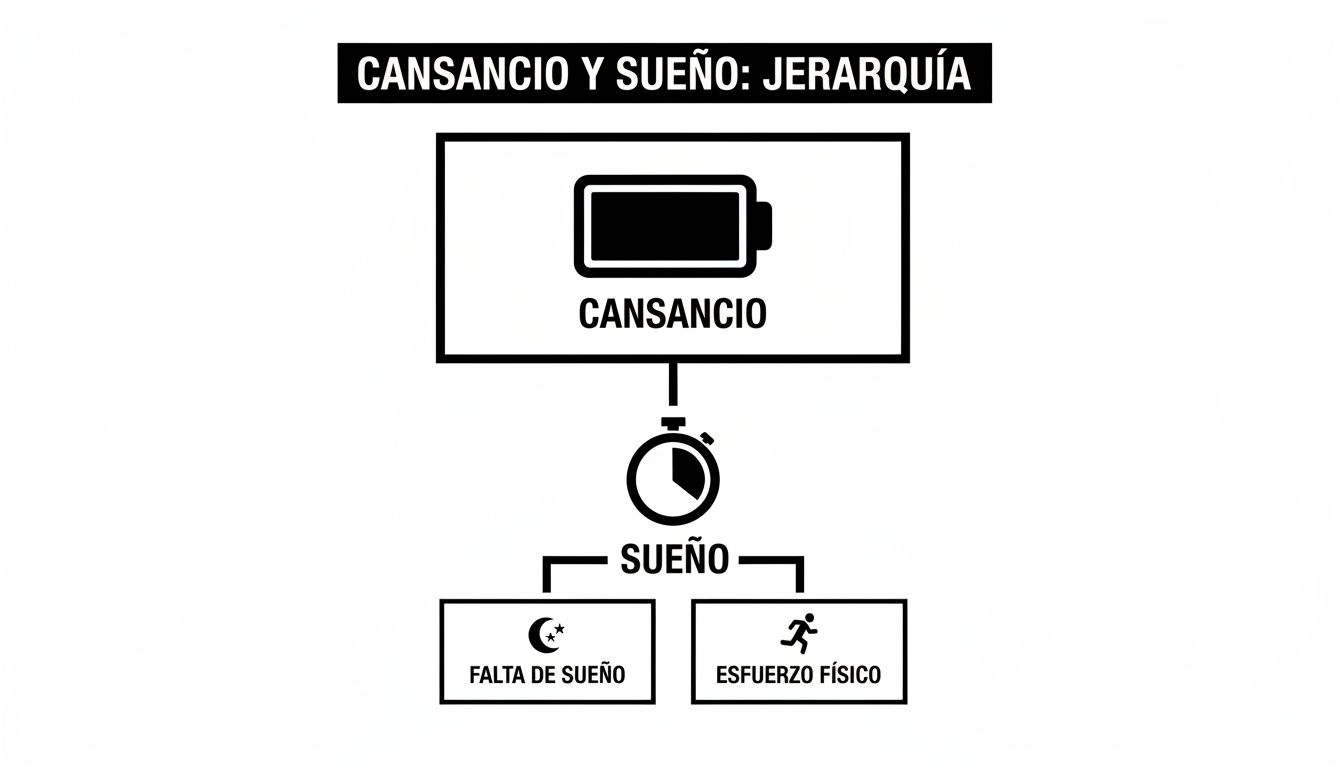
As you can see, the most common causes—our routines, stress—form the foundation of the problem. Medical conditions are less frequent, but no less important.
Lifestyle habits that sabotage your energy
Sometimes, without realizing it, the answer lies in our most ingrained routines. They are small actions that, day after day, slowly drain our energy reserves almost without us noticing.
Think about caffeine, for example. That mid-afternoon coffee may seem like the perfect solution to keep going, but its stimulating effect can last for hours, sabotaging the quality of your deep sleep at night. The same goes for alcohol: although it may help you fall asleep, it fragments your rest in the second half of the night, leaving you feeling like you haven't rested at all when you wake up.
Other habits that are robbing you of your energy are:
- An unbalanced diet: If your diet is based on refined sugars and processed foods, your glucose levels will experience sharp peaks and drops. The result? An energy rollercoaster throughout the day.
- Sedentary lifestyle: A lack of physical activity weakens the body and makes it less efficient at using energy. A simple daily walk can make a huge difference.
- Chaotic sleep schedules: Going to bed and waking up at very different times, even on weekends, disrupts your internal biological clock and makes it very difficult for your body to get truly restorative rest.
The invisible weight of stress and anxiety
Stress and anxiety are two of the biggest energy thieves of our time. When you live under stress, your body releases hormones like cortisol, which keep you in a constant state of alert, as if you were preparing for an emergency that never arrives.
This "fight or flight" state consumes a huge amount of resources, both physical and mental. The brain simply cannot switch off, which prevents you from reaching the deepest and most restorative stages of sleep.
Stress is a key factor behind tiredness. Sometimes, exhaustion has deeper roots, such as mental health or pressure at work, and it's best to identify them to understand what is causing it.
To get a clearer picture, this summary table will help you quickly identify the possible sources of your exhaustion.
| Possible causes of your tiredness and sleepiness | ||
|---|---|---|
| Cause category | Specific examples | Key symptoms to watch for |
| Lifestyle habits | Unbalanced diet, sedentary lifestyle, irregular sleep schedules, caffeine/alcohol consumption in the afternoon/evening. | Energy ups and downs, difficulty falling asleep, waking up feeling unrested, general weakness. |
| Stress and anxiety | Work-related worries, personal problems, constant pressure, inability to disconnect. | Racing mind, muscle tension, irritability, difficulty concentrating, difficulty falling asleep. |
| Sleep disorders | Insomnia, sleep apnea, restless legs syndrome. | Difficulty falling or staying asleep, loud snoring, breathing pauses, need to move legs. |
| Medical conditions | Anemia, hypothyroidism, diabetes, infections, fibromyalgia. | Paleness, feeling cold, unexplained weight gain or loss, excessive thirst, widespread pain. |
| Medication | Antidepressants, antihistamines, blood pressure medications, beta-blockers. | Daytime drowsiness listed as a side effect in the medication insert. |
This table is an initial guide. If you suspect any of these causes, the next step is to talk to a professional.
Sleep disorders you should not ignore
If you already take care of your habits, manage stress, and still have no energy, you may be dealing with a sleep disorder without knowing it. These are medical conditions that directly disrupt your rest.
The most common are:
- Insomnia: It's not just "not being able to sleep". It also includes waking up a thousand times during the night or too early in the morning without being able to fall back asleep.
- Sleep apnea: It is characterized by pauses in breathing while you sleep. Although brief, they prevent your brain and body from receiving the oxygen they need, which causes you to wake up exhausted and with terrible daytime drowsiness.
- Restless legs syndrome: That irresistible need to move your legs, especially at night, which makes falling and staying asleep a real nightmare.
Medical conditions and medications
Finally, tiredness that doesn't go away can be a symptom of an underlying medical condition. Your body could be fighting something internally, and fatigue is its way of asking you to slow down.
Some of the conditions most associated with this exhaustion are:
- Anemia: Iron deficiency reduces your blood's ability to carry oxygen. Less oxygen equals less energy. It's that simple.
- Hypothyroidism: If your thyroid gland is running at half speed, your metabolism slows down. This causes tiredness, weight gain, and a constant feeling of cold.
- Diabetes: When blood sugar levels are poorly controlled, whether too high or too low, they can cause considerable fatigue.
Also, don't forget to check your medication. Certain drugs, such as some antidepressants, antihistamines, or blood pressure pills, can have drowsiness as a side effect. It is essential to read the medication insert and, above all, talk to your doctor if you suspect your pills may be the cause of your exhaustion.
When you should consult a doctor about your tiredness
Knowing when simple tiredness becomes a warning sign is key to taking care of your health. Think of that exhaustion that doesn't go away as the "check engine" light in your car: you can ignore it for a while, but the underlying problem will still be there and could get worse.
It is completely normal to feel exhausted after a bad night or a crazy week. The problem comes when tiredness and sleepiness settle into your life as if they were family. It's not about assuming the worst, but about being proactive and listening to what your body is trying to tell you.
Warning signs you should not overlook
There are certain symptoms that, if they appear along with that fatigue that won't leave you, should make you pick up the phone and make an appointment with your doctor. These are the typical "red flags" that suggest exhaustion is more than just a bad stretch of sleep.
Pay close attention if your tiredness comes with:
- Unshakeable persistence: The exhaustion doesn't go away with a good night's sleep, or even after a vacation. You feel that no matter how much you try to recharge your batteries, the battery never reaches 100%.
- Unexplained physical symptoms: Fatigue comes with a fever that won't go away, night sweats, strange headaches, joint pain, or swollen lymph nodes for no apparent reason.
- Drastic weight changes: You have lost or gained a lot of weight without having changed your diet or exercise routine.
- Digestive problems: You notice changes in your bowel movements, such as diarrhea or constipation that persist over time.
- Difficulty breathing: You run out of breath doing everyday things that used to be easy for you.
The combination of these symptoms points to the fact that fatigue may be just one piece of a larger puzzle. Perhaps it is related to a medical condition that needs a professional to take a look.
How to prepare for your doctor's appointment
Once you decide to go to the doctor, arriving prepared can make a difference. It helps the diagnosis be faster and the visit much more useful. Instead of saying a generic "I'm always tired", try to provide specific and well-organized information.
Keeping a record of your symptoms is one of the most powerful tools you can give your doctor. A small sleep and energy diary from the last two weeks can bring to light patterns that even you hadn't seen, making the search for the real cause much easier.
To get your ideas in order, you can follow these steps:
- Keep a sleep diary: Write down what time you go to bed and wake up, how many times you wake up during the night, and how you feel in the morning.
- Describe your tiredness: Is it more physical or mental? Is there a time of day when it gets worse? Is there anything that relieves it or makes it worse?
- Note other symptoms: Don't leave anything out. Write down anything else you've noticed, no matter how small it may seem.
- Make a list of medications: Include everything you take, from prescription drugs to supplements and vitamins.
Arriving with this "cheat sheet" will help you explain your situation clearly and directly. This way, your doctor will have a complete picture and can help you regain that energy you miss so much.
Practical strategies to win the battle against tiredness
Understanding where that exhaustion comes from is the first step, but now it's time to roll up your sleeves and take action. If you want to leave behind persistent tiredness and sleepiness, you need a plan with two fronts: it's not just about improving your nights, but also adjusting your days so they work in favor of your rest.
Let's look at some realistic tools so you can start recharging your batteries right now.

Think of your sleep cycle as if it were an orchestra. For the symphony of rest to sound perfect, each instrument must enter at the right moment. This is achieved with good sleep hygiene, which is nothing more than a set of habits that prepare your body and mind for a truly restorative night.
Optimize your day to improve your night
What you do during the day has a direct echo on how you sleep at night. You don't need to turn your life upside down; it's about small adjustments that, added together, make a huge difference.
The first step is to set your biological clock, the one experts call the circadian rhythm. The easiest way is to expose yourself to sunlight in the morning, ideally during the first 30 minutes after waking up. It's a simple gesture that sends an unequivocal signal to your brain: "It's time to get active!"
Another key pillar is exercise. Moving your body not only puts you in a better mood and lowers stress, but also helps you have a deeper and higher-quality sleep. Of course, the when is almost as important as the what.
- In the morning or mid-afternoon: This is the ideal time. Exercise raises body temperature, and when it drops at night, it makes it easier for your body to fall asleep.
- Intense at night: Better avoid it. If you give yourself a hard workout at the gym less than 2-3 hours before going to bed, you can get the opposite effect: your body speeds up and finds it much harder to relax and fall asleep.
Food also has a lot to say. Avoid heavy and abundant dinners, and leave caffeine and alcohol for another time. Opt for light dinners with foods that contain tryptophan (turkey, bananas, nuts...), which help produce serotonin and melatonin, the hormones of well-being and sleep. And since stress is one of the biggest energy thieves, setting aside some time at the end of the day to disconnect from work also helps.
Design an evening ritual that works for you
Your brain cannot go from 100 to 0 in a second. It needs a smooth transition between the hustle of the day and the calm of the night. An evening ritual before bed is precisely that deceleration ramp that tells your body: "Okay, it's time to slow down."
Your bedroom should be a sanctuary for rest, not a branch of the office or the movie theater. If you associate the bed only with sleep and intimacy, your brain will make that connection automatically and it will be much easier for you to fall asleep.
The key here is consistency. Try to go to bed and wake up at the same time every day, even on weekends. This regularity is gold for your circadian rhythm and helps your sleep-wake cycle regulate naturally.
To create your own ritual, you can try this:
- Turn off screens: The blue light from phones, tablets, and computers inhibits melatonin. Put them aside at least 60 minutes before going to bed.
- Create a zen environment: Dim the lights, make sure the room is cool (between 18 and 21°C is ideal), and use blackout curtains so not a single ray of light gets through.
- Incorporate calming activities: Spend 15-30 minutes reading a book (a physical one, if possible), listening to relaxing music, meditating, or taking a warm bath. Whatever helps you slow down your heart rate and clear your mind.
If you want to learn more about setting up an insomnia-proof bedtime routine, check out these tips for sleeping better and getting restful sleep. Putting these ideas into practice not only combats daytime fatigue and sleepiness but also lays the foundation for boundless energy and noticeable well-being.
Your mattress as an ally for restful sleep
After adjusting your routines and improving sleep hygiene, it's time to look at the place where you spend almost a third of your life: your bed. We often overlook it, but your mattress can be the unsung hero of your rest or the villain sabotaging your nights, contributing directly to that feeling of daytime fatigue and sleepiness.
Think of your mattress as the foundation of a house. If it's unstable or in poor condition, the entire structure suffers. An old, sagging, or simply unsuitable mattress creates uncomfortable pressure points on your shoulders, hips, and back that force you to keep moving.
Even if you don't realize it, these micro-awakenings fragment your sleep and prevent you from reaching the deeper, more restorative stages. The result is obvious: you wake up feeling like you haven't rested at all.
Key features for deep sleep
A good mattress is not a luxury; it's an essential tool for your health. To truly help you recharge your batteries, it must meet certain essential characteristics that you'll notice every morning when you wake up.
It's no minor issue: consistently poor sleep shows in your performance, mood, and energy levels throughout the day. That's why choosing the right mattress is a decision worth taking the time to make.
Support that aligns your spine
Ergonomic support is, without a doubt, the most important quality. A proper mattress should keep your spine aligned in a neutral position, regardless of whether you sleep on your side, back, or stomach. This helps prevent strain that often leads to back and neck discomfort upon waking.
- Medium-firmness: This is the best fit for most people because it balances support and comfort, like the Altus Mattress.
- Adaptive materials: Memory foam layers or hybrid systems mold to the curves of your body, distributing your weight evenly to eliminate pressure points.
A good mattress is neither hard as a board nor soft as a cloud. It's an intelligent surface that adapts to you, providing support where you need it and relief where your body exerts the most pressure.
Breathability for the ideal temperature
Do you often wake up sweating or feeling too warm? Temperature regulation is vital for uninterrupted sleep. In fact, overheating is one of the main causes of nighttime awakenings.
That's why modern mattresses incorporate technologies and materials designed to promote airflow. Breathable fabrics, open-cell foams, or gel-infused layers help dissipate heat and maintain a cool, stable temperature throughout the night. This helps you sleep through the night and enjoy much deeper sleep.
Motion isolation for uninterrupted sleep
If you sleep with a partner, you're sure to know that feeling: you wake up just when the other person moves, turns over, or gets up. Motion isolation is the mattress's ability to absorb those vibrations and prevent them from spreading across the bed.
This feature is a strong point of mattresses with memory foam layers and hybrid designs. It allows each person to have their own undisturbed sleeping space, which translates into more continuous, higher-quality sleep for both.
To show you how good design can solve the most common problems, we've prepared this table:
Features of the ideal mattress for restful sleep
| Common Sleep Problem | Key Mattress Feature | How It Helps |
|---|---|---|
| Back or neck pain upon waking | Ergonomic support and medium firmness | Keeps the spine aligned, eliminating strain. Memory foam layers adapt to the contours of the body. |
| Waking up due to heat or sweating | High breathability | Materials such as open-cell foams and technical fabrics dissipate body heat, maintaining a cool temperature. |
| Discomfort from your partner's movements | Bed independence | Hybrid cores (pocket springs + memory foam) absorb movement, preventing vibrations from transferring. |
| Feeling like you haven't rested | Adaptability and pressure relief | Comfort layers eliminate pressure points on the shoulders and hips, reducing micro-awakenings. |
| Allergies or respiratory problems | Hypoallergenic and anti-dust mite materials | Specific treatments on fabrics and foams prevent the proliferation of allergens and ensure a healthier environment. |
As you can see, every detail counts when creating the perfect sleep environment.
Choosing well is a crucial decision for combating fatigue. That's why we've prepared a complete guide on how to choose the right mattress for your needs to help you make the right choice. Remember that a good mattress works for you every night, laying the foundation for you to wake up full of energy.
Reclaim your energy and start living life to the fullest
If you've made it this far, it's because we've traveled together a complete path to understand what lies behind persistent fatigue and sleepiness. And if there's one idea to take away, it's this: you don't have to resign yourself to living with half-charged batteries. Feeling chronically exhausted is not your destiny, but a problem with a solution.
Throughout this guide, you've seen the tools to take control. Now you know how to distinguish between fatigue and sleepiness, you can identify some of the hidden causes that rob you of your energy, and, most importantly, you recognize the warning signs that tell you when it's time to talk to a professional.
Your action plan for a new beginning
What you now have in your hands is nothing more and nothing less than an action plan. You've learned to apply practical sleep hygiene strategies and optimize your daily routines so they work for you, not against you. The next step depends only on you.
Think of your rest not as a luxury, but as the most important investment you can make in your well-being. Every small change you implement today is a giant step toward a life with more vitality, more mental clarity, and more joy.
Take the first step today. You don't have to do everything at once. Start with one of the strategies we've seen, such as adjusting your sleep schedule or improving your bedtime ritual. And, of course, don't underestimate the power of your environment. Making smart decisions, such as choosing a mattress with the right ergonomic support, is key to ensuring that every night you are actively working on your recovery.
Reclaiming your energy will allow you not only to feel better, but to live a much fuller and more active life. The path toward truly restorative sleep has just begun.
Morfeo's recommendation
If you wake up tired, also look at where you sleep
In addition to habits, check the mattress and pillow: if they are years old or don't suit your posture, your rest will fall short.
How to choose a mattress in 6 steps
Size, posture, weight, material, and firmness, in order and without beating around the bush.
Read the guide →
Morfeo Pillows
Three heights for three postures: 12, 13, and 18 cm.
View the collection →
Mattresses: 100-night trial · 10-year warranty · Free shipping within the mainland · Made in Spain
We answer your questions about fatigue and sleepiness
To top it off, we're going to clarify those questions that always arise when we talk about fatigue and sleepiness. Here are direct and simple answers to the most common questions, so you have everything clear on your path toward better rest.
Why do I get terribly sleepy after eating?
That feeling of heavy eyelids after eating is called postprandial sleepiness, and it's very common. It has two main causes. The first is the biological clock: early in the afternoon there is a natural drop in alertness, whether you eat or not. The second is the meal: large meals, rich in refined flours and sugars or accompanied by alcohol, accentuate that drop.
If you're also carrying a sleep deficit, the post-lunch drowsiness is much more noticeable. It's one of the clearest signs that you're not getting enough sleep at night.
To make the post-lunch slump less difficult, try this:
- Eat smaller portions and spread them better throughout the day.
- Stay away from very heavy dishes, especially those that abuse fats and refined carbohydrates.
- Take a short walk after eating. In 10 or 15 minutes you'll reactivate your circulation and feel much better.
Do I really need to sleep that many hours?
The million-dollar question. The reality is that the ideal amount of sleep depends a lot on age, your lifestyle, and even your genetics. There is no magic number that works for everyone, but there are some general guidelines that work for the vast majority.
For a healthy adult (between 18 and 64 years), it is recommended to sleep between 7 and 9 hours every night, and to do so regularly, according to the National Sleep Foundation. Getting used to sleeping less than 6 hours is associated with a higher health risk and a notable drop in performance.
For other stages of life, the needs change:
- Adolescents (14-17 years): They need between 8 and 10 hours.
- Older adults (over 65 years): They usually get enough with 7 or 8 hours.
Beyond obsessing over the clock, the key is learning to listen to your body. If you wake up with energy in the morning and stay alert during the day, you're most likely getting exactly the amount of sleep you need.
Naps: friend or foe of fatigue?
The eternal debate. The short answer is that a well-timed nap can be an incredible tool against the fatigue and sleepiness that appear in the middle of the afternoon. It can improve your alertness, your performance, and even your mood.
The secret is in the how long and the when.
- The perfect nap: It should last between 20 and 30 minutes, no more and no less. This is just enough time to get restorative benefits without reaching the deep sleep stages. This way you avoid "sleep inertia," that feeling of grogginess and confusion upon waking.
- The best time: Early in the afternoon, ideally between 2:00 and 4:00 PM. If you take it later, you run the risk of it stealing hours of sleep at night.
A nap that is too long or late can throw off your biological clock and make it extremely difficult to fall asleep later. If you notice that you need very long and frequent naps, it could be a sign that your nighttime rest is not of good quality. In that case, it would be worth reviewing your habits or consulting a specialist.
At Morfeo, we are convinced that quality rest is the pillar of a life full of energy. If you want to transform your nights and say goodbye to fatigue, we invite you to discover our mattresses, made in Spain and with a 100-night trial so you can check at home if they help you rest better.