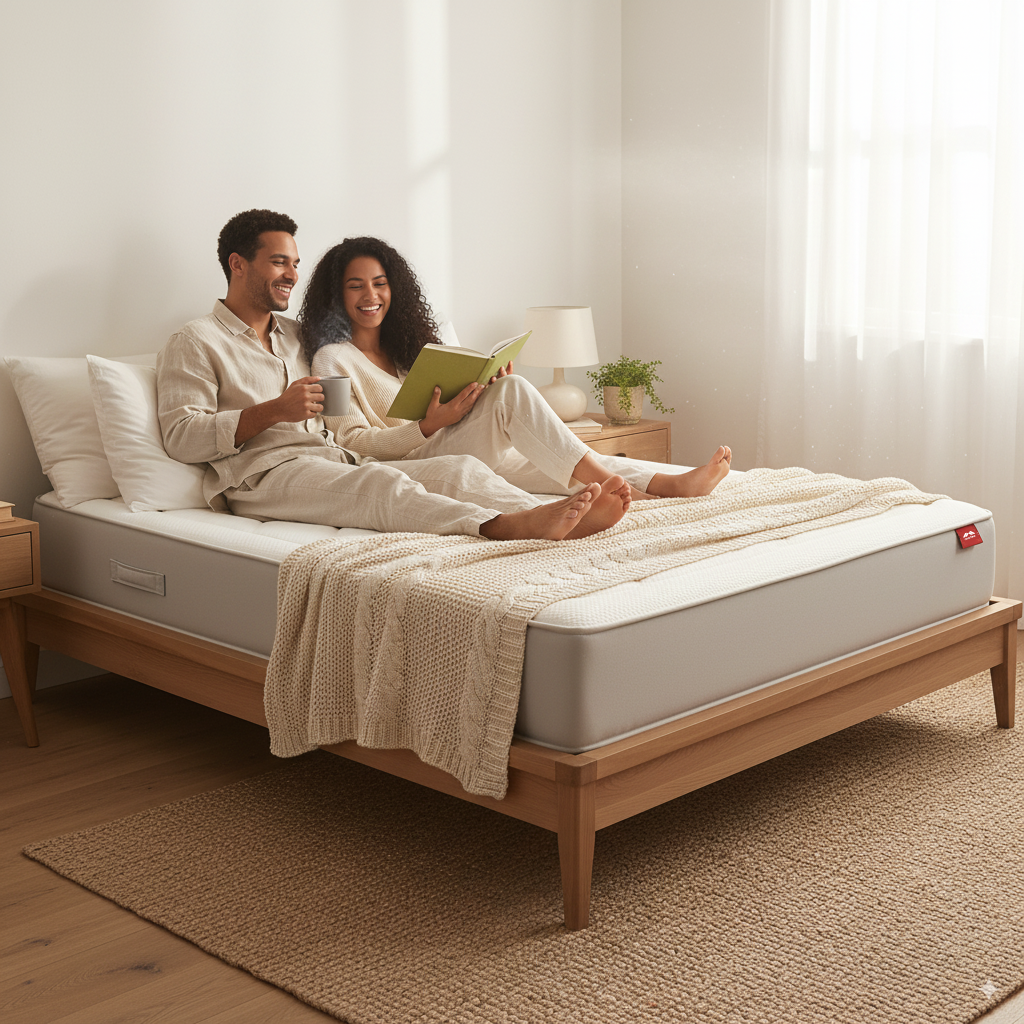

The ultimate guide with tips to sleep better and wake up energized
Tossing and turning in bed shouldn't be your nightly routine. The solution to a poor night's sleep almost always lies in a combination of smart habits and a suitable environment. This guide is designed to give you the tips that really work to help you sleep better. We'll cover everything: from optimizing your bedroom to choosing the right sleep equipment so that, once and for all, you can regain control of your nights.
Why getting a good night's sleep has become an urgent priority

Sleep deprivation is no longer just a complaint; it has become a full-blown public health problem. Sleepless nights don't just leave you yawning the next day; they directly affect your productivity at work, cloud your mood, and can even strain your personal relationships.
When poor sleep becomes chronic, the impact accumulates. You feel less focused, more irritable, and lack the energy to face the day's challenges. It's a vicious cycle: the stress of the day keeps you from sleeping, and sleep deprivation spikes your stress.
A look at poor sleep in Spain
The numbers don't lie and paint a rather worrying picture. Take a look at this table to get an idea of the scale of the problem:
| Key Statistic | Percentage/Data |
|---|---|
| Adult population with poor-quality sleep | 48% |
| People with chronic and severe sleep disorders | More than 4 million |
| Impact on work productivity | Negative and significant |
| Relationship with mood and relationships | Increased irritability and tension |
Source: Data based on studies by the Spanish Society of Neurology (SEN).
As you can see, the situation forces us to go beyond the usual advice. It's not just about "trying to sleep more," but about understanding what is stealing your sleep and making changes that will truly make a difference.
A good day starts the night before. Prioritizing your sleep is not a luxury; it is a direct investment in your physical and mental health, your performance, and ultimately, your well-being.
Beyond the obvious advice
This guide is not just another list of superficial recommendations. Our goal is to give you a clear plan so you can take back control of your nights. We'll explore how to transform your habits, how to optimize your environment, and, crucially, how the right sleep equipment is the foundation for truly restorative sleep.
You'll understand that a mattress is not just a piece of furniture, but the foundation of your rest. A mattress with the right firmness for you and breathable materials helps keep your spine properly supported and distribute pressure, and you can feel the difference in how comfortably you sleep.
Build your bedtime routine to truly unwind

How you end your day is just as important as how you start it. A bedtime routine is not a whim; it is the clearest signal you can send to your brain and body to say: "it's time to wind down".
Think of it as a smooth transition, a bridge between the alertness of the day and the calm you need to sleep. You can't go from answering emails to trying to sleep in five minutes. You need a decompression period, and that's where a good routine becomes your best ally.
The golden hour before bed
This is perhaps the most powerful change you can make. Reserve the 60 minutes before going to bed for activities that do not involve any screens. The infamous blue light from phones, tablets, and computers is an expert at sabotaging melatonin, the hormone that regulates your sleep cycles.
When your eyes receive that light, your brain interprets that it is still daytime, which delays the feeling of sleepiness and makes it much harder for you to fall asleep. That hour is your personal sanctuary to disconnect from the digital world.
Creating a screen-free 'golden hour' is not just about avoiding blue light; it is about giving your mind permission to disconnect from the demands of the day and actively prepare for deep, restorative rest.
Examples of bedtime routines that really work
There is no magic formula that works for everyone. The key is to find a mix of activities that personally relax you. Forget generic solutions and try one of these ideas:
- Old-fashioned reading: Pick up a paper book or a magazine. The feeling of turning pages and the warm light of a bedside lamp are much more soothing than the glare of a screen.
- Mindful listening: Prepare a playlist of ambient music, nature sounds, or a relaxing podcast. The goal is for the sound to accompany you, not demand your attention.
- Guided meditation (short version): You don't need to be a guru. There are apps like Calm or Headspace with 5 to 10-minute meditations designed specifically to induce sleep.
- Gentle stretching: Focus on slow, controlled movements to release the tension accumulated during the day, especially in your neck, shoulders, and back.
- A hot shower or bath: The change in body temperature, rising with the hot water and falling upon getting out, is a natural trigger for your body to start the sleep process.
Beware of sleep's false friends
There are certain habits that seem relaxing but are actually sabotaging the quality of your rest. It is essential that you identify them so you can look for better alternatives.
A very heavy or late dinner forces your digestive system to work at full capacity just when it should be resting. This can cause discomfort, heartburn, and nighttime awakenings. Try to eat dinner at least two or three hours before going to bed.
And that glass of wine... although it may seem to help you sleep, it actually fragments your sleep in the second half of the night. Alcohol alters sleep architecture, preventing you from reaching the deepest and most restorative phases. A chamomile, linden, or valerian infusion is much better. These small adjustments are tips for sleeping better that make a huge difference.
Turn your bedroom into a sanctuary of rest

Think about it for a moment. Your bedroom should have a single mission: to be that corner of the world where you recharge your batteries. However, over time, we have gradually turned it into an improvised office, a pocket cinema, or even a dining room. To truly sleep well, it is vital to return it to its original purpose and transform it into a sacred sanctuary for rest.
This means taking control of three fundamental pillars that dictate the quality of your sleep: light, noise, and temperature. Each of them sends direct signals to your brain that can either prepare you for deep sleep or completely sabotage it. Addressing them head-on is one of the most powerful tips for sleeping better you can start applying tonight.
Master darkness completely
Light is, quite literally, the master switch of our biological clock. The slightest exposure to light during the night, even from that streetlight that seeps through a gap in the blinds, can abruptly halt melatonin production and fragment your sleep. The goal is simple: total darkness. Or as close to it as possible.
To achieve this, you have several tools at your disposal. Good opaque curtains (or blackout, as they are known) are an investment you will pay off in quality of life, because they almost completely block out outside light. If you prefer something simpler or want extra reinforcement, a quality sleep mask that fits your face well can work wonders.
Create your own bubble of silence
Noise is another of the great enemies of rest. A car engine, your neighbor's dog barking, or even your partner's snoring can pull you out of deep sleep phases without you even realizing it. Your brain remains alert, processing sounds while you sleep.
Here, the solutions depend somewhat on the intensity of the problem:
- Earplugs: A simple classic and extremely effective for most everyday noises.
- White noise machines: These devices do not eliminate sound, but rather mask it. They generate a constant, monotonous hum that makes other sudden noises (a slamming door, a siren) go unnoticed by your brain.
- Long-term soundproofing: If street noise is a chronic problem, it may be worth considering more serious solutions, such as installing double-glazed windows.
The ideal temperature for sleeping, according to science
Does that sound familiar: waking up sweating in the middle of the night? Heat is a silent saboteur of good rest. For our body to start the sleep process, it needs to slightly lower its internal temperature.
Sleep science is clear on this: the perfect temperature for sleeping falls between 18 and 21 °C. Keeping your room in this cool range helps your body enter and stay in the deepest and most restorative sleep phases.
It is as easy as airing out the room well before going to bed, using a fan, or adjusting the thermostat. Choosing bedding made from breathable materials, such as cotton, is also key to preventing heat from building up.
An orderly environment for a calm mind
Visual clutter creates mental stress, it is that simple. A chaotic room, with clothes piled on a chair or work papers in plain sight, is sending your brain the message that there are "pending tasks". It keeps you active just when you need it to shut down the most.
On the contrary, a minimalist and orderly environment invites tranquility. Details such as the Morfeo bed bases and headboards are designed with clean lines and materials that convey peace, helping to create that atmosphere. Dedicating just five minutes to tidying your space before bed can have a huge impact on how quickly you relax.
Proven techniques to calm a hyperactive mind
Many times, the biggest obstacle to sleeping well is not street noise or an overly hot room, but the commotion inside our own heads. A mind that does not stop, jumping from one worry to another without rest, is the perfect recipe for a sleepless night. Fortunately, there are very practical and effective techniques to teach it to slow down.
Stress and anxiety are among the great sleep saboteurs. When they are not managed, it is harder to fall asleep, nighttime awakenings increase, and dreams become more intense or restless.
Instead of fighting those thoughts, the key is to give them a controlled outlet and activate your body's natural relaxation response.
Learn to breathe to disconnect using the 4-7-8 method
One of the most powerful and fastest tools to calm the nervous system is simply breathing consciously. The 4-7-8 method is a rhythmic breathing technique that helps many people relax before sleep. And the best part is that it is incredibly easy to put into practice.
Here is how it works:
- Get comfortable: Sit or lie down in a relaxed position. Place the tip of your tongue just behind your upper front teeth and keep it there throughout the exercise.
- Inhale for 4 seconds: Close your mouth and breathe in quietly through your nose while counting mentally to four.
- Hold for 7 seconds: Hold your breath while counting to seven.
- Exhale for 8 seconds: Release all the air through your mouth audibly, making a soft "fuuu" sound, while counting to eight.
- Repeat the cycle: Inhale again and repeat the process three or four more times. You will notice almost instantly how your heart rate slows down and a feeling of calm washes over you.
This type of controlled breathing activates the parasympathetic nervous system, which is the part responsible for "rest and digestion". Basically, you are sending a direct biological signal to your body that everything is fine and it is time to relax.
Release physical tension with progressive muscle relaxation
Stress does not just live in your mind; it accumulates in your muscles in the form of tension. Progressive muscle relaxation (PMR) is a technique that teaches you to identify and release that physical tension, which in turn helps calm the mind.
The idea is very simple: you tense a specific muscle group for a few seconds and then completely relax it, paying close attention to the difference between tension and relaxation. By doing this throughout the body, you release accumulated tension almost without realizing it. If you are interested in trying it, there are detailed guides that can take you step by step through a complete relaxation session to sleep better.
Unload your mind with the "brain dumping" technique
Just as you turn off the light, does your brain turn into an endless to-do list? For that, your best ally is brain dumping or "mental dumping". It is as simple as it sounds: before going to bed, take a notebook and a pen and write down absolutely everything that is going through your head.
Do not worry about order or grammar. Simply pour onto paper all those ideas, tasks, fears, and reminders that are constantly spinning around.
- What do I have to do tomorrow? Write it down.
- Will I forget to call that person? Jot it down.
- Am I worried about Wednesday's meeting? Write it down.
By taking those thoughts out of your head and putting them on paper, you give your mind permission to stop clinging to them. You know they are there, safe in the notebook, and that you will deal with them the next day. This simple act can free up a huge amount of mental space, making the transition to sleep much easier.
Choose the right mattress and win the battle against insomnia
Okay, you have perfected your bedtime routine. Your bedroom is a sanctuary of rest and you have an arsenal of techniques to calm your mind. And yet, are you still tossing and turning in bed? Sometimes, the answer is right beneath you: in the mattress.
It is of little use to have a perfect plan if your sleep equipment is sabotaging you. An unsuitable mattress not only steals hours of sleep from you; it is one of the main culprits behind those back, neck, and shoulder pains that give you a hard time in the morning. Think of it as the foundation of your rest. If the base is unstable or does not fit you, the whole structure comes crashing down.
What to look for in your perfect sleep ally
Choosing a mattress may seem like an impossible mission, but in reality, it all comes down to three key features that must work in harmony. If you ignore one of them, you leave the door open to interrupted nights and mornings of discomfort.
Firmness is the fundamental pillar. You need a surface that gives solid support to your spine, keeping it aligned all night. For most people, a medium-firm level is the sweet spot. If it is too soft, your body sinks and forces unnatural postures. If it is hard as a rock, it will create unbearable tension in your joints.
Then comes adaptability. This is where materials like memory foam make the difference. A good mattress must mold to the curves of your body, distributing your weight evenly. This eliminates pressure points, especially in the hips and shoulders, which are what make you move around constantly and pull you out of deep sleep.
And finally, breathability, the factor many people forget. Your body needs to regulate its temperature at night. A mattress that traps heat will make you sweat and feel uncomfortable, causing you to wake up. Materials that allow air to circulate are key to maintaining a cool, dry microclimate, one of the most important tips for sleeping better. If you want to learn more about this material, here we explain in detail what a memory foam mattress is and why it is a game-changer for your rest.
Morfeo as a solution to real problems
At Morfeo, we don't see mattresses as just another product, but as a direct solution to the problems that keep you awake. It's not about overwhelming you with a thousand options, but about offering you the right ones.
To help you visualize which path to take when stress won't leave you alone, we have created this simple decision tree.

As you can see, identifying whether your stress is physical or mental is the first step in choosing the relaxation technique that will work best for you that night.
Now, let's get practical. So you know where to start, here is a quick guide that will help you find the Morfeo mattress that best suits your sleeping style.
Find your ideal Morfeo mattress
We have created this table so that, at a glance, you can compare our models and see which one best meets your needs. It's not about choosing at random, but about finding the one that seems designed for you.
| Morfeo Model | Material Type | Firmness | Ideal For |
|---|---|---|---|
| Original Hybrid | Hybrid (over 2,000 pocketed micro-springs + memory foam) | Firm with comfort | Those looking for firm support that adapts to the body. It is Morfeo's most chosen mattress. |
| Altus | Hybrid (over 2,000 pocketed micro-springs + linen fabric) | Medium-firm | Those who prefer one point less firmness and a breathable feel. |
| VisCool | Pocketed springs + VisCool foam + PCM temperature-regulating fabric | Firm | Hot sleepers: it is the coolest mattress in the range. |
This table is your personal cheat sheet. Do you feel like you "sink" and find it hard to move? Perhaps the firm firmness of the Original Hybrid will suit you. Does heat wake you up in the middle of the night? The VisCool, with temperature-regulating fabric, is the coolest in the range.
The 100-night test: the ultimate guarantee
Let's be honest: testing a mattress for five minutes in a store, with clothes on and under fluorescent lights, is useless. Your body needs time, sometimes weeks, to get used to a new sleeping surface.
That is why the 100-night test is much more than a return policy. It is the peace of mind of knowing that you are going to make the right decision. It allows you to try the mattress in the only place that really matters: your home, on your terms. For more than three months, you can feel how it responds to your movements, how it relieves tension, and how, night after night, it improves the quality of your sleep.
Choosing the right mattress is one of the best investments you can make in your rest. It is not an expense, it is the purchase of thousands of nights of restorative sleep, days full of energy, and a general well-being that will be noticeable in all aspects of your life.
If during that time you discover that it is not for you, the process is simple and drama-free. But the reality is that, when you choose a mattress designed to solve real problems, you will most likely ask yourself how you ever lived without it. That peace of mind is essential, because it completely eliminates the fear of making a mistake in such an important decision.
We answer your most frequent questions to help you sleep better
Embarking on the path toward better rest always generates questions. That is normal. That is why we have compiled the most common questions to give you a clear and, above all, realistic roadmap in this mission to achieve truly restorative nights.
How long will it take me to notice the changes?
Here, patience is your best ally. I know it sounds like a cliché, but it is the pure truth. Do not expect miraculous results overnight; you are building new habits, and that, my friend, takes time.
For your body and brain to truly absorb the new sleep routines, you will need to be consistent for about three or four weeks. At first, it may be a little difficult, but every night you apply these tips is one step forward. Do not get frustrated if one day it doesn't go perfectly.
The key is not perfection, but progression. A small change maintained over time has a much more powerful impact than an enormous and one-time effort.
What do I do if I wake up in the middle of the night?
First, and this is almost an order: don't look at your phone! The light from the screen tells your brain it is time to wake up, and the insomnia cycle starts all over again. If you have been wide awake for more than 20 minutes, get up.
Go to another room, turn on a very dim light, and do something relaxing. Read a few pages of a book (a paper one, if possible) or listen to soft music. Do not go back to bed until you feel sleep calling at your door again. With this, you teach your brain that bed is for sleeping, period.
Is the pillow as important as the mattress?
Absolutely. They are an inseparable team, like Batman and Robin. An excellent mattress with a pillow that doesn't suit you can ruin your rest, and vice versa. The mission of both is to keep your spine, from your lower back to your cervical spine, in a neutral and natural posture.
Think of it this way: the mattress adapts to the shape of your body, but it is the pillow that must fill that crucial gap between your head and your shoulders. If it doesn't, goodbye rest and hello neck tension. The right combination is essential to avoid tension and sleep soundly. If in doubt, choose the pillow according to your sleeping position.
At Morfeo, we manufacture mattresses, pillows, and bed bases in Spain designed so you can get the rest you deserve. Discover Morfeo mattresses and try them for 100 nights at home.