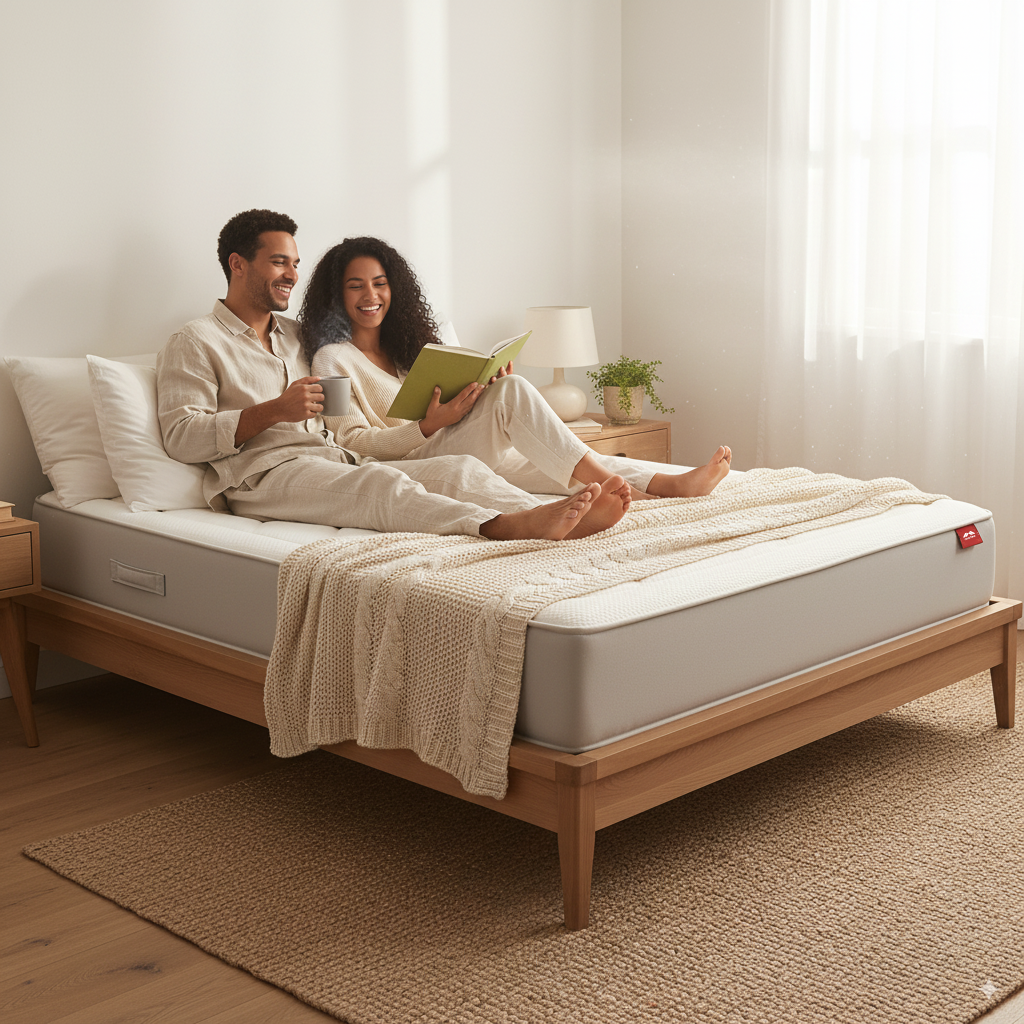

Mattress for back pain: how to choose firmness and materials
If you wake up with a stiff back, what your body usually needs is not a firmer mattress, but one with medium-firm to firm support: a firm core that supports the hips without letting them sink and a comfort layer that accommodates the shoulders and lumbar curve.
In practice, this means pocket springs, high-density memory foam, or hybrid mattresses that combine both. What matters is not the material label, but that your spine stays aligned, more or less as it does when you are standing.
The exact firmness depends on two variables: how much you weigh and which sleeping position you spend the most hours in. Below you will find the chart, the materials explained clearly, the role of the bed base and pillow, and which model from the Morfeo mattress range fits each profile.
Why the mattress affects how you wake up
Your body is not a uniform block: your shoulders and hips protrude, while your waist and neck are hollow areas. A good mattress does both at once: it accommodates what protrudes and fills what is hollow. When it does this, the spine maintains its natural curve for hours and the back muscles do not have to work to compensate.
When it fails, one of two things happens. If the mattress is too soft or has already lost support, the pelvis sinks lower than the chest and the lumbar area hangs unsupported: this is the classic hammock effect. If it is too firm, the opposite happens: the shoulder and hip do not sink in, the body rests on two or three points, and the waist is left suspended in the air, without real contact with the surface.
This is why the myth that "the firmer, the better" falls apart as soon as you try it: an excessively firm mattress does not provide more support, it distributes your weight over a smaller surface, and that pressure is what makes you readjust during the night and wake up stiff.
There is a practical test to find out if your mattress helps or hinders you: compare how you feel when you lie down with how you feel when you get up. If you feel good when you lie down but worse when you wake up, and you also sleep better away from home, your bed is on the list of suspects.
Let's be clear: a mattress does not treat or correct any back problem. What it does is offer you a surface that respects alignment instead of forcing it, and that can help you rest better. If your pain is persistent or intense, appears at night, or radiates down your leg, consult a healthcare professional: that cannot be resolved by changing mattresses.
The firmness you need according to your weight and sleeping position
Firmness is a sensation, not a universal measure. A mattress that feels firm to a 60 kg person may feel soft to a 95 kg person, because their weight makes them sink into it more. That is why the two variables always go together.
If you sleep on your side
This is the most common sleeping position and the one that requires the most adaptability. The shoulder and hip must be able to sink into the mattress; if they do not, the spine tilts and the waist is left unsupported. The signs are recognizable: a numb shoulder upon waking, the need to tuck your arm under the pillow, pressure on the hip. A medium firmness with a generous comfort layer works well here.
If you sleep on your back
The goal changes: here, lumbar support is what matters. The pelvis should not sink lower than the chest, and the lumbar area should not hang unsupported. If the mattress gives way in the middle, the lower back spends the night under tension; if it is like a board, the lumbar curve is left unsupported. The sweet spot is usually a medium-firm to firm support with a top layer that accommodates.
If you sleep on your stomach
This is the least back-friendly position: it forces you to turn your neck and accentuates the lumbar curve. If you cannot change it, the important thing is that your abdomen and hips do not sink. Here, high firmness is the reasonable option.
Indicative firmness chart
| Position | Up to 95 kg per person | More than 95 kg per person |
|---|---|---|
| On your side | Medium firmness, with a good comfort layer for the shoulder and hip | Reinforced high firmness, so the shoulder does not hit bottom |
| On your back | Medium-firm to firm support, with stable lumbar support | Reinforced high firmness, with a core that does not give way at the hip |
| On your stomach | High firmness, so the hip does not sink | Reinforced high firmness, the most structured support |
If you sleep together and weigh very differently, the reference is set by the heavier person: they sink into the mattress the most and will notice the lack of support first. All Morfeo mattresses are guaranteed for up to 95 kg per person; above that weight, the recommended model is the Morfeo XL Mattress.
Materials: what each does and who it is for
No material is better than another in the abstract. Each one solves a specific problem well and another poorly. Here is the quick translation:
| Material | How it behaves | It is for |
|---|---|---|
| Pocket springs | Each spring works separately, so the support adjusts zone by zone. Firm core, good ventilation, and virtually no motion transfer. | Couples, people who get hot, and those who need stable support when sleeping on their back. |
| High-density memory foam | It molds to the contours of the body and distributes pressure over a larger surface. An enveloping sensation and relief at the pressure points. | Those who sleep on their side and feel pressure on the shoulder or hip. |
| Hybrids (springs + memory foam) | Firm spring core with adaptable comfort layers on top. They provide support and adaptability at the same time, without compromising either. | Most profiles, and especially those who are not sure what they prefer. |
| Natural latex | It instantly regains its shape, is elastic, and does not give the sensation of being trapped. Very stable over time. | Those who move a lot during the night and those looking for natural materials. |
If your main problem is pressure on the shoulder and hip, start with memory foam mattresses. If what you lack is support, because the hip sinks and the lumbar area hangs unsupported, look at pocket spring mattresses. And if you have both at the same time, which is the most common, a hybrid is usually the answer.
Mattresses to take care of your back
If you wake up with a stiff back, look at the mattress
A core that supports the hip and a layer that accommodates the shoulders. If you are looking for the medium-firm to firm support we recommend above, the Altus; if you prefer something firmer, the Original Hybrid.
 Original Hybrid Mattress
High firmness with comfort: more than 2,000 pocket micro-springs and a memory foam layer. Morfeo's most popular choice.
View the Original Hybrid Altus Mattress
The same micro-spring core, one point less firm (medium-firm) and with breathable linen fabric.
View the AltusIt is not a treatment: if the pain persists, consult your doctor or physical therapist.
100-night trial on mattresses · 10-year warranty · free shipping on the mainland · made in Spain
The role of the bed base and the pillow
The mattress is the large piece, but it does not work alone. The base supports the mattress just as the mattress supports you: a slatted bed base with very separated, bent, or broken slats leaves unsupported areas, and the mattress ends up reproducing that sinkage. This is the most frequent reason why a new mattress does not perform as it should.
For hybrids and memory foam, the appropriate choice is a continuous and rigid surface: a upholstered base or a storage bed. If you are going to change your mattress and your base is more than a decade old, check it at the same time.
The pillow completes the alignment from above: it fills the gap between the neck and the mattress so that the head is neither raised nor dropped relative to the rest of the spine. The height depends on the position: on your side, the gap is larger and requires more height; on your back, less; on your stomach, the flatter, the better. A well-chosen mattress with an unsuitable pillow leaves half the work undone.
Which Morfeo mattress fits each case
All our mattresses are made to order in Spain, so none have been sitting in a warehouse for months. These are the profiles:
- Nature Mattress — Medium firmness, natural latex and organic cotton over pocket springs. It is a good fit if you sleep on your side and want your shoulder to sink in without leaving your waist suspended in the air.
- Original Hybrid Mattress — High firmness with comfort: more than 2,000 pocket micro-springs with a memory foam layer on top. The balance between support and comfort, and the most versatile in the range if you sleep on your back or change positions during the night.
- Altus Mattress — Medium-firm to firm support, hybrid core of more than 2,000 pocket micro-springs and an outer linen fabric. For those who want support that does not give way throughout the night and also sleep hot.
- VisCool Mattress — High firmness, pocket springs, and a temperature-regulating layer. The option if you need firm support but do not want to give up the adaptability of memory foam.
- Morfeo XL Mattress — Reinforced high firmness and 30 cm height, designed for people over 100 kg. It is the recommended model from 95 kg per person, because it prevents the hip area from sinking with use.
If you are torn between two, decide by thinking about your main position and the heavier person; you have 100 nights to check it at home.
Common buying mistakes
- Buying "the firmest" by default. An excessively firm mattress concentrates pressure on the shoulders and hips and fragments sleep.
- Deciding by lying down for five minutes in a store. Five minutes dressed and tense says nothing about how your back will respond after eight hours.
- Changing the mattress and keeping the old base. If the bed base is worn out, the new mattress will copy that sinkage.
- Judging it in the first week. The body needs an adaptation period and at first it is normal to feel different.
Frequently asked questions
Is a firm mattress or a soft one better for the back?
Neither of the two extremes. What your back is looking for is support with adaptability: a core that supports the hip and a top layer that accommodates the shoulder and lumbar curve. For most people, that is in the medium-firm to firm range, adjusted according to weight and position.
How long does it take for the body to get used to a new mattress?
It depends on how similar it is to the previous one. If you are coming from a very worn-out mattress, your muscles had adapted to that position and the change is noticeable for a few days. That is why the 100-night trial is useful: it gives you time to assess if you really wake up better.
Can a topper fix my current mattress?
A topper adds comfort and adaptability to the surface, so it can help if your mattress is too firm and you feel pressure. What it cannot do is restore support to a sunken mattress: if the core has given way, the topper will sink with it.
My partner and I weigh very differently, what do we do?
Choose the firmness thinking about the heavier person and prioritize a pocket spring core, which works independently and prevents the movement on one side from transferring to the other. If either of you exceeds 95 kg, the appropriate model is the Morfeo XL Mattress.
How often should you change the mattress?
Rather than counting years, look at the condition. If there is visible sinkage in your area, if you feel the springs, or if you clearly sleep better away from home, the mattress no longer fulfills its function.
Can a mattress take away my back pain?
No. A mattress does not treat or correct anything: it offers you a surface that maintains alignment instead of forcing it, and that can help you rest better. If your pain is persistent or intense, the first thing is to have it assessed by a healthcare professional. For everyday life, you have more ideas in how to relieve back pain.
Try it for 100 nights in your home
The only test that really works is sleeping. All our mattresses are made to order in Spain and arrive rolled in a box in 3-7 business days, with free shipping on the mainland.
You have 100 nights to try the mattress —the trial covers the mattress, not the rest of the pieces in a pack— and 10 years of warranty on mattresses (3 years on furniture). You can pay it in interest-free installments with Klarna in 3 payments or with Alma in 4 payments.
Take a look at all Morfeo mattresses and, if you are unsure about which one fits your weight and your position, write to us before buying: we prefer to help you get it right the first time.