

How to relieve back pain: what to do today and what to avoid
When back pain strikes suddenly, the first thing you need is a quick and effective plan of action. It's not just about lying down and waiting for it to pass. The key is knowing what to do in those first moments to ease the pain, reduce inflammation, and prevent a temporary discomfort from becoming a chronic problem.
Remember, you're not alone. Lower back pain is one of the most common reasons people seek medical attention in Spain. Knowing how to respond to an acute episode is essential.
To help you get started, here is a visual guide that will help you decide where to begin based on what you're feeling.
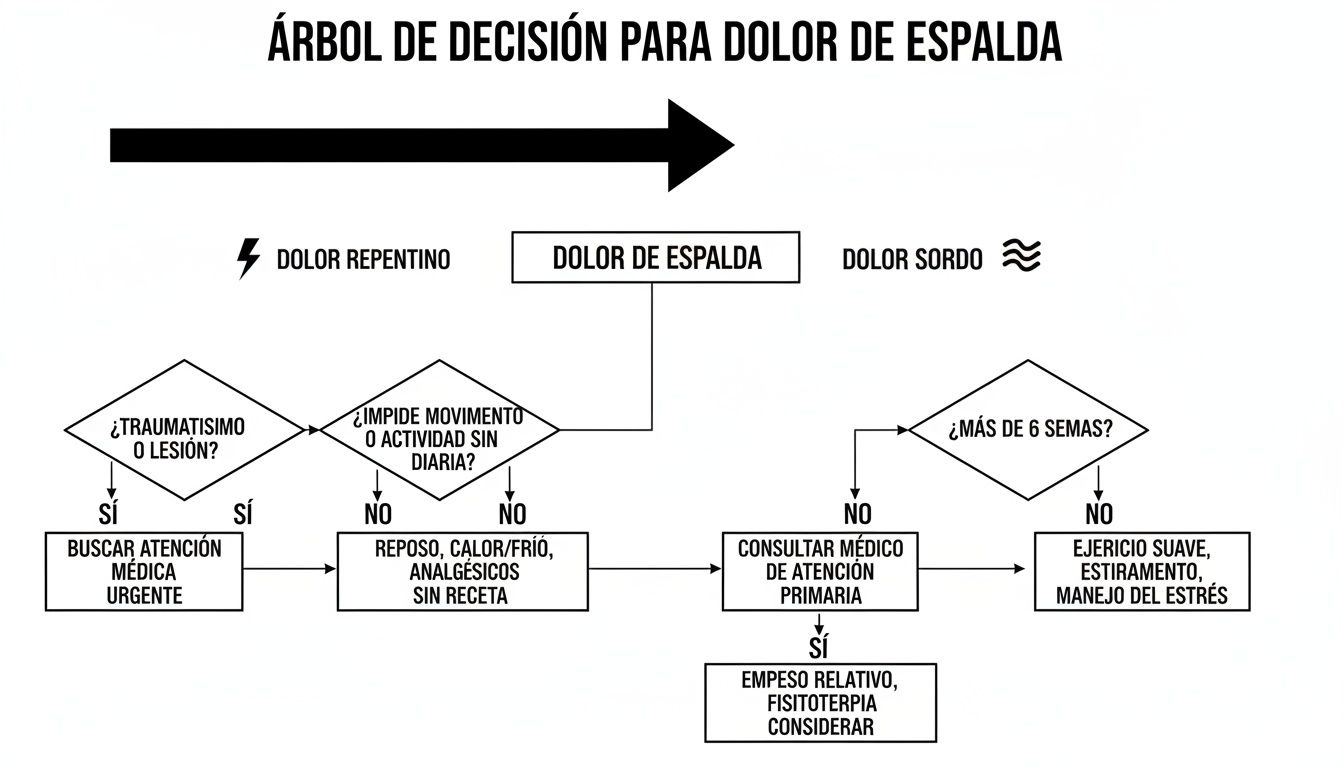
As you can see, the first step is to identify whether the pain is sharp and sudden (typical of an injury) or rather a dull, constant ache (which usually indicates muscle tension). This will guide you toward the best initial solution.
The dynamic duo: cold and heat therapy
One of the simplest and most powerful tools at your disposal is thermotherapy. But be careful—it's not just about applying heat or cold without thinking. The trick is knowing when to use each one.
-
Cold to start (cryotherapy): During the first 24-48 hours after a strain or if you notice swelling in the area, cold is your best ally. It helps constrict blood vessels, which reduces inflammation and acts as a natural pain reliever. Take an ice pack (always wrapped in a cloth) and apply it in 15-20-minute sessions.
-
Heat to relax (after 48 hours): Once the acute phase has passed, or if your pain is more muscular due to accumulated tension, heat is what you need. It increases blood flow, relaxes tight muscles, and relieves that feeling of stiffness. An electric blanket or hot water bottle for 15-20 minutes will work wonders.
A golden tip: Never, ever apply ice or heat directly to the skin. Always use a thin towel or cloth to protect yourself from burns.
To make it even clearer, here is a comparison table of the most immediate relief techniques.
Quick relief techniques for back pain
A comparison guide of immediate relief methods, their main benefits, and when it is most appropriate to use each one.
| Technique | Main Benefit | When to Apply | Important Precaution |
|---|---|---|---|
| Cryotherapy (Cold) | Reduces inflammation and has a pain-relieving effect. | First 24-48 hours after an acute injury. | Wrap the ice in a towel to prevent skin burns. |
| Thermotherapy (Heat) | Relaxes tight muscles and relieves stiffness. | After 48 hours or for chronic pain without inflammation. | Use at a moderate temperature and do not fall asleep with the electric blanket. |
| Resting Postures | Decompresses the spine and relieves lower back pressure. | At any time during acute pain for immediate relief. | Find the posture that does not cause more pain; do not force it. |
| Gentle Mobility | Prevents stiffness and maintains circulation in the area. | After initial relief, to start regaining movement. | Slow and controlled movements, without reaching the point of pain. |
With these guidelines, you will know exactly which tool to use at each moment to achieve the greatest possible relief without taking risks.
Postures that release your spine
Sometimes, the best remedy is simply taking the weight off your back. Instead of lying down on the bed in any way (which can sometimes make things worse), try these postures designed to release tension:
-
Lying on your back with your legs raised: Lie on the floor, on a mat if possible, and rest your calves on a chair, sofa, or a pile of pillows. The idea is for your hips and knees to form a 90-degree angle. You will notice almost instantly how the entire lower back area relaxes.
-
Fetal position with support: Lie on your side, bend your knees, and gently bring them toward your chest. Place a pillow or cushion between your knees. This simple gesture helps align the pelvis with the spine, significantly reducing tension.
Gentle movement to regain control
Although your instinct may tell you to stay completely still, a little controlled movement is pure gold. It prevents muscles from weakening and stiffness from taking over.
A fantastic exercise to start with is pelvic tilts. Lie on your back with your knees bent and your feet flat on the floor. From there, gently press the lower part of your back against the floor, as if you wanted to flatten it, and then relax, creating a small arch. It is a subtle, almost imperceptible movement, but extremely effective for mobilizing the pelvis and releasing tension without any risk.
How your daily posture is affecting your back
Many times, the key to knowing how to relieve back pain is not in an elaborate treatment, but in those small gestures we repeat day after day almost without realizing it. Poor posture is like a drop that falls incessantly: at first you don't notice it, but over time it accumulates tension in the spine until, one day, the pain suddenly appears.

Imagine your spine as a perfectly aligned stack of blocks. Every time you hunch over to look at your phone, slump into the sofa, or lift something off the floor the wrong way, that tower becomes unbalanced. Your muscles and ligaments are forced to overexert themselves to keep it from falling, creating fatigue that, sooner or later, turns into pain.
Ergonomics at work: your great ally
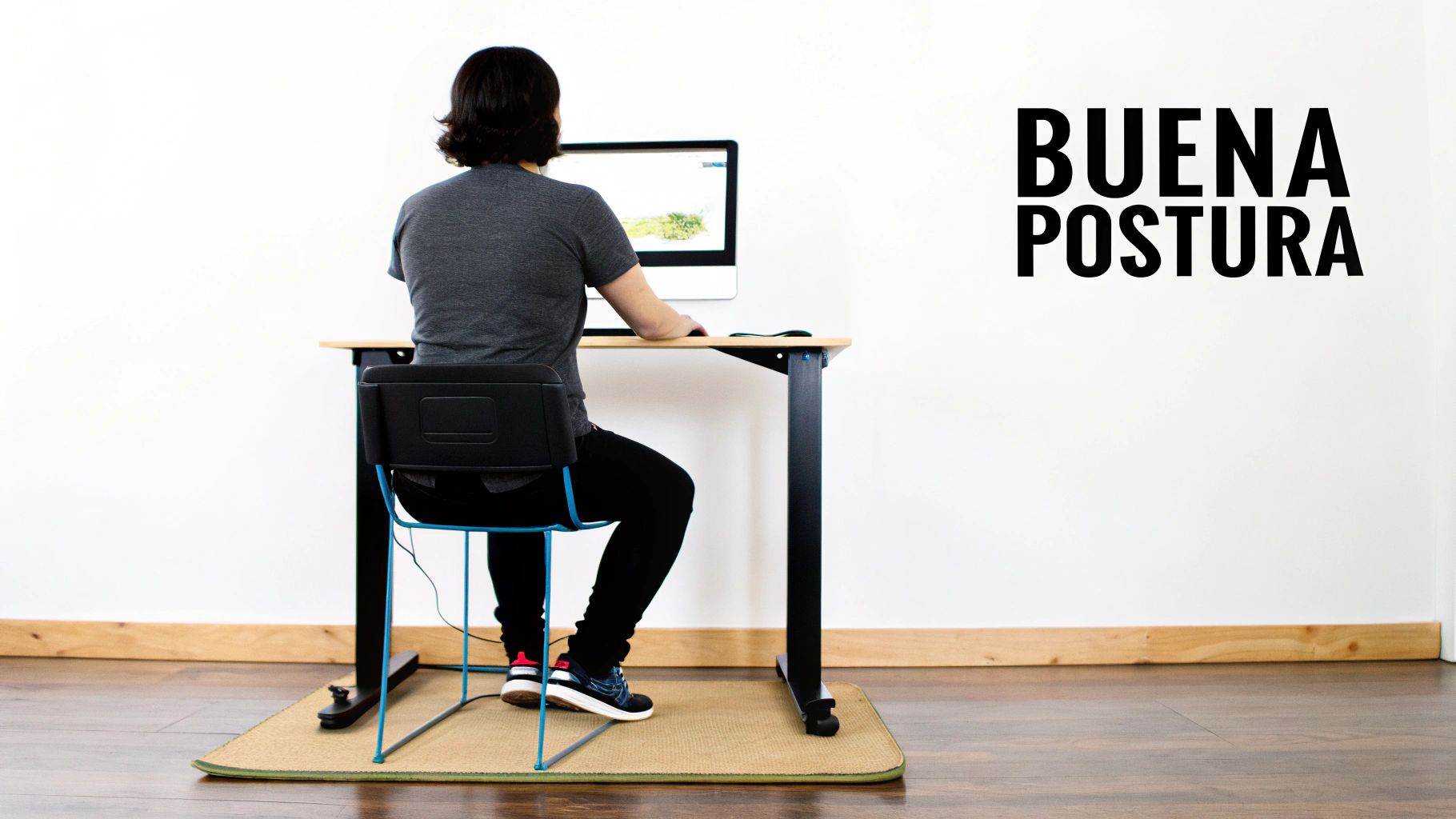
Spending eight hours in front of a computer can be pure torture for your back if your workstation is not properly adapted. That typical "turtle" posture, with your neck stretched toward the screen and your shoulders slumped, is the perfect recipe for disaster.
To fix it, check that your workspace meets these key points:
- Monitor height is crucial. The top edge of the screen should be at eye level or slightly below. This will prevent you from having your head tilted all day.
- Adjust your chair properly. Your feet must be completely flat on the floor, with your knees at a 90-degree angle. If you can't reach, don't hesitate to use a footrest.
- You need lumbar support. Your chair should respect the natural curve of your lower back. If it doesn't, a small cushion or even a rolled-up towel can make a huge difference.
- Control the arm distance. Get close enough so that your elbows also form a 90-degree angle when typing. This helps keep your shoulders relaxed and tension-free.
A trick I always recommend is the 20-20-20 rule: every 20 minutes, look away from the screen, look at a point that is 20 feet (about 6 meters) away for 20 seconds. Take that moment to stretch your neck and move your shoulders.
Lifting weight safely
One of the most common and damaging mistakes I see is bending at the waist to pick something up off the floor, whether it's a heavy box or something as simple as a pencil. This movement puts all the pressure directly on the lumbar discs.
The correct technique is very simple, but essential. You just have to make it second nature:
- Get close to the object. Get as close as you can to what you are going to lift.
- Bend your knees. Bend your knees and hips to lower yourself, always keeping your back straight. Think of it as doing a squat.
- Engage your core. Contract your abdominal muscles to stabilize your spine. It's like putting on a natural corset.
- Use the strength of your legs. Push off with your legs to stand up, keeping the object close to your body. Never with your back!
Small gestures that make a difference
Being aware of your posture goes beyond the office. When you do everyday tasks like vacuuming, washing dishes, or cooking, avoid bending from the waist. Instead, take a step forward and bend your knees slightly to keep your back upright. These are small changes that, added up throughout the day, protect your spine from completely unnecessary wear and tear.
And, of course, posture doesn't only matter when you're awake. The way you sleep is key to your body recovering at night. If you want to take it to the next level, we recommend learning how to improve your sleeping posture for optimal rest, because a good alignment while you sleep is the best way to start the day without discomfort.
Strengthen your back with a safe exercise routine
A strong and flexible back is not a luxury; it's your best defense against pain. If poor postures and daily habits have been weakening your spine, properly done exercise is the perfect tool to rebuild it. But be careful—it's not about jumping into just any activity; the key is to opt for a low-impact routine focused on strengthening the muscles that act as a natural corset for your back.
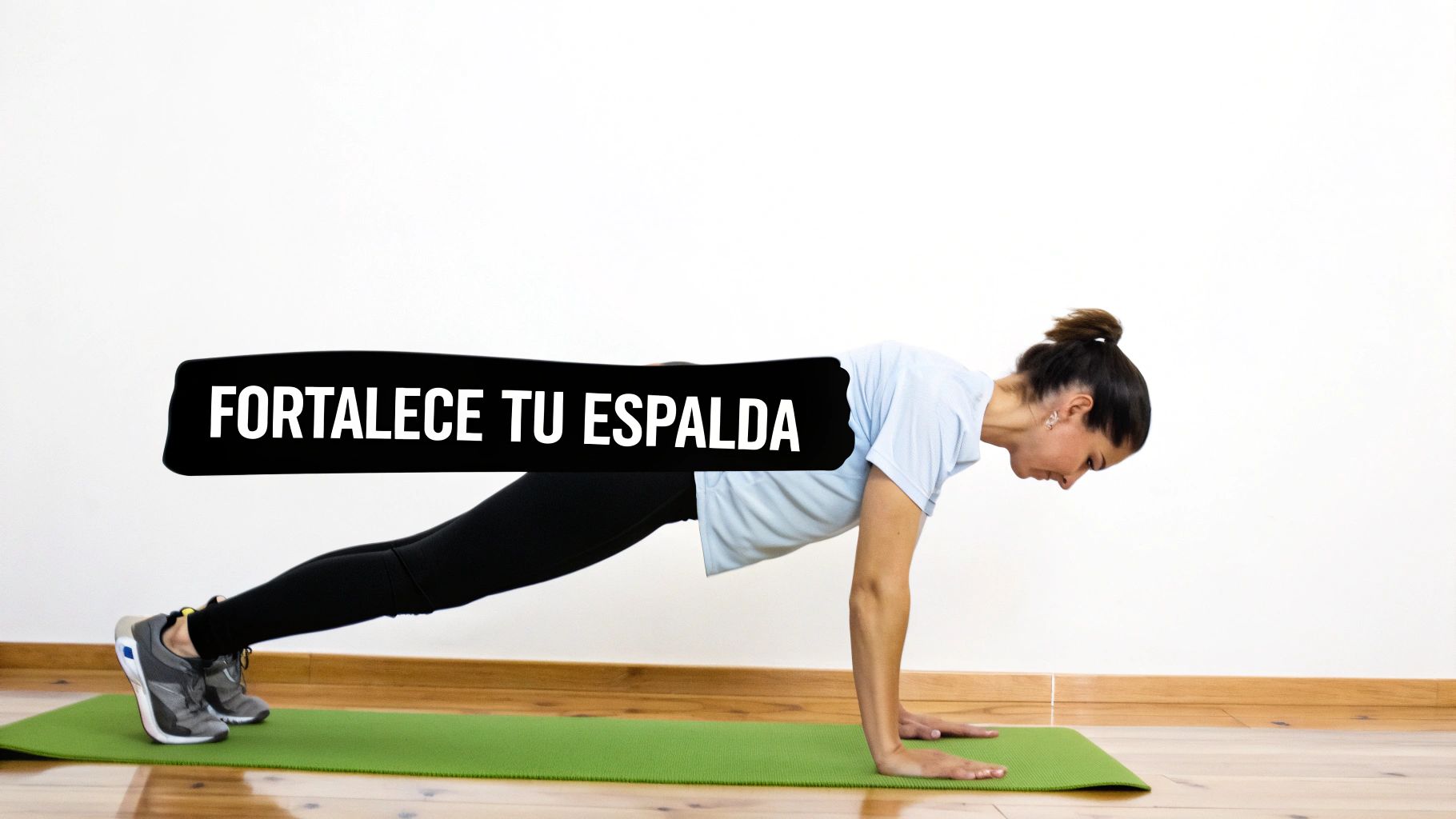
Controlled and conscious movement is essential. Prolonged inactivity usually worsens stiffness and pain. In contrast, specific exercises improve circulation, nourish the intervertebral discs, and strengthen the entire muscular support. Getting started is much easier than you think.
Key exercises to shield your core area
Your core or abdominal core is much more than the "six-pack." It includes the deep abdominal muscles, lower back, and pelvis. When this system works in harmony, it stabilizes the spine and absorbs much of the impact your body endures every day.
Here are three fundamental exercises to start getting it in shape:
-
Glute bridge: Lie on your back with your knees bent and your feet flat on the floor, hip-width apart. From there, contract your glutes and raise your pelvis until your body forms a straight line from your shoulders to your knees. Hold the position for 2-3 seconds and lower slowly. This movement activates the glutes and hamstrings, two muscle groups whose weakness often overloads the lumbar area.
-
Bird-Dog: Get on all fours, with your hands just below your shoulders and your knees below your hips. Keeping your back completely straight and your abdomen contracted, extend one arm forward and the opposite leg backward at the same time. The key here is to prevent your back from arching. Return to the starting position in a controlled manner and alternate sides.
-
Isometric plank: This is, without a doubt, the king of core exercises. Support yourself on your forearms and the tips of your toes, keeping your body in a perfect straight line from your head to your heels. It is crucial that you do not let your hips drop or raise them too high. Hold the position for as long as you can while maintaining good technique, starting with sets of 20-30 seconds.
A golden tip: Quality always beats quantity. It is much better to do 5 perfect repetitions of a "bird-dog" than 20 poorly done ones. Proper technique is what protects your back from injuries and ensures you are strengthening the right muscles.
Stretches to release accumulated tension
Maintaining flexibility is just as important as strengthening. The tension we accumulate throughout the day shortens the muscles and creates stiffness. Incorporate these gentle stretches at the end of your day or after your exercise routine to release that load.
-
Piriformis stretch: Lying on your back, cross your right ankle over your left knee. Now, hold your left thigh with both hands and gently pull it toward your chest until you feel a stretch in your right glute. Hold the position for 30 seconds and switch sides.
-
Gentle lumbar twists: In the same position, extend your arms out to the sides and let both knees drop together to one side, turning your head to the opposite side. Try to keep your shoulders flat on the floor and breathe deeply. Hold the stretch for another 30 seconds on each side.
Integrating these movements into your routine doesn't have to be complicated. For more ideas, you can check out this guide of exercises to do at home that will help you stay active without the need for equipment.
Consistency is your best ally. Dedicate just 15-20 minutes a day, about three times a week, to start noticing a big difference. And most importantly: always listen to your body. If an exercise causes you pain, stop. The goal is for movement to become your great ally in relieving back pain for good.
A restorative rest is the key to a healthy back
We spend almost a third of our lives sleeping. It is such a huge amount of time that it is impossible to ignore the impact it has on our health. If you wake up feeling stiffer and in more pain than when you went to bed, you have a very clear sign: your nightly rest is not repairing anything, but rather making the problem worse.
During the night, the body does its maintenance work. The intervertebral discs rehydrate, and the muscles finally relax and repair. But if you sleep with poor posture or your mattress does not give you the support you need, this vital process is interrupted, and instead of relief, you create more tension. Believe me, the way you sleep is just as crucial as the posture you maintain when sitting or lifting weight.
Sleeping postures that truly protect your spine
Not all sleeping postures are the same. Some can put brutal pressure on your neck, hips, and back, keeping your spine misaligned for hours. Finding and adopting a posture that maintains the neutrality of the spine is a giant step toward relieving back pain.
- On your side with a pillow between your knees: It is one of the most recommended postures for the back. Bend your knees slightly and place a pillow between them. This simple gesture prevents the top leg from shifting forward, keeping the pelvis and spine perfectly aligned and reducing torsion in the lumbar area.
- On your back with a cushion under your knees: Sleeping on your back is fantastic for alignment, but you have to do it right. The trick is to place a small pillow under your knees. This helps maintain the natural curve of the lower back and takes a lot of pressure off that very sensitive area.
There is one posture you should avoid at all costs: sleeping on your stomach. It forces you to turn your head for hours, which creates tremendous tension in your neck that ends up going down your entire back. In addition, it flattens the natural curve of the lumbar area, which can aggravate any pain you already have.
Choosing a mattress: an investment in your well-being
Your mattress is, literally, the foundation on which you build your rest. If it is too soft, your body will sink like into a hammock, misaligning the spine. If it is excessively hard, it will create painful pressure points on your shoulders and hips. The secret, as with almost everything, is balance.
A good mattress should give you a smart combination of firmness and adaptability. It has to be firm enough to support your weight and keep your spine straight, but it also needs to mold to your curves to distribute pressure evenly.
This topic is especially important because lower back pain is one of the most common causes of sick leave. Taking care of your sleep is a simple way to avoid making it worse every night.
Don't take the choice of mattress lightly; it is a key tool for managing pain. If you're not sure where to start, our guide on how to choose a mattress that reduces back pain will give you all the information you need to make the right decision.
What to look for in your next mattress
When you go looking for a new mattress, don't rely solely on your first impression in the store. Think about how it will treat your body for eight hours straight, night after night.
- Quality materials: Memory foam and hybrid materials, like those in Morfeo's hybrid mattresses, are designed to adapt to the contours of your body. They relieve pressure points without sacrificing the support you need.
- Comfort zones: Some more advanced mattresses are designed with different firmness zones. They allow your shoulders and hips to sink in a little more, while the lumbar area receives extra support.
- Trial period: Look for brands that offer a trial period at home. Your body needs time, sometimes several weeks, to get used to a new sleeping surface.
Don't think of your mattress as an expense, but as an essential tool for your health. Quality sleep is one of the most effective (and passive) ways to fight back pain in the long term.
Morfeo's recommendation
Eight hours on a worn-out mattress undo what you gain during the day
You can stretch, correct your posture, and walk more, but if the mattress sags in the middle, your spine spends a third of the day misaligned. Support that distributes your weight well won't cure an injury, but it will stop making it worse every night.


This information is for general guidance and does not replace the advice of a healthcare professional. If the pain persists, consult your doctor or physical therapist.
100-night trial · 10-year warranty · Delivery in 3-7 business days
When to pick up the phone and call your doctor
Although most back pain is a battle we can fight and win at home, it is essential to know how to distinguish a simple discomfort from a real warning sign. Sometimes, by not taking it seriously, we let a manageable problem become chronic and much more severe.
The key is to listen to your body. It knows. If something feels "different" or worse than usual, you're probably right. It's not about being alarmist, but about being proactive about your health.
The red flags you should never ignore
Some symptoms are like flashing neon lights: they are telling you that the problem could be something more than a muscle spasm. If you notice any of the following, it's time to pick up the phone and make an appointment with a professional.
Pay special attention to these signs:
- The pain travels: If the discomfort doesn't stay in your back and starts going down one or both legs, often as a cramp or an electric shock, it could be a sign that a nerve is pinched. This is very typical of sciatica.
- Weakness or strange sensations: Noticing that you're losing strength, feeling tingling or a strange numbness in your legs, feet, arms, or hands is a neurological symptom. Don't ignore it; it needs to be assessed as soon as possible.
- Bathroom problems: Any sudden change in bladder or bowel control is a medical emergency. There's no doubt here: you need urgent attention.
- Pain that keeps you from sleeping: If the pain is so intense that it doesn't improve even with rest, wakes you up at night, and is constant, it deserves to be thoroughly investigated by a specialist.
To give you an idea: most people will experience back pain at some point in their lives. Most are acute episodes that go away within a few weeks. But if yours lasts more than 12 weeks, it is already considered chronic and needs a different approach.
Which door to knock on?
Knowing who to turn to can save you a lot of time and suffering. Your first stop is usually your primary care doctor. They will perform an initial assessment and, if they think it's necessary, refer you to the right specialist.
Depending on what's going on, you may need a physical therapist to start a rehabilitation and exercise plan, or an orthopedic surgeon if a more structural problem is suspected, such as a herniated disc or something similar.
We answer your most common questions about back pain
When your back hurts, it's normal to have a lot of questions. Here we're going to clarify those common doubts and debunk some myths so you have the right information and can take better care of yourself.
Is complete rest the best solution?
Many people think that the best thing to do is not to move, but the reality is quite the opposite. Staying in bed for more than a day or two can even be counterproductive. Why? Because the muscles that aren't used lose strength, weaken, and stiffness takes over the area, which often ends up making the pain worse in the long term.
The key is gentle, controlled movement. Something as simple as walking or doing the stretches we saw earlier keeps blood flowing and helps keep your muscles flexible, which actually speeds up your recovery.
Do back braces really help?
Braces can give a sense of immediate relief and support, especially if you have to lift something heavy. However, using them constantly is a double-edged sword. The muscles in your abdomen and lower back get "spoiled" by that external support and basically stop doing their job.
Excessive use of a brace can weaken your core, which is precisely the natural corset you need to strengthen to protect your spine in the long term.
My advice is to use them very occasionally and always under the recommendation of a professional, but never as a permanent fix. The real solution, the one that will protect you in the future, is to strengthen your own muscles.
What exercise can I do if I already have pain?
If the pain is very acute, the first thing to do is slow down and apply the immediate relief techniques we already discussed. But once that intense phase has passed, you can and should start moving with very low-impact exercises.
Here are some safe options to get started:
- Walking: It is one of the safest and most effective things you can do. Start with short walks on flat ground and gradually increase the time.
- Water exercises: The pool is your best ally. Swimming or doing water exercises is fantastic because the water supports your weight and takes all the pressure off your joints and your back.
- Gentle stretches: The stretches we mentioned, such as the piriformis stretch or gentle spinal twists, are perfect for releasing tension without straining anything.
The most important thing is to learn to listen to your body. If a movement makes the pain increase, stop. The golden rule is to move without reaching that point of sharp pain. If you're not sure, a physical therapist can design a customized exercise plan for you that is completely safe, and thus ensure that every movement brings you closer to recovery.
Your back deserves support that works for you even while you sleep. At Morfeo, we manufacture hybrid mattresses in Spain with pocket springs designed to keep the spine well-aligned while you rest. View mattresses for back pain, with a 100-night trial to test them at home.