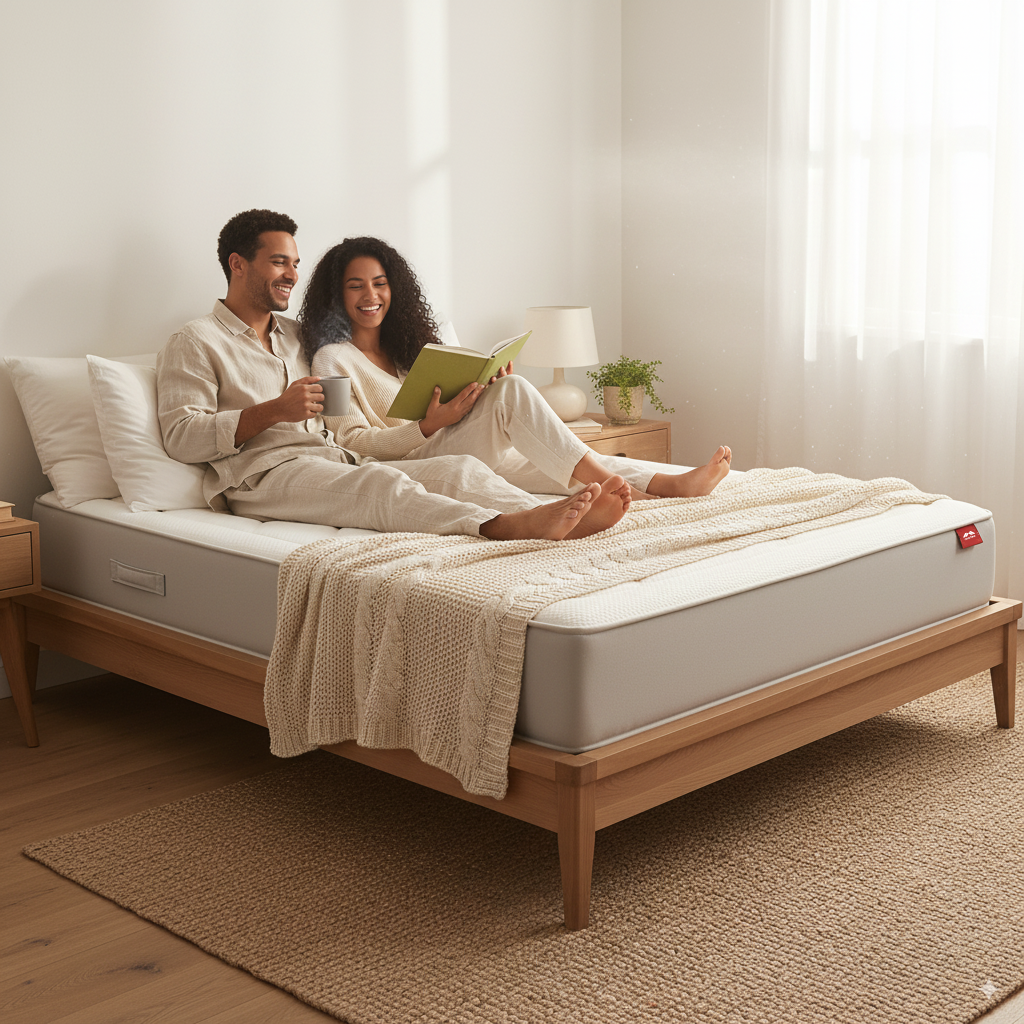

Mattress for Osteoarthritis: Guide to Choosing the Best in 2026
You lie down carefully. You look for a position that doesn't put too much strain on your hip, knee, or shoulders. You drift off for a while, change sides, readjust the pillow, and yet, when you get up, you feel like your body has spent the night working instead of resting.
This happens to many people with osteoarthritis. The problem isn't always just the joint. Sometimes it's also the surface you try to recover on every night. An unsuitable mattress can force the body to compensate, tense up, and bear pressure right where it hurts the most.
Choosing a good mattress for osteoarthritis isn't about buying "the hardest" or "the softest". It's about understanding how your body sleeps, which areas need relief, and what happens when you share a bed with someone else or move around a lot during the night. That's where many guides fall short.
Waking up with osteoarthritis and the role of your mattress
There's a very common scene. The alarm goes off, you try to get up, and you notice that mixture of stiffness, a sharp pain, and slowness in your joints. It's not just pain. It's the feeling that your body needs several minutes to get started.

When this happens repeatedly, many people think "it's normal" with osteoarthritis. Some of that stiffness can be due to the joint problem, yes. But another part can be worsened by a bad combination of firmness, support, and pressure for hours on end.
What usually happens during the night
If the mattress gives too much, the pelvis and torso sink, and the body loses a stable position. If it's too rigid, the shoulders and hips receive more pressure than they should. In both cases, rest stops being restorative.
Nights become fragmented. You change positions to escape one discomfort, then another appears. And even if you don't always fully wake up, your body certainly notices it in the morning.
Sleeping doesn't "cure" osteoarthritis, but good support can make the night stop adding load to the next day's pain.
The mattress as a relief tool
Thinking of the mattress as a simple piece of furniture falls short. For someone with osteoarticular pain, it's a daily support tool. It's in contact with your body for many hours, every night, and conditions how weight, pressure, and posture are distributed.
That's why it deserves a more technical and less impulsive choice. You don't need to become an expert in materials. You need to understand a few key points and apply them to your real case: how you sleep, where it hurts, how much you move, and if you share a bed.
Why your mattress is key to relieving osteoarthritis
Think about a car's suspension. If it's too soft, the vehicle sways and loses stability. If it's too hard, every road irregularity is felt more. A mattress does something similar with your body during the night.
A good mattress for osteoarthritis needs to combine two functions at the same time. It must absorb pressure in sensitive areas and keep the spine aligned. If it fails in one of the two, the joints pay the price.

The two problems that strain your joints the most
The first is the lack of support. When the mattress doesn't support well, the back and pelvis are left in a forced position. The body tries to correct it with muscle tension and small compensations that accumulate over hours.
The second is pressure points. In osteoarthritis, this matters a lot. The biomechanical logic is to reduce pressure peaks on shoulders, hips, and knees. In general, viscoelastic materials and latex help distribute pressure and align the spine, while an excessively soft mattress increases the strain on the joints and can worsen the pain.
Support does not mean extreme hardness
This is where a common confusion appears. Many people hear "you need support" and translate that as "you need a board". It's not the same.
A mattress with good support allows the heaviest parts of the body to settle just enough, without the whole thing deforming. It's the difference between resting a hand on loose sand or on well-designed technical foam. In both cases there is contact, but only one maintains a stable shape.
To better understand how alignment and pain are related, this explanation on how the mattress affects back pain can help you. Although it talks about the back, the postural logic also affects those who live with osteoarthritis.
What you notice when you get it right
It doesn't always feel "softer" or "firmer". It feels like less struggle with the bed. You take less time to find a position. There's less need to turn over to escape the pressure. And getting up stops being that moment when everything creaks at once.
Practical rule: if a mattress forces you to choose between "not sinking" and "not having hip pain", the problem isn't your body. It's that the mattress lacks balance.
Firmness and adaptability: the perfect balance
The myth of "the harder, the better" holds up because it seems logical. If your body hurts, you imagine that a hard surface will support it more. In practice, with osteoarthritis it usually works worse.

For osteoarthritis, the most common recommendation is a mattress of medium or medium-high firmness that distributes pressure. Models with memory foam or latex layers tend to be the most comfortable in these cases, because they combine adaptability and support.
Firmness and support are not the same
Firmness is the initial feeling when you lie down. Support is what happens next, when the mattress supports your body throughout the night.
A mattress can seem firm at first contact and, yet, support poorly. It can also have a pleasant surface feel and offer very solid internal support. That's why it's worth looking at the complete construction and not just the feeling of the first few seconds.
If you're torn between firmer or more adaptable sensations, this guide on what is better between a hard or soft mattress helps separate myth from reality.
How to recognize the correct balance
It usually looks like this:
- Shoulders and hips need to sink slightly so they don't bear all the load.
- Lumbar area and torso need continuous support so the posture doesn't collapse.
- Changes of position should be easy, without the feeling of being trapped.
That is exactly what a well-executed medium-high firmness seeks. It's not about sleeping on something hard. It's about sleeping on something that gives intelligently.
This video helps visualize that difference between hardness and ergonomics:
When a "high" firmness can actually make sense
There are cases where it's worth increasing the perceived firmness level a bit. For example, if the person weighs more, if they have trouble turning over, or if they feel they sink too much when sitting and getting up. But even then, a rigid surface without adaptable padding can increase pressure on the shoulders or hip.
If when you lie down you feel relief at first, but after a while localized pain appears on a bony prominence, you probably have excessive surface rigidity.
The best materials for a mattress if you have osteoarthritis
When you read product sheets, it seems like everything sounds good. Technical foam, memory foam, latex, hybrid, reinforced core, premium padding. The problem is that those names only work if you know what function each layer fulfills in your body.
For users with osteoarthritis, it's worth prioritizing mattresses with a stable core and a viscoelastic or latex comfort layer. In the Spanish market, firm systems with elasticity are described as suitable, which reduce pressure points and favor individualized support, something especially useful in couples with weight differences.

Memory foam when the problem is pressure
Memory foam stands out for its ability to distribute load. Simply put, it "hugs" the body's contour better. That helps especially when the painful areas are shoulders, hips, or knees.
Its strong point is not just softness. It's the way it reduces the concentration of weight on specific points. For a person with lateral hip osteoarthritis, that difference can be very noticeable when sleeping on their side.
Latex when you seek elastic adaptability
Latex usually offers a livelier and more elastic feel. It adapts, but recovers quickly. Some people find it easier to move on this surface than on certain more enveloping memory foams.
It can be a good option if you need pressure relief, but you don't like the feeling of progressive sinking. It also fits well with restless people during the night.
Hybrids when you share a bed or move around a lot
This is one of the keys that is most overlooked. If you sleep as a couple or change positions a lot, the material should not only relieve pressure. It should also respond well to movement.
Hybrid mattresses combine adaptable layers on the top with a more structured support inside. That mixture usually helps achieve three things at the same time:
- Localized relief in sensitive joint areas.
- Greater stability to get in and out of bed with less effort.
- Better coexistence as a couple when there is a weight difference or different sleep habits.
Several models move in that category. For example, Morfeo manufactures in Spain the Altus Mattress, a hybrid of pocket springs with medium-high firmness, and the Nature Mattress, made of natural latex on pocket springs with medium firmness: two configurations that seek that balance between support and adaptability.
What to look at in the technical sheet
You don't need to obsess over every commercial term. It is worth paying attention to this:
| Element | What it provides |
|---|---|
| Stable core | Maintains the structure and prevents overall sinking |
| Memory foam or latex layer | Reduces pressure on shoulders, hips, and knees |
| Multilayer construction | Allows combining support, comfort, and breathability |
| Breathable cover | Improves the thermal sensation during the night |
If a sheet only talks about "softness" or "firmness" but does not explain how the support is distributed, important information is missing.
Buying guide according to your posture and pain area
Posture changes the experience of a mattress for osteoarthritis a lot. The same model can seem correct for someone who sleeps on their back and too hard for someone who spends the whole night on their side.
Everything also changes when there are two sleepers. Most guides do not explain how to balance support, bed independence, and pressure relief when sleeping as a couple, a key factor in Spanish households. The "firmer" sensation can worsen pain in shoulders and hips, unlike a hybrid with adaptable padding that isolates movement and adjusts to each sleeper.
If you sleep on your side
This posture concentrates more pressure on shoulders and hips. If the mattress doesn't give a little in those areas, the body is pushed up and pain points appear.
You need a surface with good top layer feel and stable support underneath. If you also have hip pain, avoid dry or overly tense surfaces.
If you sleep on your back
Here it matters more that the pelvis doesn't sink and that the lumbar area doesn't stay "in the air". You need a stable base and moderate, not excessive, adaptability.
If your main pain is in the knees or hips, comfortable padding is still useful. But the main thing is the overall alignment of the torso.
If you move around a lot or share a bed
This is the real scenario in many homes. One turns over, the other wakes up. One needs more shoulder feel. The other prefers a firmer feel. And if one has osteoarthritis, any interruption adds fatigue and worse pain perception the next day.
In those cases, it's worth prioritizing:
- Movement isolation so that the other person's changes of position are felt less.
- Individualized support if there is a weight difference.
- Agile response to move without extra effort.
To review how posture influences sleeping on the back, hips, and shoulders, this guide on sleeping postures can help you.
Mattress recommendations according to your profile
| Posture / Main Pain | Ideal firmness level | Recommended material |
|---|---|---|
| Side / shoulder pain | Medium or medium-high with good feel | Memory foam or hybrid with adaptable layer |
| Side / hip pain | Medium with stable support | Memory foam, latex, or hybrid |
| Back / lumbar pain and stiffness upon waking | Medium-high | Stable core with adaptable comfort layer |
| Couple / weight difference | Medium-high personalized by layers | Hybrid or system with individualized support |
| Frequent nighttime movement | Medium-high with balanced response | Hybrid or latex |
As a couple, the best mattress is not the one that "both like" when sitting for five minutes. It's the one that allows each one to rest without disrupting the other's rest.
Morfeo's recommendation
With osteoarthritis, what matters is distributing pressure, not hardness
A very hard mattress concentrates weight on the hip and shoulder, right where it hurts the most. One too soft leaves the spine without support. The balance is in a firm core with a feel layer that absorbs pressure points.


This information is for general guidance only and does not replace the advice of a healthcare professional. If the pain persists, consult your doctor or physiotherapist.
100-night trial · 10-year warranty · Delivery in 3-7 business days
How to test and buy your mattress online risk-free
Lying down for a few minutes in a store tells you very little. You're dressed, alert, out of your routine, and on a bed that isn't yours. With osteoarthritis, the first impression isn't what matters. What matters is how you feel after several nights in a row.
That's why it makes sense to try the mattress at home. Spanish guidelines on lower back pain indicate that the ideal mattress length should exceed your height by 15-20 cm, and for weights over 100 kg, increased firmness is recommended. This logic of personalization is what justifies the need for an extended trial period to validate the choice at home, as stated in this authoritative Spanish guide on mattresses and lower back pain.
What to check in the first few days
Don't just focus on "is it comfortable". Look for more useful things:
- How you get up in the morning. Less stiffness is usually a better sign than a soft feeling when you lie down.
- What happens when you turn over. If you need to exert yourself to change positions, there may be excessive sinking.
- How it responds as a couple. If you notice every movement your partner makes, the bed independence is insufficient.
- If the size fits. Length matters more than it seems, especially for tall people.
Buying online with a safety net
Here, the services matter almost as much as the mattress. A generous trial period allows you to check the body's real response. Free shipping and returns reduce the pressure of "having to get it right the first time". And a long warranty speaks to the expected durability of the product.
In a sleep purchase, that completely changes the experience. You stop buying blindly and start evaluating calmly, in your bedroom and with your real habits.
Buying online makes sense when you can turn the purchase into a controlled trial. If you cannot test it at home with enough time, the risk remains high.
Frequently asked questions about the ideal mattress for osteoarthritis
Is a firm mattress better if I have osteoarthritis?
Not necessarily. What usually works best is the balance between support and adaptability. If the mattress is too firm, it can increase pressure on the shoulders and hips. If it is too soft, it can worsen your posture during the night.
Memory foam or latex?
It depends on the sensation you tolerate better. Memory foam usually relieves localized pressure more. Latex offers more elastic adaptation and makes movement slightly easier. If you move a lot, latex or a hybrid may be more comfortable for you.
What if I sleep with my partner and we have different needs?
This is a very common case. Look for a mattress with good bed independence and individualized support. If one person weighs more or moves more, a hybrid model usually solves the balance between stability and pressure relief better.
Does the base or bed frame matter?
Yes. The mattress works on a base. If the base is unstable, bows, or does not ventilate well, the mattress's performance worsens. A good base helps the actual support resemble what the product sheet promised.
Can a topper fix a bad mattress?
Sometimes it helps as a temporary solution, especially if the problem is excessive surface firmness. But it does not correct a worn-out core or poor overall alignment. If the mattress fails in support, the topper masks the problem, it does not solve it.
How do I know if the thickness or firmness is insufficient?
Typical signs are excessive sinking when you lie down, difficulty turning over, a "falling" sensation in the pelvis, or more pain in specific areas after several hours. In heavier people, it is usually necessary to increase the firmness compared to a lighter profile.
How long do I need to know if I have made the right choice?
More than one night. The body needs to adapt and compare real sensations in your environment. The key is not whether the mattress impresses on the first day, but whether it consistently reduces stiffness, pain-related awakenings, and localized pressure.
Is there a better posture for sleeping with osteoarthritis?
There is no single universal posture. Sleeping on your side requires more pressure relief on the shoulders and hips. Sleeping on your back requires more stability in the torso. The important thing is that the mattress supports your usual posture instead of forcing you to fight against it.
If you are looking for an option with an ergonomic approach and easy online purchasing, you can consider Morfeo mattresses. The brand offers hybrid and memory foam models, 100 nights to try, free shipping and returns, and a 10-year warranty, useful conditions when you need to check at home, calmly, if a mattress for osteoarthritis truly fits your body and your way of sleeping.