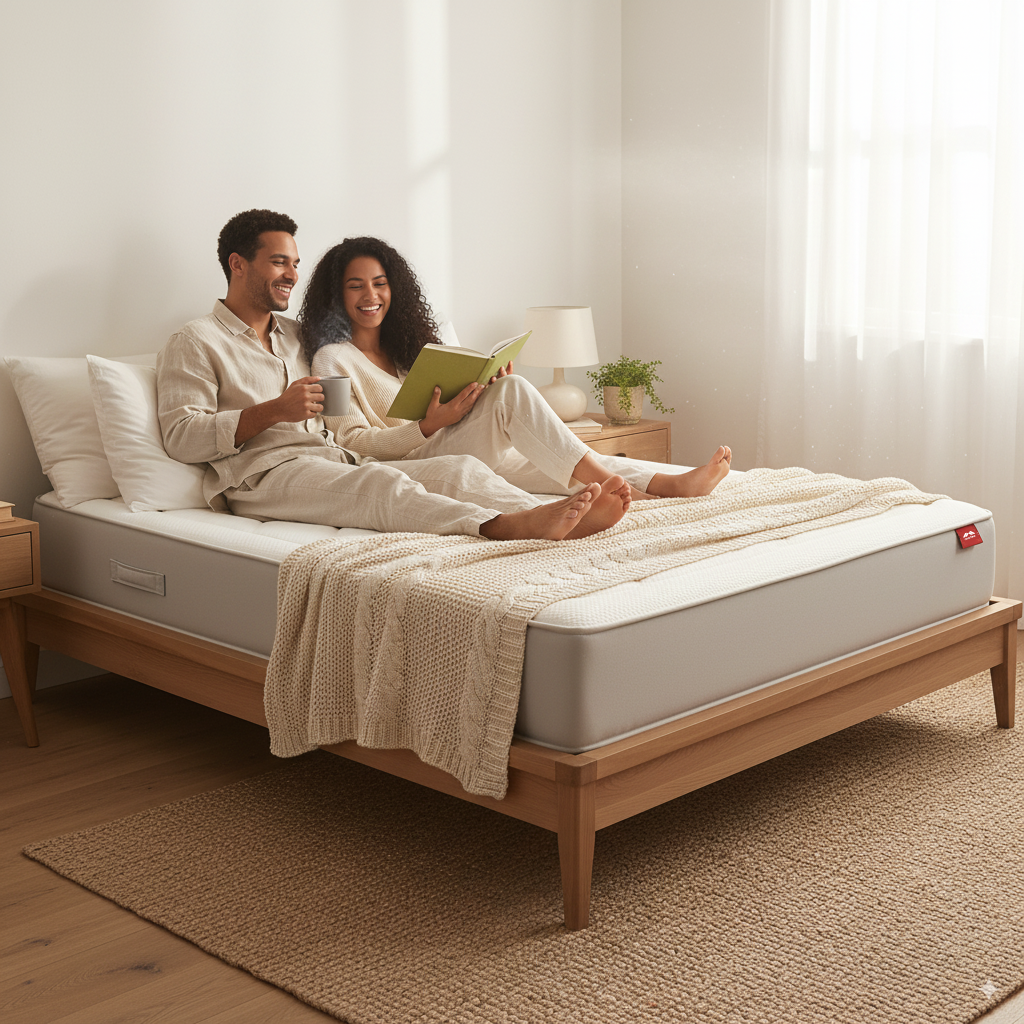

Mattress for neck problems: choose the ideal one in 2026
You get up, turn your head to look at your phone, and feel that pull. It's not dramatic pain, but it is annoying enough to start the day with a stiff neck, tense shoulders, and the feeling that you slept worse than you should have. Many people attribute it to stress, spending many hours in front of the computer, or an occasional bad posture. Sometimes they are right. Other times, the problem repeats itself because every night your bed forces your neck to spend hours in a position that is not right for it.
The underlying idea is very simple: rest is not just “lying down on something comfortable.” Resting well means that the mattress, pillow, and posture work together to keep the spine in a stable position. If one fails, the other two have to compensate. And the neck is usually the first to protest.
If you are looking for a mattress for cervical problems, you don't need grandiose promises. You need to understand what your bed really has to do so that your cervical spine stops suffering while you sleep.
Mattresses for the Neck
Medium or medium-high firmness, with welcoming
For the neck, the mattress has to support the torso and let the shoulder enter just enough. These two models are in that range; the pillow does the rest.
 Altus Mattress
Medium-high firmness: more than 2,000 pocketed micro-springs that support the torso and linen fabric that breathes.
View the Altus Nature Mattress
Medium firmness, with natural latex and organic cotton on pocketed springs: more welcoming for the shoulder if you sleep on your side.
View the NatureIt is not a treatment: if the pain persists, consult your doctor or physical therapist.
100 nights of trial on mattresses · 10 years of warranty · free shipping in the peninsula · made in Spain
The Pillow Your Great Ally or Your Worst Enemy
You can get the mattress right and still wake up feeling bad if the pillow fails. It is very common: people who change the bed, improve quite a bit, but maintain a residual discomfort because the head continues to be left too high or too low.

Mattress and pillow form a single system
The appropriate height of a pillow does not exist on its own. It depends on two things. Your sleeping posture and how much you sink into the mattress.
A very clear example. If you sleep on your side on a firm mattress, the shoulder enters little into the surface. Then there is more space between your head and the mattress. You need a pillow with more height to fill that gap. If, on the other hand, you sleep on a more adaptable mattress, the shoulder and torso penetrate more. The gap decreases and a high pillow can push your head up.
How to know if the pillow is causing imbalance
Ask yourself these questions when waking up:
- Do you feel your neck tilted to one side? It usually happens with pillows that are too high or too low for sleeping on your side.
- Do you wake up with stiffness at the base of the skull? It can indicate excess cervical flexion or extension.
- Do you push the pillow away during the night? Your body sometimes tries to correct what the pillow spoils.
To better understand what features to look for, this guide on cervical ergonomic pillow can guide you.
A simple rule according to your posture
If you sleep on your back, a more contained pillow usually works better, which supports the natural curve of the neck without throwing the head forward, like the SojaVisco Pillow (13 cm, medium firmness).
If you sleep on your side, the pillow must fill the side space with precision (for this posture the AirHigh Pillow is designed, 18 cm, the highest in our range). “More or less” is not enough. If height is missing, the neck falls. If there is too much, the neck bends.
This video can help you better visualize the relationship between posture and support.
A correct pillow does not seek to immobilize you. It seeks that, when you relax, the head stays where it should.
The most common mistake in couples
A couple can share a mattress and need different pillows. This is completely normal. Shoulder width, preferred posture, and the way of sinking into the mattress change from one person to another. The neck does not understand closed packs. It understands alignment.
How to Sleep to Protect Your Cervical Spine
The best mattress for cervical problems loses a large part of its value if you sleep in a posture that punishes the neck for hours. Position matters. A lot.

On your back
Sleeping on your back is usually a kind option with the cervical spine when the pillow is not excessive. The key is that the head rests, it does not project forward.
Look for these sensations:
- Neutral chin: neither very raised nor forced toward the chest.
- Support under the neck: the pillow supports the curve, not just the nape.
- Stable mattress: the dorsal area should not be left in tension.
If you also feel lumbar load, you can try to slightly flex your knees with the help of a soft support. Sometimes unloading the lower area also improves the comfort of the neck, because the entire posterior chain rests better.
On your side
Sleeping on your side can also go very well, but it demands more precision. Here the goal is that the head remains aligned with the sternum and the torso, without falling toward the mattress or being suspended outward.
Do this mental check. If someone were to look at you from the front, your neck should look like a continuation of the rest of the spine.
Some useful aids:
| Side posture | What helps | What it is for |
|---|---|---|
| Aligned head | Pillow with sufficient height | Avoids lateral tilt |
| More stable hips | Cushion between knees | Reduces torsion of the body chain |
| Comfortable shoulder | Mattress with adaptability | Decreases local pressure |
If you are interested in better adjusting your rest according to your position, this guide on sleeping posture can be useful for you.
Sleeping on Your Stomach
Sleeping on your stomach is the least advisable position when you have neck discomfort. It forces you to keep your head turned for a long time so you can breathe. That sustained turn is not good for your neck.
It is not always easy to change an old habit. If this is your usual position, try a gradual transition. You can start with a semi-lateral position, supporting yourself with a pillow or cushion to prevent your body from turning completely onto your stomach.
If you wake up on your stomach many times, don't beat yourself up. Adjust your environment so that the good position is the easiest to maintain.
Smart Buying Guide: What to Look for and Demand
There is a very common scenario. The person tries a mattress for five minutes in the store, finds it comfortable, and thinks that is it. Then they spend eight hours on it, with their usual pillow, their usual position, and a base that may have already sagged. That is when it is decided whether the neck rests or compensates.
That is why it is advisable to buy with a clear idea in mind. You are not just choosing a mattress. You are choosing how it will work together with the pillow and the position you sleep in the most. If one of those three pieces fails, the other two have to correct the problem, and the neck usually pays the price.
What You Should Check Before Paying
Start with the home trial. It is the most honest way to know if the system works. In the store you don't turn the same way, you don't sleep on the same side, and you almost never use your pillow. A sensitive neck needs several nights to show if the support follows along or if it forces you to seek strange positions.
Also check the return policy. Don't see it just as a commercial condition. Use it as a safety margin to check something very specific: if when you get up you notice less stiffness, less need to stretch, and fewer changes of position during the night.
The warranty also matters, but for a practical reason. A material that loses its shape changes the support of the body. And when the support of the body changes, the pillow stops working at the angle you needed at the beginning.
There is another point that many overlook. The bed base. A mattress can be well designed and perform poorly if underneath it has a sunken, deformed, or unstable base. It is similar to wearing good sneakers on a slanted floor. The problem is not only in what you step on, but in how the whole thing responds.
Quick Checklist to Avoid Mistakes
- Your midsection must be supported: if the pelvis or torso sinks more than they should, the neck will tend to compensate.
- Shoulder and hip must give, but with control: you need adaptation, not a feeling of falling.
- Test the mattress with a pillow similar to yours: the cervical height changes a lot depending on that combination.
- Evaluate your main sleeping position: on your side, on your back, or combined. Not all models respond the same way.
- Confirm that the base is compatible: an unstable base alters the real behavior of the mattress.
- Demand a sufficient trial period: a good decision is noticed upon waking up, not just when lying down.
How to Check It Yourself
Buy with a method. Lie on your side and pay attention to one simple thing: if someone were looking at you from the front, the head should continue the line of the torso, not fall or remain tilted. Then lie on your back and check if you feel uniform support, without strong pressure on the shoulders or a feeling of a hollow under the neck.
If everything seems comfortable in the store, but you cannot evaluate that alignment calmly, you lack information to decide.
I also advise you to ask the salesperson specific questions. What type of base do they recommend, with what pillow profile does that mattress usually work best, and what changes would you notice if you sleep on your side or back. Someone who understands the product knows how to explain how the whole thing behaves. Someone who only sells sensations usually talks about softness, freshness, or padding, but not about posture.
Your goal is not to find the softest or the firmest mattress. It is to find one that allows the mattress, pillow, and position to work as a team. When that team works, the neck stops making extra effort during the night.
When Your Neck Pain Needs a Professional
A good mattress helps a lot. But it does not replace a clinical assessment when there are warning signs.
Seek professional help if the neck pain is intense, if it does not improve, if it wakes you up every night, or if it appears along with tingling, weakness, or pain that goes down to the shoulder, arm, or hand. It is also advisable to consult if you have dizziness, persistent headaches associated with the neck, or if you notice a clear loss of mobility.
Sometimes the mattress is part of the problem. Other times, it is only amplifying a previous dysfunction. In those cases, adjusting the bed helps, but it is not enough. A physical therapist or a doctor can help you distinguish if we are talking about muscle overload, joint irritation, nerve compression, or another cause that requires more specific treatment.
Frequently Asked Questions about Mattresses and Neck Pain
Is it normal for a new mattress to bother me at first?
Yes, it can happen. A new mattress changes the way your weight is distributed and how your muscles rest during the night. If you are coming from a sunken or very different surface, the body needs a small adjustment period. The important thing is to observe the trend. If every day you find yourself feeling a little better, it is usually a good sign. If you clearly get worse or notice new symptoms, it is advisable to review the combination of mattress, pillow, and position.
How often is it advisable to renew the sleep equipment?
There is no universal date that works for all cases. It depends on wear and tear, the quality of the materials, use, and how the surface behaves over time. Rather than looking at the calendar, look at the signs. Sunken areas, loss of support, frequent awakenings, morning stiffness, or deformed pillows usually indicate that it is time to review the whole thing.
What do we do if my partner and I need different things?
It is very common. You do not have to need the same pillow, and you do not have to seek identical sensations in bed. If you share a mattress, give priority to stable support, reasonable adaptability, and motion isolation. Then individually adjust the pillow and the sleeping position. Many times the agreement is not in finding a perfect middle ground, but in building a system that respects both.
If you are looking for a more stable, ergonomic rest that is easy to try at home, it is worth knowing Morfeo mattresses. Their proposal combines pocketed micro-springs with comfort layers, 100 nights of trial with free pickup, free shipping on the mainland, and 10 years of warranty, something especially valuable when you need to check calmly how your neck responds night after night.