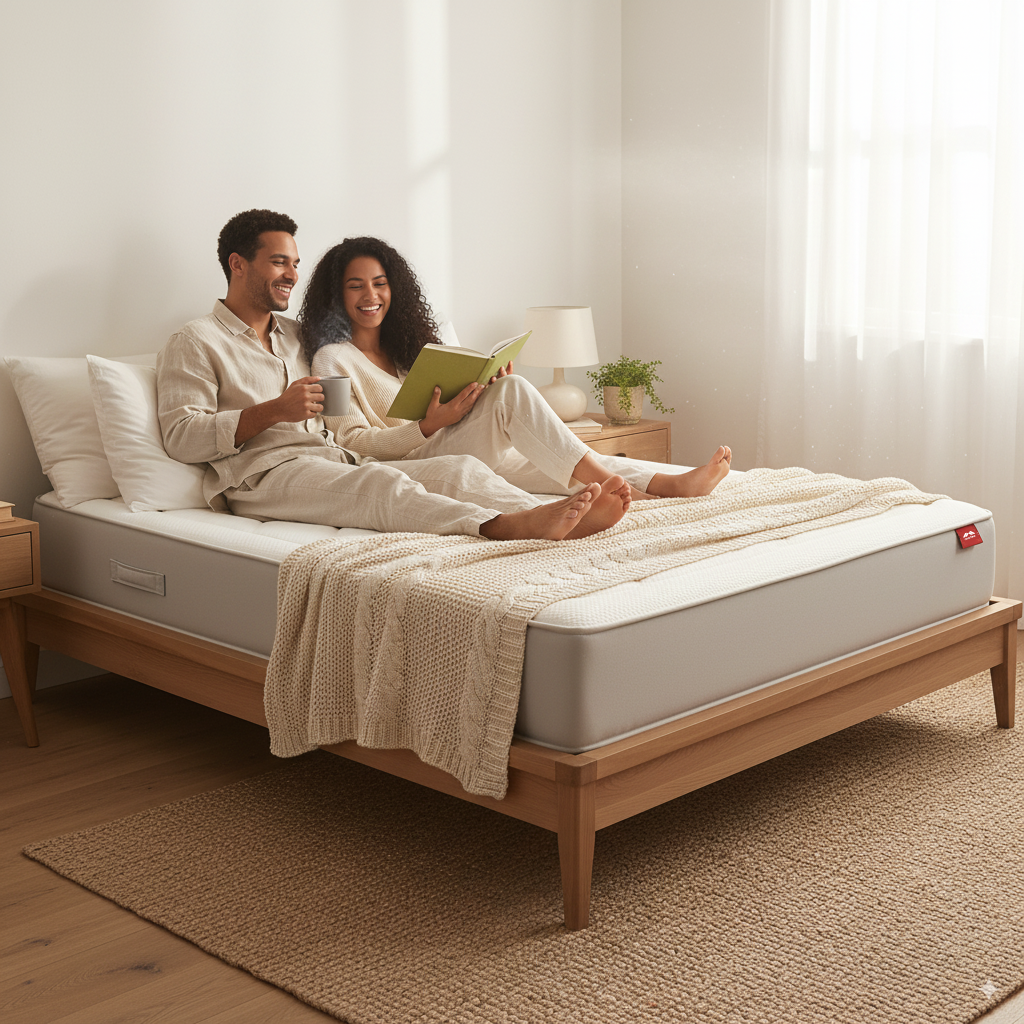

When to replace your mattress: signs, lifespan, and how to choose
As a general rule, a mattress should be replaced between 8 and 10 years. Before that if it is made of basic foam, and after that if it is made of latex or well-maintained pocket springs, because the material matters as much as the calendar.
And the most important sign is not the date, but how you feel when you get up: if you wake up with a stiff body, if you see a dip where you sleep, or if you rest better away from home, your mattress is no longer supporting you.
This guide shows you the specific signs to help you decide, how many years each material lasts, what you lose by making it last too long, and how to choose the right one next.
Signs that your mattress is worn out
A mattress doesn't break overnight. It gradually loses its performance, which is why it is so hard to notice: your body gets used to sleeping worse without warning. These are the signs that really do help you decide.
1. You feel worse when you get up than when you went to bed
Feeling stiff or sore when you wake up, and having that sensation continue as you move around, is the most reliable sign of all. It means the mattress has stopped distributing your weight. If the discomfort persists or gets worse, talk to a healthcare professional: a mattress affects your rest, but it is no substitute for a diagnosis.
2. You can see a dip
Remove the sheets and look at the bare mattress from the side, at eye level. A slight indentation is normal wear and tear. A pronounced valley right where you sleep is not: the core has given way.
3. You sleep better away from home
If you rest better in a hotel or at someone else's house than in your own bed, the problem is the bed, not you. It is the simplest test and the hardest to argue with.
4. You can feel the structure or it makes noise
Feeling the springs when you lie down, hearing creaks when you turn over, or noticing that the surface no longer responds the same way when you lean on it are signs that the internal structure is worn out.
5. The edge gives way
Sit on the edge where you always sit to put on your shoes. If it sags much more than the rest, the perimeter has lost its support and the mattress has started to deform from the outside in.
6. The person sleeping on it has changed
A new partner, a significant change in weight, or switching from sleeping alone to sleeping with someone else changes what you need from a mattress. The one you had may still be good, but it may no longer suit you.
7. The entire bed needs replacing
Sometimes the problem is not the mattress, but what is underneath it. A worn-out bed base or broken slats show through on the surface and make the mattress seem worse than it really is. Before deciding, also check the base: upholstered bases and Morfeo storage beds offer the heights and dimensions you need to match your mattress.
How long a mattress lasts depending on the material
The 8 to 10-year range is the industry standard, but it is distributed very unevenly: a latex mattress can last almost twice as long as a cheap foam one. This is how long each core lasts, what fails first, and which model from the Morfeo range uses it.
| Core type | Realistic lifespan | What fails first | In the Morfeo range |
|---|---|---|---|
| Natural latex | 10-12 years | Latex barely deforms: the cover and textile layers give out first | Nature mattress (natural latex layer on pocket springs) |
| Pocket springs (hybrid) | 8-10 years | The top comfort layers compact much sooner than the springs | Altus mattress, Original Hybrid mattress, VisCool mattress, Morfeo XL mattress |
| High-density memory foam | 8-10 years | It loses its ability to recover: it takes longer and longer to return to its shape when you get up | Comfort layers in several models |
| High-density HR foam | 7-9 years | It settles in the hip area, where the most weight is concentrated | Lite Youth mattress |
| Bonnell springs (continuous) | 6-8 years | The spring gives way and you start to feel the frame when you lie down | We do not make them |
| Low-density foam | 4-6 years | It sags where the hips rest, sometimes within the first two years | We do not make them |
There is one detail that almost no one puts in writing: within the same material, density matters more than the name. Two memory foam mattresses with different densities are labelled the same on the tag, but they do not last as long. If a product page does not list the density, there is probably a reason. This information is clearly displayed on Morfeo mattresses.
Four things that shorten the life of any mattress
- Two people sleeping on it. This reduces its lifespan by one or two years compared to single use, especially in the middle of the bed.
- Exceeding the weight it was designed for. Our entire range is guaranteed for up to 95 kg per side. If you weigh more, the appropriate model is the Morfeo XL mattress, designed for over 100 kg. Above this limit, the core settles sooner and the guarantee no longer covers it.
- A base in poor condition. A worn-out bed base or one with widely separated slats is the most common cause of premature sagging we see at the factory, and it also usually voids the guarantee.
- Not rotating it. Single-sided mattresses should not be flipped, but they should be rotated from head to foot every six months to distribute wear and tear evenly.
What happens if you make it last too long
Making a finished mattress last longer is not free, even if the cost is not immediately obvious:
- The support gives way unevenly. Foam loses its resilience and springs lose their tension. The hip area, which bears the most weight, sags sooner than the rest, so you stop lying in a straight line and spend the night readjusting yourself.
- Comfort becomes uneven. Since we all tend to sleep on the same side, wear and tear becomes concentrated there and the bed is no longer the same from one end to the other.
- Hygiene deteriorates. Every night, moisture is absorbed, and some of it ends up inside the mattress. Over the years, this leads to increased weight, odours and accumulated dust. Airing it daily and using a breathable protector helps, but it does not restore the support lost by the core.
- The base ages with it. A worn-out bed base can ruin a new mattress in just a few months, so replacing only one of the two pieces usually ends badly.
And there is another, more subtle effect: your body gets used to it. The loss of support is so gradual that almost no one notices it until they sleep on a new mattress for a few nights and compare.
How to choose your next mattress
There is no universally perfect mattress; there is only the one that is right for you. Three things decide almost everything.
Firmness, depending on how you sleep
- On your side: medium firmness. Your shoulders and hips should sink just enough to keep your spine straight.
- On your back: medium-firm to firm, with support in the lumbar area to prevent it from sagging.
- On your stomach: firm, so your back does not arch too much.
Firm is not synonymous with hard, nor soft with comfortable. The right firmness keeps your spine aligned without forcing you to adjust your posture during the night.
Weight and who shares the bed
The heavier you are, the more support you need to avoid the feeling of sinking. The entire range is guaranteed for up to 95 kg per person, and above that, the recommended model is the Morfeo XL mattress. And if you sleep with someone else, independent sleeping areas are no longer an extra: they prevent you from noticing every time your partner turns over.
The base, included in the calculation
The mattress and what is underneath it work together. If you are going to replace the base as well, it is better to look at the whole set than at each piece separately: in bedroom packs, the mattress and base are already matched in size and height, and if you only want to replace the support, you can choose storage beds or
Try it at home, not in a store
Lying on a display model for five minutes does not tell you much: your body needs weeks to adapt to new support. That is why you can try the mattress at home for 100 nights. This trial is only for the mattress, not for the bases or the other components of a pack.
If you need to replace it, this is how we work
We make each mattress to order in Spain: it does not come off a shelf, but is made to your dimensions and firmness when you place your order. Mattresses arrive rolled in a box within 3–7 business days; bases and storage beds arrive within 12, with free home assembly included. Mattresses come with a 10-year guarantee and furniture with a 3-year guarantee. And if you prefer to spread the cost, you can pay in 3 interest-free instalments with Klarna or 4 with Alma.
If you have recognised two or three of the signs above, you already have your answer. Take a look at the range of Morfeo mattresses, choose the firmness and size you need, and try it on your own bed for 100 nights, because that is where the real decision is made.
If you need to replace it
Where to start
The Original Hybrid is the model we recommend by default. If you want something more welcoming, choose the Nature.
 Original Hybrid mattress
Firm support with a welcoming feel: over 2,000 pocket springs and a layer of memory foam. Morfeo's most popular choice.
View the Original Hybrid Nature mattress
Medium firmness, with natural latex and organic cotton on pocket springs: more welcoming when you lie down and providing support where your back needs it.
View the Nature100-night mattress trial · 10-year guarantee · free shipping within mainland Spain · made in Spain
Frequently asked questions
How often should a mattress be replaced?
Between 8 and 10 years is the general guideline. In any case, the signs are what matter: visible sagging, waking up with a stiff body, or sleeping better away from home are more important than the purchase date.
What if it is 10 years old but I still sleep well?
Check it against the signs above, because at that age it is likely to have lost support. It happens very gradually and your body adapts without you noticing; the difference is usually noticeable during the first week with a new mattress.
How do I know if sagging is normal?
A slight indentation is normal wear and tear and is not a defect. If you look at the mattress from the side and can see the dip where you sleep, it is no longer normal.
Should I replace the bed base when I replace the mattress?
Not always, but you should check it. If the slats are broken, it makes noise, appears worn out, or is not the same size, replace it: a base in poor condition can ruin a new mattress in just a few months and usually voids the guarantee.
Is it worth rotating the mattress?
Yes, to distribute wear and tear evenly. Single-sided mattresses should not be flipped, only rotated from head to foot, and doing this every six months is enough. It helps the mattress reach the end of its useful life intact, but it does not make it last indefinitely.
What mattress do I need if I weigh more than 95 kg?
The Morfeo XL mattress, designed for people over 100 kg. The rest of the range is guaranteed for up to 95 kg per person, and above that limit, the core settles prematurely.