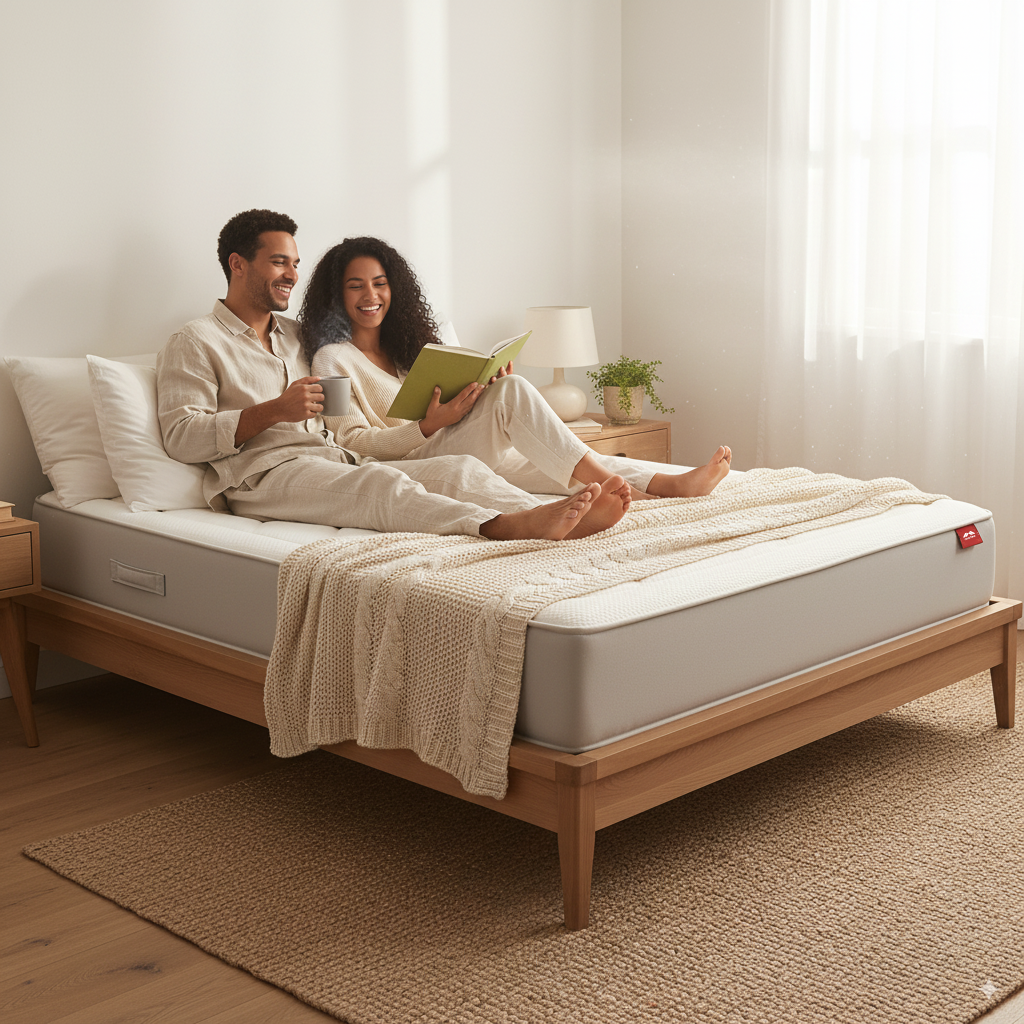

How to sleep on your back: tips to get used to it and when to avoid it
We often don't even think about it, but the way we sleep is one of the pillars of our health. You may not know it, but adopting the position of sleeping on your back (what experts call supine position) is, for many, the gold standard of rest. The reason? It aligns the spine and minimizes pressure points.
Why sleeping on your back can transform your rest (and your health)
Changing the way you sleep may seem like a minor detail, but its effects go far beyond simple comfort. When you lie on your back, you give your body the opportunity to rest in a completely neutral position, and that has a direct impact on your well-being, from your back to the skin on your face.

Think of your spine as if it were a tower of blocks. If you sleep on your side or stomach with poor posture, that tower tilts and twists, creating unnecessary tension in the discs and the muscles surrounding it. In contrast, by sleeping on your back, you allow that tower to stay straight and the weight to be distributed evenly.
The number one ally for your back
The main benefit, and the most obvious, is the correct alignment of the spine. By keeping the head, neck, and back in a straight line, pressure almost completely disappears. This is essential for those who wake up with that annoying stiffness or with pain in the lumbar area.
The key here is to let the mattress do its job well: support the natural curves of your body without forcing them. Over time, this simple habit can help you wake up with less stiffness. If the pain is persistent, consult your doctor or physical therapist.
An unexpected beauty trick
But the benefits are not just for the back. Sleeping on your back also has aesthetic advantages. Have you ever stopped to think what happens when you sleep on your side or stomach? Your face spends hours pressed against the pillow. This constant friction and compression is one of the causes of the famous "sleep wrinkles".
By keeping your face exposed to the air, you not only avoid this problem, but you also allow the creams and serums you apply at night to be absorbed into your skin and not into the pillowcase. All advantages!
Adopting the supine position is not just a matter of comfort, it is an active decision to improve the health of your spine, relieve muscle tension, and take care of your skin while you rest.
Combat nighttime acid reflux
If you suffer from heartburn or gastroesophageal reflux, gravity can be your best friend or your worst enemy at night. Sleeping on your back, especially with your head slightly elevated, helps keep stomach acid where it belongs and prevents it from rising into the esophagus.
- Natural alignment: Keeps the spine in a neutral position, reducing tension in the neck and back.
- Fewer wrinkles: Avoids pressure and friction on the face against the pillow for hours.
- Reflux relief: A slight elevation of the head helps control stomach acidity.
Real comparison of sleeping positions
Below, we analyze the pros and cons of each position so you can understand why sleeping on your back is usually the most recommended option for the health of your spine.
| Position | Impact on the spine | Other effects to consider |
|---|---|---|
| On your back (Supine) | Optimal. Maintains the natural alignment of the head, neck, and back. | Reduces facial wrinkles; with the head slightly elevated, it can relieve reflux. It may worsen snoring. |
| On your side (Fetal or log) | Good, with the right pillow. It can cause misalignment if the pillow is too high or too low. | Ideal for pregnancy and reducing snoring. It can create pressure on the shoulders and hips. |
| On your stomach (Prone) | The worst. Forces an extreme rotation of the neck and flattens the lumbar curve. | Facilitates the appearance of wrinkles and tension in the neck. Not recommended. |
As you can see, each position has its nuances: supine is the most neutral for the spine, although it is not the best option if you snore or have reflux.
Despite all these benefits, it is a minority position: most people sleep on their side. Even so, to distribute weight evenly, it is one of the best options, as long as the mattress and pillow are right.
Changing such a deeply rooted habit requires patience, but the benefits of learning to sleep on your back make the effort worth it. To better understand how your posture affects your rest, take a look at our guide on how to improve your sleeping posture for optimal rest.
The essential equipment to master the supine position
For your mission to sleep on your back to be successful, your mattress and pillow are not just accessories, they are your key allies. A bad choice can undermine all your efforts and create more discomfort than you are trying to avoid. In contrast, the right equipment will make the change feel much more natural and, above all, restorative.
It is not about going for the most expensive, but about understanding what your body needs when lying in this position. We are going to break down the keys so you can set up your ideal rest environment.
The foundation of everything: a good mattress
The mattress is the foundation on which you build a good night posture. Think of it this way: would you try to build a house on sand? No matter how good the bricks were, the structure would sink. Well, the same thing happens to your back on a mattress that is not up to par.
To sleep on your back, you need an almost perfect balance between support and adaptability.
-
Medium-high firmness: This is the sweet spot. A mattress that is too soft will make your hips sink more than the rest of your body, creating a forced lumbar curve, as if you were sleeping in a hammock. On the other hand, one that is excessively hard will not respect the natural curves of your spine, creating uncomfortable pressure points on the shoulders and glutes. Medium-high firmness gives you robust support that keeps everything in place.
-
Adaptability without sinking: This is where materials like high-density memory foam come into play. It adapts to your silhouette without making you feel "trapped". The idea is that it distributes your weight evenly, relieving pressure in the heaviest areas and, very importantly, filling the lumbar gap so it does not remain in the air. This is crucial to avoid the tension that accumulates during the night.
In the Morfeo range, the medium-high firmness is the Altus. If you prefer firmer support, the Original Hybrid has high firmness: more than 2,000 pocketed micro-springs with a layer of memory foam that provides comfort, so the lumbar area does not remain in the air.
The main pillow: the support for your neck
With the base already controlled, the pillow becomes the piece that completes the cervical alignment. A bad choice here can ruin all the work of the mattress and leave you with a bad neck or head pain in the morning.
The golden rule is neutrality. Your head should not be tilted forward (very high pillow) or fall backward (too low). The perfect pillow is the one that fills just the space that remains between your neck and the mattress, keeping the head in line with the rest of the spine.
For most people who sleep on their back, a medium-height and firmness pillow is the safest bet. It allows the head to rest comfortably without forcing the neck posture.
If you want to delve deeper into this topic, our article analyzing whether it is better to sleep with or without a pillow will be great for you. There you will find more details to get your choice right.
The ultimate trick: lumbar and knee support
And now, the advice that really makes a difference and transforms the experience of sleeping on your back from "bearable" to "incredibly comfortable". Almost all initial discomfort in the lumbar area comes from that small arch that forms in the back, even on a good mattress.
The solution is extremely simple and effective: put a small pillow or cushion under your knees.
This very simple gesture has a super positive domino effect:
- Flexes the hips slightly: This relaxes the tension in the hip flexor muscles, which are usually shortened by spending a lot of time sitting.
- Flattens the lumbar curve: By raising the knees, the pelvis rotates slightly backward. This makes your lower back have a more complete and relaxed contact with the mattress.
- Relieves all pressure: It completely eliminates that tension that accumulates in the lumbar area, which is the number one complaint of those who try this posture.
You can use a regular pillow, a rolled-up towel, or even specific leg cushions. This small adjustment is the best ally so that your body feels comfortable and secure on your back all night.
Morfeo's recommendation
When sleeping on your back, the failure is usually in the lumbar gap
It is the posture that best distributes weight, but only if the mattress supports the lower back. If it sinks, the lumbar area remains hanging all night. And the pillow must fill the neck curve without pushing the head forward.


100 nights trial on the mattress · Mattresses in 3-7 business days · Made in Spain
How to train your body to sleep on your back
Let's be honest: changing a habit as deeply rooted in our DNA as sleeping posture is no small thing. Your body has memory, and in the middle of the night, unconsciously, it will want to return to that usual position. That is why this is not about forcing anything, but about guiding your body patiently until sleeping on your back feels natural and yours.
The key is consistency and, above all, creating an environment that makes it easy for you. It is not a battle of wills, but an intelligent and gentle training with your own body.
Build your pillow fortress
The most effective technique to start is limiting your ability to move while you sleep. It is what we call the "pillow fortress". The idea is very simple: you surround yourself with cushions to create physical barriers that prevent you from turning to the sides almost without realizing it.
- First, lie on your back in the ideal position: main pillow under the head and another smaller one under the knees.
- Now, take long and full pillows (couch cushions work!) and place them on both sides of your torso. They must be well snug, from the shoulders to the hips.
- Make sure they leave you little room to turn. The idea is that they work as a soft "stop" that reminds you to maintain the posture.
This method not only stops you, but also gives a feeling of coziness and security that helps a lot to feel comfortable in the new posture. It is as if you were building a small nest that keeps you in the center of the bed.
Prepare your body before getting into bed
Just as you warm up before exercising, preparing your back to spend the night on your back can change everything. A short routine of gentle stretches is perfect to release the tension you have accumulated during the day, especially in the lumbar area and hips.
Spending five minutes on this before going to bed is enough:
- Knees to chest: Lying on your back, hug your knees and bring them to your chest for about 30 seconds. Feel how the entire lower back relaxes.
- Gentle spine twist: With knees bent and feet on the floor, let them fall slowly to one side, but without lifting your shoulders off the mattress. Hold there for 30 seconds and change to the other side.
- Psoas stretch: Standing, take a long step backward and bend the front knee. You will notice how the front of the hip of the leg you left behind stretches.
These movements tell your muscles that it is time to relax, and that makes the transition to the rest posture much easier.
A key tip: Do not try to master this in a single night. Patience is your best ally. Start trying it during naps or set yourself to hold in that posture only the first 30 minutes of sleep. Each small achievement creates the new habit.
The tennis ball technique
If the pillow fortress is not enough and you keep waking up on your side or stomach, you can try an old conditioning trick. Sew a tennis ball into the front or sides of a pajama you don't wear much anymore.
What happens with this? That when you try to turn at night unconsciously, the discomfort of the ball will wake you up just enough so that you put yourself back. It sounds a bit drastic, but it is a very effective method to re-educate your brain and your body. It is a temporary measure that can significantly speed up the process.
In this image you can see the three pillars of the support you need to maintain the posture throughout the night.

As you can see in the graphic, success depends on a complete system: the mattress as the base, the cervical pillow for the head and, the key point that many forget, the pillow under the knees to protect the lumbar area.
Your 4-week adaptation plan
So you don't get overwhelmed, here you have a gradual training plan. The idea is to gradually get the body used to it, without drama.
| Week | Key objective | Recommended actions |
|---|---|---|
| Week 1 | Familiarization | Start each night on your back. Don't worry if you move. Use the pillow fortress only the first 30 minutes to get the feeling. Try the posture in short naps. |
| Week 2 | Increase duration | Keep the pillow fortress for at least the first 2 hours of sleep. Incorporate the 5-minute stretching routine before going to bed every night. |
| Week 3 | Consolidate the posture | Try to spend most of the night with the support of the pillows. If you wake up in another position, consciously and calmly reposition yourself on your back. It is normal for this to happen. |
| Week 4 | Automation | Start removing some of the side pillows. Your body should already start to "remember" the correct posture. If you still turn over a lot, consider the tennis ball trick. |
Remember that everyone is different. If you need more time in one of the phases, that's okay. Listen to your body and move at your own pace. The important thing is not to give up!
When it is best to avoid sleeping on your back
Although sleeping on your back is reputed to be the ideal posture, the reality is that it is not for everyone. In fact, for some people, it can be counterproductive.
In certain cases, this position can worsen snoring and sleep apnea. When lying on your back, it is easier for the tongue and the soft tissues of the throat to fall backward, obstructing the airways. The result is frequent awakenings and an unrefreshing rest.
That is why it is key to know how to identify when this posture is not your ally.
Contraindications of the supine posture
There are very specific situations in which sleeping on your back is not the best option. Pay attention if you identify with any of them:
- Obstructive sleep apnea: If you already suffer from apnea, this posture can aggravate it. The obstruction of the airways becomes more likely, interrupting your rest.
- Loud snoring: Although you do not have apnea, if you snore a lot, sleeping on your back can intensify the sound and frequency of snoring.
- Gastroesophageal reflux (hiatal hernia): Gravity does not play in your favor. In the supine position, stomach acid can more easily rise into the esophagus, causing uncomfortable heartburn that wakes you up.
- Acute lower back pain or scoliosis: For some back conditions, the supine posture without proper support can generate tension in the lumbar area, causing stiffness and pain upon waking. A good mattress is essential, but sometimes sleeping on your side is simply better.
- Third trimester of pregnancy: At this stage, sleeping on your back can compress the inferior vena cava, a key blood vessel, reducing blood flow to the heart and the baby.
Although sleeping on your back is a good option for many, if you snore or have breathing pauses, this posture can make it worse.
Signs that something is wrong at night
Your body sends you signals. If you start sleeping on your back and notice any of these symptoms, it may not be the right posture for you:
- You wake up with a dry and sore throat.
- Your partner tells you that you snore louder than before.
- You suffer from constant daytime fatigue, even though you think you have slept enough hours. Those small breathing pauses (apneas) interrupt your sleep without you realizing it.
- You get up with a headache or a feeling of "brain fog" (brain fog).
If these symptoms sound familiar to you, write them down. They will be very valuable information if you decide to consult a specialist.
Fragmented sleep and chronic fatigue are not something you have to settle for. Listen to your body.
Quick and easy alternatives
If sleeping on your back is causing you problems, don't worry. There are easy solutions you can try tonight.
One of the most effective is to slightly elevate the headboard of the bed, between 10 and 15 degrees. You can use specific wedges or even solid and secure blocks under the bed legs. This small change helps keep the airways more open.
The other great alternative is to switch to side sleeping (sleeping on your side), especially on the left side. This posture not only minimizes reflux, but also facilitates breathing and reduces snoring. To make it perfect, place a pillow between your knees to keep your spine well aligned.
Posture comparison
| Posture | Advantages | Disadvantages |
|---|---|---|
| On your back | Keeps the spine in a neutral position, without twisting. | Can aggravate snoring, sleep apnea, and reflux. |
| On your side | Reduces reflux and snoring. Improves breathing. | Can generate pressure on shoulders and hips if the mattress is not suitable. |
When is it time to see a specialist?
There are symptoms you should not ignore. If you suspect you may have sleep apnea, it is time to seek professional help.
Consult your doctor if:
- Your partner notices that you make breathing pauses of more than 10 seconds while you sleep.
- You suffer from daytime sleepiness so intense that it affects your daily life (work, driving, etc.).
- The back or neck pain is persistent and intense. A physical therapist can give you guidelines and help you choose the right sleep equipment.
A sleep specialist can recommend a sleep study (polysomnography) to obtain an accurate diagnosis and, if necessary, prescribe a treatment such as CPAP. Do not ignore these signs; your cardiovascular health could be at stake.
Summary for making safe decisions
- If you notice that you snore much more or wake up tired, try sleeping on your side.
- A quick and effective solution is to elevate the headboard of the bed.
- When in doubt or with serious symptoms, always consult a professional. Your rest is essential for your quality of life.
Critical considerations for pregnancy and babies
At two key stages of life, sleeping posture stops being a preference and becomes a matter of safety. During late pregnancy and in the first months of a baby, how we rest directly impacts their well-being. The recommendation to sleep on your back is completely reviewed.

For many expectant mothers, from the second trimester onward, lying on your back stops being the safest option. The expanding uterus presses on the inferior vena cava and reduces blood flow back to the heart.
That decrease can cause complications for the mother and the fetus. That is why gynecologists and midwives advise changing posture.
The safe posture during pregnancy
Research such as the MiNESS study from the University of Manchester shows that sleeping on your back in the third trimester can double the risk of late intrauterine death. To learn more, consult the details of the research on sleeping posture.
The optimal alternative is sleeping on the left side. This frees the vena cava, improves circulation to the heart, kidneys, and uterus, and the baby receives more oxygen and nutrients.
A practical trick to avoid turning over during the night:
- Place a pillow between your knees to align your hips.
- Put another one behind your back as a stop.
If you want more tips on support and comfort, check out our guide to the best sleeping postures during pregnancy.
The only safe posture for babies
In the case of newborns, the message is clear: always on their back. This position is the basis of safe sleep campaigns, and for good reason.
- Clear airways: the trachea remains above the esophagus, preventing aspiration.
- Lower risk of overheating: it facilitates the natural dissipation of heat.
- Prevention of CO₂ rebreathing: it prevents the baby from breathing their own exhaled air.
Since the 90s, adopting this posture has reduced deaths from SMSL by more than 50% in countries like the United States. The golden rule allows no exceptions: always on their back, on a firm surface and without loose objects in the crib.
We answer your questions about the supine posture
Although the theory seems simple, changing a habit so ingrained in our DNA as sleeping posture always brings a lot of questions and one or two bumps. Don't worry, it is normal. We are going to clear up the most common doubts that arise along the way, with clear answers and practical tricks so you don't throw in the towel in your mission to sleep on your back.
Is it normal for my lower back to hurt at first?
Yes, totally. It is one of the most frequent complaints and, although it sounds strange, it is a very useful sign. This little pain usually appears because your lumbar area does not have the support it needs, creating a small arch that generates tension throughout the night.
The cause is almost always the same: even with a good mattress, there can be a gap between the lower part of your back and the surface. The solution is surprisingly easy: put a small pillow or a rolled-up towel right under your knees.
This simple gesture changes the rules of the game instantly:
- Relaxes the lumbar muscles: By slightly elevating your knees, the pelvis rotates slightly and the lumbar curve flattens, allowing your entire back to rest in contact with the mattress.
- Goodbye to tension: That feeling of tightness that accumulates in the area disappears as if by magic.
If after trying this trick the pain is still there after a few days, it could be a pretty clear clue that your mattress is too soft and is not giving you the firmness your spine needs.
How long will it take me to get used to it?
Here every body is different, but most people need between two and six weeks of consistency for the new posture to feel natural and stop being a struggle. The key is to be patient and not want to change overnight.
Don't get frustrated if you wake up on your side. It is a reflex you have been training for years. Every time you realize it, simply reposition yourself on your back, calmly and without stress.
To make the process gentler, go little by little. Start by trying it for short periods, such as during naps or during the first 30-60 minutes after lying down. Use the "pillow fortress" technique we told you before so that it is not so easy for you to turn over. Over time, your brain will start to register this position as safe and comfortable, and it will become your new normal.
My partner says I snore louder now, what do I do?
It is a fairly well-known side effect of sleeping on your back. Gravity does its job and causes the tongue and the soft tissues of the throat to fall backward, narrowing the passage of air. But before giving up, there are several things you can try.
The first thing is to adjust your posture a bit. Try a pillow that is a little taller or, even better, a wedge type to slightly elevate the entire torso. A homemade trick that works wonderfully is placing secure wooden blocks under the legs of the bed headboard. The goal is simple: create a small incline so that gravity works in your favor.
In addition, habits influence a lot. Avoid alcohol and heavy dinners right before bed. Both things relax the muscles of the throat even more, which can make snoring a lot worse.
If despite all this snoring is very loud or, and this is very important, your partner notices that you make pauses when breathing, it is essential that you consult a doctor. A possible sleep apnea must be ruled out.
I have acid reflux, can I sleep on my back?
Yes, of course you can! But with a very important condition: never sleep completely flat. If you suffer from gastroesophageal reflux, gravity is your best ally to keep stomach acid where it should be.
Your ideal posture is sleeping on your back, but with the torso slightly elevated. This incline creates a slope that makes it difficult for acid to rise into the esophagus, avoiding that very unpleasant burning sensation.
To achieve this, you have two main options:
| Option | Description | Advantages |
|---|---|---|
| Wedge pillow | A triangular foam pillow that is placed under the back and head, creating a gradual and comfortable elevation. | It is an affordable solution, you can take it on a trip and it works on any bed. |
| Adjustable bed base | It allows you to elevate the upper part of the bed just by pressing a button, like in hotels. | It offers a super precise angle adjustment and uniform support for the entire torso. |
As an alternative, specialists also usually recommend sleeping on the left side. This position helps keep the junction between the stomach and the esophagus above the acid level, reducing the chances of reflux.
At Morfeo we know that the basis of a good rest is a complete system. That is why we manufacture in Spain mattresses that support the lumbar area without giving up comfort, so that sleeping on your back is more comfortable for you.