
Sleeping on your stomach while pregnant: quick guide to safety and comfort
It is one of the first questions that comes to mind when you see the positive test: “How do I sleep now?” If you have spent your whole life sleeping on your stomach, the idea of changing might feel a bit overwhelming.
The quick and reassuring answer is that yes, you can sleep on your stomach while pregnant, but with some caveats. In the beginning, your baby is more than protected, and this position poses no problem for them. However, as your pregnancy progresses, your own body will naturally start to ask for a change.
The posture dilemma: can I sleep on my stomach during pregnancy?
Along with diet or exercise, the way you sleep is one of those lifelong habits that suddenly comes into question during pregnancy. If sleeping on your stomach is your go-to position, you will be glad to know that you do not have to give it up overnight.
During the first trimester, the uterus is still well protected behind the pelvic bone. It is as if your baby were in the safest vault in the world; the uterine walls and amniotic fluid are their personal cushioning system. That is why external pressure does not affect them at all.
The natural transition to new positions
There is no exact date on the calendar for when you should stop sleeping on your stomach. Your own body will be your best guide. Typically, between weeks 16 and 20, your belly will start to grow to a size that simply makes this position uncomfortable. It feels a bit like trying to lie down on a tennis ball; it is neither practical nor appealing.
This change is more of a gradual transition than a drastic break. Understanding it this way will help you adapt without stress, gradually trying other positions that feel comfortable for the rest of your pregnancy.
The key is very simple: listen to your body. Discomfort is the clearest sign that it is time to explore new ways of sleeping to ensure your rest and comfort.
This is what midwives usually explain: you can maintain your usual position until your belly becomes too large for it to be comfortable, without this posing a risk to the baby, who is protected by the uterus and amniotic fluid. If you have any specific concerns, consult your midwife or gynecologist.
To make it easier to visualize, here is a quick summary:
Safety of sleeping on your stomach by trimester
| Trimester of pregnancy | Is it safe to sleep on your stomach? | Main recommendation |
|---|---|---|
| First trimester (0-13 weeks) | Yes, completely safe. | Sleep in whatever position feels most comfortable. The uterus is protected, and the baby is not at any risk. |
| Second trimester (14-27 weeks) | It depends. It becomes uncomfortable and less practical. | Start experimenting with side positions. Discomfort will be your guide to leaving this position. |
| Third trimester (28-40 weeks) | It is neither feasible nor recommended. | The ideal position is on your side, preferably your left, using pillows for extra support. |
Adopting a new way of sleeping takes time. A good trick is to start familiarizing yourself with pillows and cushions from the beginning. That way, when you really need to change positions, you will already know what works best for you. The goal is not to fight a habit, but to adapt to your body's changes while always taking care of your well-being and that of your baby.
How your rest changes over the nine months
Pregnancy is an incredible journey, and your way of sleeping, believe me, evolves with it. If you understand how your body transforms at each stage, it will be much easier to adapt your rest without stress. The key is to ensure that both you and your baby are always comfortable and safe.
Think of your body as a house being remodeled to welcome a new member. In the beginning, the changes are internal, almost imperceptible from the outside. But little by little, the walls expand, and the layout of the interior space changes completely. The same thing happens with sleep.
First trimester: a start without drastic changes
During the first 13 weeks, although you are experiencing a real hormonal revolution inside, everything on the outside remains more or less the same. Your uterus, which is roughly the size of an orange, is still well protected behind the pelvic bone.
What does this mean? It means that if your favorite sleeping position is on your stomach, you can continue doing so without any worries. Your baby is perfectly protected by a triple barrier: the uterine walls, the amniotic fluid, and your own pelvic anatomy.
Now, you may notice some indirect discomfort. Breast tenderness, one of the first symptoms of pregnancy, can make this position uncomfortable. Similarly, sleeping on your stomach sometimes causes tension in your neck or back, something you will want to avoid as your body prepares for the changes ahead.
Second trimester: the turning point
From week 14 onward, you enter a growth phase that is already noticeable. Your belly starts to round out, and the uterus rises, moving beyond the protection of the pelvic bone. This is when sleeping on your stomach while pregnant stops being a comfortable and, frankly, natural option.
Your own body will send you very clear signals. Trying to lie down on your abdomen will be like trying to sleep on top of a small ball. Simply put, you will not find a stable or comfortable position. This is the ideal time to start actively practicing sleeping on your side.
This infographic will help you visualize the evolution of the recommended position as your pregnancy progresses.
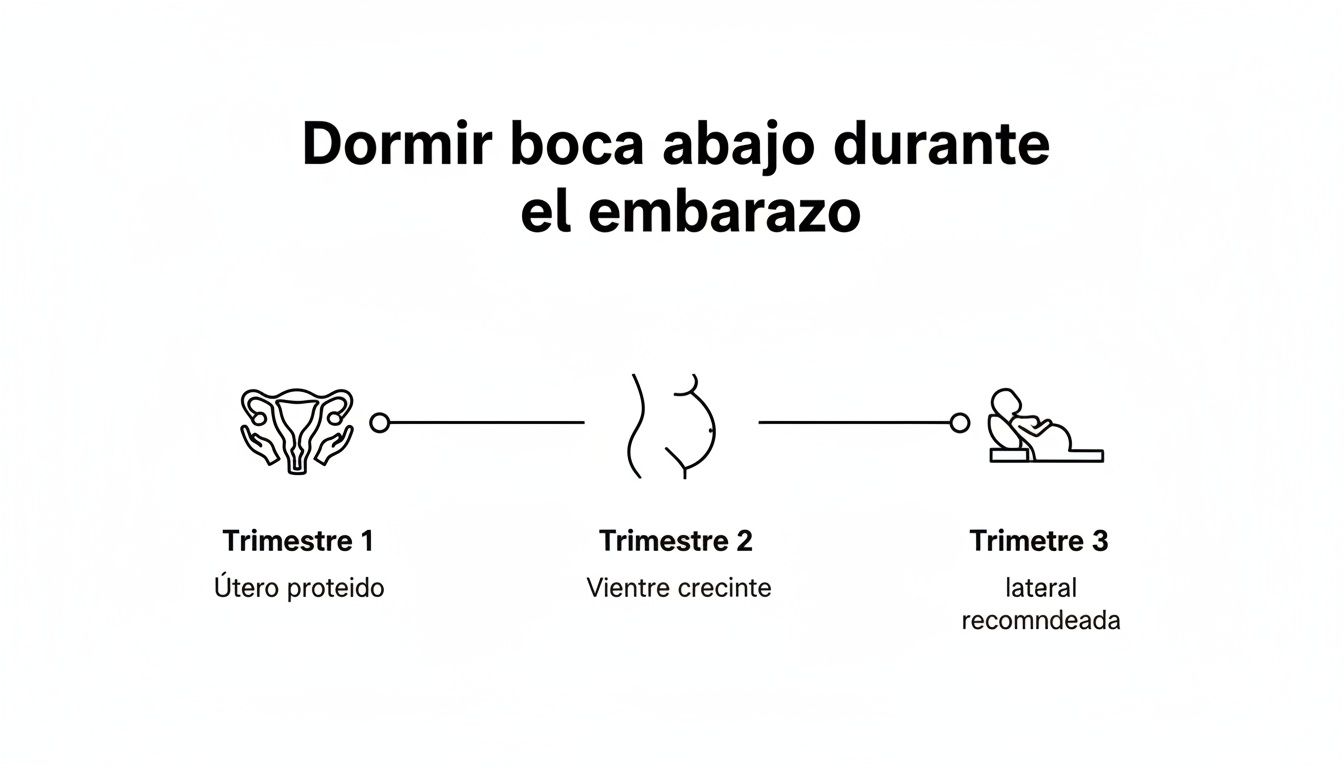
As you can see, the transition is gradual. Rather than a strict rule, your own comfort will guide you.
Third trimester: the focus shifts to safety
In the home stretch of pregnancy, sleeping on your stomach is simply mission impossible. Your attention should focus on avoiding another position that, although it may seem harmless, does involve certain risks: sleeping on your back.
As your uterus reaches its maximum size, its weight can exert considerable pressure on important blood vessels.
- Inferior vena cava: This is the major "highway" that returns blood from the lower part of your body to your heart.
- Abdominal aorta: It carries oxygenated blood from your heart to the rest of your body, including the uterus and placenta.
When you lie on your back, the baby's weight can compress these vessels, reducing blood flow. This can not only make you feel dizzy or short of breath, but it can also affect the supply of oxygen and nutrients reaching your baby.
That is why, even if your initial concern was sleeping on your stomach while pregnant, the real focus at this stage is to establish the habit of sleeping on your side. Until roughly halfway through pregnancy, sleeping on your stomach is not a problem; from that point on, discomfort itself makes it unfeasible.
The real sleeping risk you do not expect
Although the first question that comes to mind is usually whether it is safe to sleep on your stomach while pregnant, the reality is that as pregnancy progresses, the focus of attention must change completely.
By the third trimester, that position is simply unfeasible. Your own body will let you know. It is precisely then that a much more subtle, but vitally important risk appears, which we often overlook: sleeping on your back.
In the home stretch of pregnancy, the supine position (lying on your back) is no longer a safe option. It may seem like the most stable and comfortable position, especially if your back starts to feel heavy, but it exerts an invisible pressure that can affect both your well-being and that of your baby.
Imagine that your uterus, which already contains a nearly full-term baby, weighs as much as a watermelon. When you lie on your back, all that weight rests directly on your spine and, crucially, on the large blood vessels that run through that area.
Compression of the inferior vena cava: the key point
The main player in this risk is the inferior vena cava. Think of it as the major highway that returns blood from the lower part of your body to your heart. When you sleep on your back, the weight of the uterus can compress it, creating a real "traffic jam" in your circulation.
This compression has two direct and immediate consequences:
- For you: The blood flow returning to your heart decreases. This can cause a drop in blood pressure, dizziness, nausea, or a feeling of shortness of breath, and may even wake you up suddenly.
- For your baby: If less blood reaches your heart, it will naturally pump less oxygenated blood to the rest of your body, including the uterus and placenta. This reduction in blood flow can compromise the supply of oxygen and nutrients that are vital for your baby.
What science tells us about this
This recommendation is not just a piece of old-fashioned advice; it is backed by solid scientific evidence. Research has repeatedly demonstrated the importance of avoiding sleeping on your back in the last trimester to ensure a safe pregnancy.
A key example is the MiNESS study, a large-scale research project conducted by the University of Manchester that gained significant attention in Spain. Its results were so clear that they helped change the recommendations for expectant mothers around the world.
The study revealed that sleeping on your back in the third trimester increases the risk of stillbirth by 2.3 times compared to sleeping on your side. This figure is not intended to scare you, but to empower you with knowledge.
That is why pregnancy guidelines advise lying on your side from the third trimester onward: it is a small habit change with a significant benefit. Your midwife can answer any questions you may have about your specific case.
So, even if your search began by asking about sleeping on your stomach while pregnant, the most valuable information you take away is that the real act of protection in the home stretch is getting used to sleeping on your side. It is the safest and most effective way to ensure that both you and your baby have a peaceful night and optimal blood flow.
Discover the sleep position recommended by experts

Now that you know the real precaution in the third trimester is avoiding sleeping on your back, let's focus on the solution. Fortunately, the safest position is also one of the most comfortable, and it is the one recommended by gynecologists, midwives, and physical therapists around the world: sleeping on your side.
This position, known as side-lying, will become your best ally in achieving restful and safe sleep. Adopting it will not only help relieve typical pregnancy discomfort, but it also plays a fundamental role in your baby's well-being.
Why the left side is the star
Although sleeping on either side is infinitely better than sleeping on your back, experts usually emphasize the benefits of prioritizing the left side. And it is not just a whim; it is for a purely anatomical reason.
Think of the veins and arteries in your body as a road system. When you lie on your left side, you relieve pressure on the inferior vena cava, which is like the main highway that carries blood from your legs and uterus back to your heart. This way, you ensure that there are no "traffic jams" and that circulation flows smoothly.
When you sleep on your left side, you are optimizing the flow of blood and nutrients to the placenta. It is a very simple gesture that ensures your baby receives all the oxygen and nourishment they need to grow healthy.
This small change in position brings with it a host of benefits that you will notice in your daily life:
- Improves kidney function: It helps your kidneys remove waste and fluids more efficiently, which can reduce that uncomfortable swelling in your ankles, feet, and hands.
- Relieves heartburn: This position can reduce symptoms of acid reflux, a very common companion in the final stage of pregnancy.
- Reduces pressure on the liver: Since your liver is on the right side, sleeping on your left leaves it free from the pressure exerted by the uterus.
Comfort comes first, and the right side is also an option
Although the left side has its anatomical advantages, let's be realistic. The most important recommendation is to sleep on your side. If you spend the whole night trying to stay rigidly on your left side and do not rest, the benefit is completely lost.
The key to restful sleep is comfort. That is why you should not be afraid to alternate and also lie on your right side. It is perfectly safe and much more beneficial than ending up turning over and lying on your back out of sheer discomfort. The goal is to find a balance that allows you to truly rest.
To achieve this, it is essential to have a good support system. If you want to know more about how to achieve this, we analyze the best sleeping positions during pregnancy and how to adapt them to each stage on our blog. Using pillows strategically can make all the difference in maintaining a side-sleeping position throughout the night and relieving pressure on your hips and back.
Ultimately, stop worrying about whether it is bad to sleep on your stomach while pregnant, because your own body will naturally prevent you from doing so. Instead, embrace side-sleeping as your new normal, knowing that it is the most effective way to take care of both yourself and your baby while you rest.
Create your sanctuary of rest for restful sleep

Adopting a side-sleeping position is much easier if you turn your bed into a true haven of comfort. It is not just about changing positions, but about giving your body the tools it needs to maintain it comfortably throughout the night, almost without you realizing it.
With the right accessories, your bed will go from being a simple piece of furniture to becoming your best ally for rest. Think of your bedroom as a sanctuary designed for your well-being and that of your baby. Here, the key is ergonomics and finding support that adapts to you.
The art of using pillows and cushions to your advantage
During pregnancy, pillows are no longer just a simple support for your head. They become your strategic tools for aligning your body, relieving pressure, and preventing you from unintentionally turning into less recommended positions while you sleep.
Specific pregnancy pillows are a fantastic investment. They come in different shapes, and each has its purpose:
- C-shaped pillows: They are like a full embrace. They provide support for your back and head and are placed between your knees, all in a single piece.
- U-shaped pillows: They offer symmetrical support on both sides of the body. They are great if you tend to change sides a lot during the night.
- Wedge pillows: Smaller and very versatile. You can place them under your belly for gentle support or behind your back so they act as a "stopper" and prevent you from turning onto your back.
But don't worry, you do not need an arsenal of new pillows to get started. With the cushions you already have at home, you can achieve a very similar effect.
The key is strategic placement. A well-placed cushion can completely transform your comfort level, relieving tensions you did not even know you had.
Try experimenting with these combinations:
- Between the knees: Placing a pillow here keeps your hips and pelvis aligned, which takes a lot of tension off the lumbar area.
- Under the abdomen: A small, soft cushion under your belly relieves that feeling of tightness and provides very pleasant support.
- Behind the back: A slightly firmer cushion along your back works as a safety barrier. It will make it harder for you to end up sleeping on your back without realizing it.
Your mattress: the foundation of a good night's sleep
You can have the best pillows in the world, but if your mattress doesn't give you the support you need, you'll keep tossing and turning. During pregnancy, your body constantly changes in weight and shape, and your mattress needs to be able to adapt to those changes with you.
A mattress that sinks too much or is hard as a board can worsen back and hip pain. Ideally, you should find a surface that combines firmness and adaptability. You need it to support your spine in a neutral position, but at the same time be gentle on the pressure points, such as your shoulders and hips.
This is where a quality mattress makes a world of difference. For example, the Morfeo Original Hybrid Mattress combines over 2,000 pocket springs, which support the spine, with a layer of memory foam that adjusts to the curves of the body and distributes weight. That shoulder and hip support is what makes it more comfortable to maintain a side sleeping position night after night.
To give you a clearer idea, we have prepared a table relating the most common pregnancy discomforts with concrete sleep solutions.
Sleep solutions for every pregnancy discomfort
| Common discomfort | Ergonomic solution | How Morfeo helps |
|---|---|---|
| Lower back pain | Keep the spine aligned with a pillow between the knees. | Its pocket spring core supports the lumbar area so the back does not sink. |
| Hip pain | Sleep on your side with proper support so the upper hip does not fall forward. | The memory foam layer adapts to the shape of the hip, relieving pressure without sacrificing support. |
| Difficulty breathing | Use a wedge pillow to slightly elevate the torso. | Its breathability helps maintain a pleasant body temperature, avoiding the heat that worsens the feeling of suffocation. |
| Feeling of abdominal tightness | Place a small cushion under the belly for gentle support. | Its adaptability allows the mattress to accommodate the volume of the abdomen without creating counter-pressure. |
Investing in your sleep environment is one of the best ways to take care of yourself during this stage. A good mattress and the smart use of pillows will not only help you sleep better, but will also allow you to wake up more rested and with less pain, ready to enjoy your pregnancy.
Morfeo's recommendation
During pregnancy, your posture changes on its own: your equipment needs to support you
From the second trimester onwards, your body asks you to sleep on your side, and that is where the mattress must allow the shoulder and hip to sink without losing lumbar support. A pillow between your legs and another that keeps your neck aligned complete the support.


This information is for general guidance and does not replace the judgment of a healthcare professional. If the pain persists, consult your doctor or physiotherapist.
100-night trial on the mattress · Mattresses in 3-7 business days · Made in Spain
Frequently asked questions about sleeping positions during pregnancy
We know that after everything we have talked about, it is normal to still have some doubts going around in your head. Pregnancy is a roller coaster of questions, and getting a good night's sleep becomes an absolute priority.
That is why we have prepared this final section to give you direct and clear answers to those concerns that almost all expectant mothers share. Consider it your quick reference guide to reinforce what you have learned and give you that peace of mind you need so much to sleep soundly.
Can I crush my baby if I sleep on my stomach at first?
This is, without a doubt, one of the top concerns, but you can take a deep breath and rest easy. During the first trimester, your baby is tiny and more protected than the crown jewel.
Imagine that it is floating in a safety bubble (the amniotic fluid), which in turn is inside a muscular safe (the uterus). And if that were not enough, all this is well protected behind the pelvic bone. So no, it is physically impossible to crush it by sleeping on your stomach while pregnant.
The real reason this position is abandoned is not because of a risk to the baby, but simply because of your own discomfort when your belly starts to grow.
What do I do if I wake up on my back without meaning to?
The first and most important thing: do not panic. It is extremely common, it happens to the vast majority of pregnant women, especially if that was your favorite position before becoming pregnant.
What really matters is the position you consciously adopt when lying down. If you wake up on your back, simply turn over calmly to one side and keep sleeping.
Your own body is an incredibly smart alarm system. Many times, you will wake up because the position is already uncomfortable or because the compression of the vena cava causes you a slight dizzy feeling. Do not feel guilty, just reposition yourself gently and continue resting.
Is the left side much better than the right?
If we get technical, anatomically speaking, the left side has a small advantage: it completely releases pressure from the inferior vena cava, which optimizes circulation to the placenta to the maximum. It is the "by the book" recommendation.
However, all experts agree that the number one priority is sleeping on your side. If you feel more comfortable on your right side or need to keep changing to avoid straining your hips, do it without hesitation. It is infinitely better to sleep on your right side than on your back.
Your comfort is key to a restorative sleep, so listen to your body and find the balance that works for you.
At what exact week should I stop sleeping on my stomach?
Do not look for a specific date on the calendar, because there isn't one. Your own body will give you a very clear sign.
Normally, this change comes naturally at some point in the second trimester, generally between weeks 16 and 20. From there, your belly starts to have a volume that makes the position as uncomfortable as trying to sleep on top of a beach ball.
The best advice is to listen to your body. As soon as you notice you are no longer comfortable, start practicing sleeping on your side. Using pillows to support yourself can make this transition much easier. In fact, the correct use of pillows is essential not only for the position, but for the health of your neck and back.
At Morfeo, we understand that your rest during pregnancy is more crucial than ever. A good mattress that offers support that adapts to you and maximum comfort is the foundation for a truly restorative sleep. We invite you to discover our range of mattresses, made in Spain and with 100 nights of trial so you can check at home if they fit you.