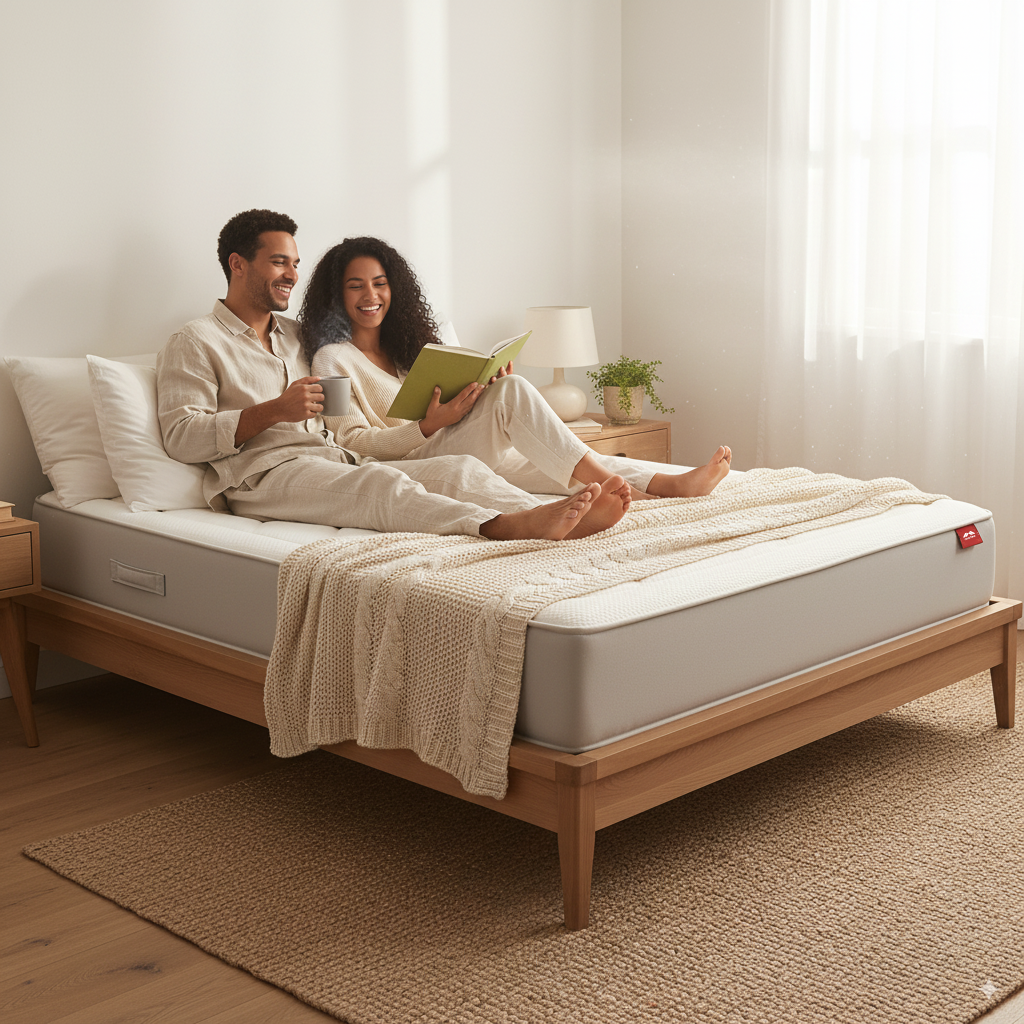

Find the perfect nightstand height for a good night's sleep
You lie down, turn off the light and, just as you are about to fall asleep, you need to grab a glass of water or check the alarm. You reach out your arm. You can't quite reach. You lift your neck a little, twist your torso, grope around in the dark and end up waking up more than you should.
That discomfort seems small, but it repeats every night. And many times it has nothing to do with the mattress or the pillow, but with something almost no one seriously checks: the nightstand height.
When it comes to rest, details matter. If the nightstand is too low, it forces you to lean over. If it is too high, it forces you to raise your shoulder or move your arm unnaturally. Choosing it correctly is not just a style decision. It is a simple way to make the bedroom work in favor of your body.
Why your nightstand height matters more than you think
There is a very common scene at home. One of the two falls asleep first, the other leaves the phone on the nightstand, turns off the lamp and, upon lying down, notices that everything is a little far away or a little high. It doesn't seem serious. But when a gesture repeats every night, the body notices.

The nightstand is a piece of constant use. That is where you leave glasses, a book, water, medication, a charger, or the lamp. That is why its height should not be chosen only by how it matches the headboard. It should be chosen by how you move when you are lying down or sitting on the edge of the bed.
The real problem is not aesthetic
When the nightstand is poorly proportioned, three very common discomforts appear:
- Uncomfortable reach. You have to stretch your arm further or sit up too much.
- Tension in neck and shoulders. Especially when turning off a lamp or picking up the phone.
- Small awakenings. The gesture activates you when you were already relaxing.
That explains why a beautiful bedroom sometimes still ends up being uncomfortable. Ergonomics matters more than decoration when we talk about daily rest.
A good nightstand not only “looks good”. It also allows you to reach what is important without breaking the resting posture.
What usually confuses when buying
Many people buy the nightstand before measuring the entire bed. And that is where the mistake begins. The mattress, the base, the storage bed, and even the bedding change the functional height of the whole. A visually “normal” bed can end up being quite a bit higher than it looks.
If you are renovating the bedroom, it is worth looking at ideas before deciding on the final model. This guide on nightstands for the bedroom can help you visualize styles and uses, but the practical key remains the same: first measure, then choose.
The golden rule for the ideal height of your nightstand
The ruling measure is very simple: the top of the nightstand should be at the same height as the top of the mattress, or a few centimeters below.
That small alignment changes a lot how the body moves at night. If the glass of water, the phone, or the lamp are at hand height, the gesture happens almost automatically. If they are too high or too low, the body compensates with the neck, shoulder, or lumbar area. In a person with back pain, that difference is even more noticeable at the end of the day and during nighttime awakenings.
As a reference, in Spain the most common height of a nightstand is between 55 and 65 cm, but the main idea is above the figure: that the nightstand accompanies the real height of the finished bed, not a standard measure taken separately.
Why this rule works
The explanation is ergonomic. Your arm rests better when it can extend horizontally or with a slight downward movement. That position demands less effort from the shoulder and prevents the neck from jutting forward. It is similar to what happens with a well-placed armrest. If it is where it should be, the body relaxes. If not, compensations begin.
At night, moreover, you move with less precision. You are drowsy, perhaps half-sitting up, and with more relaxed muscles. That is why a small difference in height can feel large in practice.
When the nightstand is well adjusted, this usually happens:
- you reach the objects without straining your shoulder
- you twist your torso less
- you support your arm better
- you interrupt the resting posture less
What happens if the nightstand falls outside that range
A nightstand that is too low forces you to lower your arm more and, very often, to lean your torso or lift your head a little to see better. That gesture seems minor, but repeated every night it adds strain to the lumbar and cervical area.
A nightstand that is too high creates the opposite effect. The forearm goes up, the shoulder tenses, and the nightstand can visually invade the space when you sit on the bed. In tall mattresses, very common today in Spain, this mistake appears quite a bit because a “pretty” nightstand is bought without taking into account that the bed plus mattress set has already gained several centimeters.
| Situation | What you notice when using it | Usual effect |
|---|---|---|
| Nightstand at mattress height | Natural and comfortable reach | Less postural tension |
| Nightstand too low | You lean over or lower your arm more | More lumbar and cervical strain |
| Nightstand too high | You raise your shoulder and forearm | Forced posture and feeling of obstruction |
A useful example with current beds
If your bed, already assembled with base and mattress, ends up near 60 cm, a nightstand in a close range usually works better than a clearly low model. This matters a lot in beds with lift-top storage and thick mattresses, because the final height of the set is usually higher than it looks in the store.
The practical idea is this. Do not buy the nightstand thinking only about the piece of furniture. Choose the height thinking about the path of your arm from the pillow. That is the difference between a nightstand that only decorates and one that also helps you rest.
How to correctly measure the height for your nightstand
This is where many purchases fail. Most people measure only the base or only the mattress. But your body does not interact with separate pieces. It interacts with the finished bed.

The correct way to measure
Do it like this, in order:
-
Prepare the bed as you really use it
Place the mattress, topper if you use one, protector, and usual bedding. If you add a thick layer in winter, take that into account. -
Use a rigid measuring tape
Measure from the floor to the top of the dressed mattress. Do not measure to the box spring or the base. -
Write down the final height
That is the useful figure. From there, look for a nightstand that is at that height or slightly below. -
Check the access sitting and lying down
If you can, simulate the gesture of picking up a glass or turning off the lamp. That practical test clarifies more than any product sheet.
If you are between two measures, the slightly lower option usually works better than a clearly higher one.
Height is not the only thing that matters
Height rules, but width and depth also influence how the space feels. In Spain, a very widespread standard measure is 50 cm wide x 35 cm deep x 65 cm high, designed for beds from 65 to 72 cm and to leave 70 cm of side passage.
That data solves a frequent doubt. Sometimes the nightstand fits in height, but takes up too much space laterally and makes the bedroom feel cramped.
A quick reference to check your bedroom
- If the side passage is tight, a compact nightstand avoids a feeling of being overwhelmed.
- If you use a table lamp, a correct height helps a lamp from 45 to 55 cm illuminate without dazzling while lying down, according to the same guide linked above.
- If you open drawers next to the bed, leave room so they do not hit the structure or other furniture.
| What to measure | Where the measure is taken | What it is for |
|---|---|---|
| Functional height of the bed | From the floor to the top of the dressed mattress | Choose the nightstand height |
| Free side space | From the edge of the bed to the wall or wardrobe | Define the width of the nightstand |
| Useful depth | From the front of the nightstand to the passage area | Avoid obstructing circulation |
Adjustments for beds with storage, high bases, and children's beds
Not all beds require the same solution. The rule remains the same, but its application changes according to the type of base and the daily use of the bedroom.

There are nightstands of very different heights on the market, precisely because beds also are. That is why it is advisable to start from the real height of your bed and not from a standard measure.
Beds with storage or high bases
With a high storage bed, many people think they should “compensate” with a standard nightstand so the bedroom does not look heavy. But if the bed goes up, the nightstand should also go up. The important thing is not to lighten visually at any cost, but not to lose accessibility.
If you are considering this type of base, it is advisable to also review a guide to choosing a storage bed, because the final height of the set changes quite a bit depending on the model.
What usually works better in this case:
- Taller nightstands. Not for fashion, but to keep the support edge close to the mattress.
- Accessible drawers. If the bed is high, opening a drawer that is too low is less comfortable.
- Clear fronts. Discreet handles or finger pulls help avoid bumps when passing.
Low beds or tatami style
The opposite happens here. A conventional nightstand can seem huge next to a low bed. Visually it weighs more and, in real use, forces you to raise your arm excessively.
In these configurations, the following usually works better:
- a low nightstand
- a suspended piece
- a fixed shelf placed at the correct functional height
In low beds, the best choice is usually the one that accompanies the line of the mattress without protruding too much.
Children's beds
In children's bedrooms, the priority changes a little. The child's autonomy matters, but so does safety. It is advisable that the surface is easy to reach from the bed, without aggressive corners or unstable pieces.
Here there is no need to chase a miniature “adult” aesthetic. A simple, stable nightstand that is proportional to the real height of the children's bed works better. If it also has storage, it is better if it is easy to open and close.
Key tips for people with back pain and accommodations
When there is back pain, the nightstand stops being a secondary detail. It becomes a daily aid or a source of repeated discomfort. And in accommodations, the correct choice directly influences the guest's experience.
If you have lumbar or cervical pain
For many people, the problem does not appear when lying down, but when making micro-gestures during the night. Turning to get water, look for glasses, or turn off a light can tense more than it seems.
If you have back pain, a nightstand at mattress height or slightly below avoids forced turns and stretches when picking things up from the bed.
That does not mean that everyone should buy a lower nightstand. It means that, if you have lumbar or cervical discomfort, it is advisable to prioritize a very short reach gesture, without lifting your head or rotating your torso more than necessary.
It can also help you review practical tips on how to relieve back pain when sleeping, because the nightstand influences, but it is part of a broader set.
What to prioritize if there is discomfort
- Clean access to essentials. Water, phone, glasses, or medication should be close to the useful edge.
- Easy-to-operate lamp. Better if it does not force you to sit up.
- Slightly conservative height. For many users with pain, a surface slightly below the mattress is friendlier than one above.
If you suffer from cervical discomfort, try the gesture from the pillow first. If you have to stick your chin forward to reach, the nightstand is not well adjusted.
What matters in hotels and tourist apartments
In accommodations, the key is to choose a height that works for most guests. It is not just about design. It is also about cleaning, durability, and a feeling of care.
In hospitality, a contained height well aligned with the bed usually gives a more intuitive experience to the guest, because everything is where they expect to find it.
An accommodation gains comfort when the nightstand allows you to support a bottle, charge the phone, and operate a lamp without effort. It is a small detail, yes. But the guest notices it the first night.
Frequently asked questions about nightstand height
What happens if my partner and I have beds or mattresses with different heights?
The most practical thing is to treat each side independently. If the real heights do not match, two identical nightstands can look very nice, but one of the two people will use theirs worse. In ergonomics, visual symmetry does not always coincide with comfort.
Do width and depth matter as much as height?
Not as much, but they do matter. Height decides how you reach objects. Width and depth decide if the bedroom breathes well and if what you use every night fits without obstructing the passage.
Does a round nightstand work the same as a square one?
In height, yes. The rule remains the same: the useful surface should be aligned with the mattress or slightly below. The difference is in the use. A round one usually softens the passage and reduces corner bumps, while a square one makes better use of storage.
Is a nightstand with drawers better or a minimalist one?
It depends on your habits. If you store medication, chargers, tissues, or reading material, drawers help maintain visual order. If you only support a lamp and a glass, a light piece may be enough.
What if I already have a nightstand that is not at the correct height?
You have several options. If it is too low, you can change the lamp for a more suitable one while you decide to replace it. If it is too high, it is advisable to consider the change sooner, because the problem affects the reach gesture more. If the difference is small, sometimes it is enough to reorganize what objects you leave on top and which ones you store.
If you are renovating your bedroom and you want the mattress, base, and storage to work together to improve your rest, at Morfeo you will find mattresses, storage beds, and bases made in Spain, so that the height of the bed is the one you are looking for. The best nightstand height starts with a well configured bed.