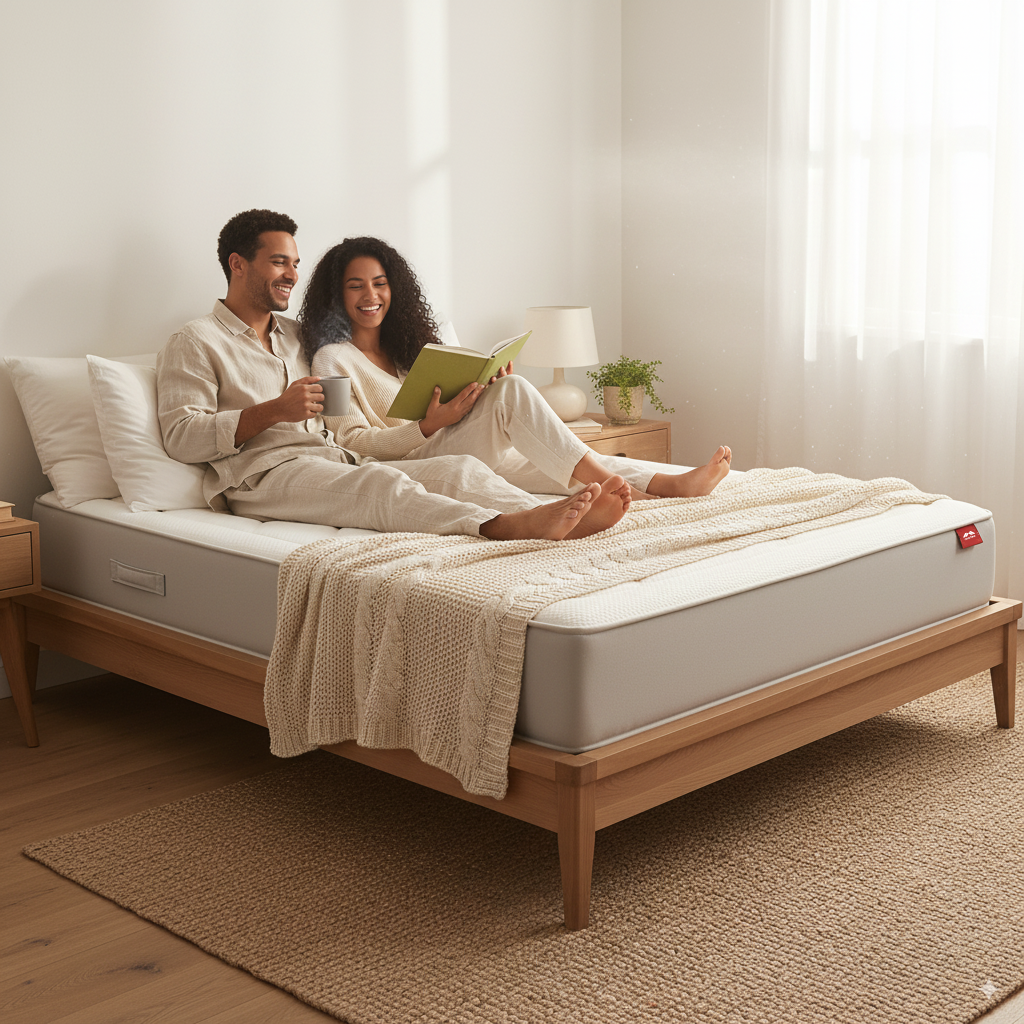

How to Sleep with Lower Back Pain: 3 Positions and the Mattress That Helps
By the Morfeo sleep team, mattress manufacturers in Yecla (Murcia) · Updated in September 2026
Quick answer
To sleep with lower back pain, sleep on your side with a pillow between your knees or on your back with a cushion under your knees, and avoid sleeping on your stomach. Use a medium-firm mattress: it supports the lower back without creating pressure points. If the pain goes down your leg or doesn't improve in 2–3 weeks, consult a professional.
In this guide
If your lower back pain gets worse when you get into bed, it's no coincidence. During the day, your muscles help support your spine; when lying down, that job falls mostly on your posture and the surface you sleep on. A bad combination of the two leaves your lower back arched or twisted for hours, and you feel it in the morning.
The 3 sleeping positions for lower back pain, from best to worst
The goal is the same for all: to keep your spine in its natural curve throughout the night.
On your side, with a pillow between your knees
Bend your knees slightly and place a firm pillow between them. This prevents your top leg from pulling your pelvis out of alignment and twisting your lower back.
On your back, with a cushion under your knees
A cushion or rolled-up towel under your knees relaxes the lower back curve. Keep your head pillow low.
On your stomach
It arches your lower back and forces you to turn your neck for hours. If you can't avoid it, place a thin pillow under your abdomen.
What if I have a herniated disc, osteoarthritis, or a pinched nerve?
The same guidelines are usually a good starting point: on your side with support between your knees or on your back with your knees slightly elevated. But every case is different, and some people with a herniated disc are more comfortable in a specific position. Ask your physical therapist which one is right for you. You can find more details in our guide on how to sleep with a herniated disc.
How to turn over and get out of bed without pain
Many twinges don't appear when you're still, but when you turn over. The trick is to move as a whole, without twisting your torso:
- To turn over: tighten your abdomen slightly, bend your knees, and turn your shoulders, hips, and knees at the same time.
- To get out of bed: turn on your side, lower your legs over the edge of the bed, and push up with your arms until you're sitting.
- To get into bed: sit on the edge, lean on your arm, and raise your legs while lowering your torso to the side.
What if your mattress is the problem?
If you recognize 2 or more, posture alone isn't enough
- You wake up in more pain than when you went to bed
- You can feel a dip where you sleep
- Your mattress is more than 8–10 years old
- You sleep better away from home
Try it at home for 100 nights. If you're not convinced, we'll pick it up.
Which mattress firmness to choose if you have lower back pain
Neither soft nor "hard as a board". A clinical trial conducted in Spain with 313 people with chronic lower back pain found less pain and disability after 90 days with medium-firm mattresses than with very firm mattresses (Kovacs et al., The Lancet, 2003). A very soft mattress lets your pelvis sink and your spine sag like a hammock; one that's too firm puts pressure on your shoulders and hips.
Morfeo mattress firmness scale
The green range is what we recommend for lower back pain: medium-firm as a starting point and firm if you sleep on your back or weigh more, so your pelvis doesn't sink.
The material matters too. Hybrid mattresses combine pocket-sprung systems, which provide support and allow air to circulate, with layers of memory foam that distribute pressure. That's why five of our six mattresses are hybrids, and all are made in our factory in Yecla (Murcia).
Find your mattress in 2 answers
How do you sleep and how much do you weigh?
Usual position
Approximate weight

Medium-firm. It supports the lower back and lets your shoulder and hip settle when you sleep on your side.

Firm. It keeps your pelvis level with the rest of your body so your lower back doesn't arch.

Extra firm and 30 cm high, so the mattress doesn't sag under heavier weight.
Prefer to compare yourself? View all mattresses for back pain
10-minute bedtime routine
- Local heat for 15–20 minutes, if the pain is muscular (a tired, stiff back). If it's a recent injury with inflammation, cold is better.
- Knees to chest: on your back, bring one knee toward your chest and hold for 20–30 seconds. Switch legs. Don't force it.
- Gentle rotation: with knees bent and together, let them fall to one side without lifting your shoulders. 20 seconds per side.
- Get into bed on your side, using the whole-body technique we described above.
If a stretch causes sharp pain, stop. You can find more ideas in exercises to relieve lower back pain.

Medium firmness to keep your neck and spine aligned.
When to consult a professional
No mattress can replace a diagnosis. Make an appointment with your doctor or physical therapist if:
- The pain goes down your leg, especially below the knee.
- You notice tingling, weakness, or numbness in your legs or groin.
- It doesn't improve after 2–3 weeks or gets worse.
- It appears along with unexplained fever or weight loss.
Go to the emergency room if you lose control of your bladder or bowels, or notice numbness in your genital area.
This guide is for informational purposes and does not replace a healthcare professional's assessment.
Frequently asked questions about sleeping with lower back pain
Which mattress is best for lower back pain?
One with medium or medium-firm firmness that supports the lower back without creating pressure points. Hybrids, with pocket springs and memory foam, combine support and adaptability well.
What is the best sleeping position for lower back pain?
On your side with a pillow between your knees. The second best is on your back with a cushion under your knees. Sleeping on your stomach puts the most strain on the lower back.
How to relieve lower back pain in bed?
Switch to one of the two recommended positions, apply heat if the pain is muscular, and do a gentle knees-to-chest stretch. If you wake up in pain, turn over as a whole and walk a few steps before getting back into bed.
Does sleeping on the floor help your back?
For most people, no. A hard surface doesn't let your shoulders and hips settle and creates new pressure points.
How long does it take to adjust to a new mattress?
Usually between 2 and 4 weeks. That's why Morfeo offers 100 nights to try it: if you're not convinced in that time, we'll pick it up. Plus, all our mattresses come with a 10-year warranty.
Mattresses designed to take care of your back
Made in Yecla (Murcia). 100 nights to try and a 10-year warranty.