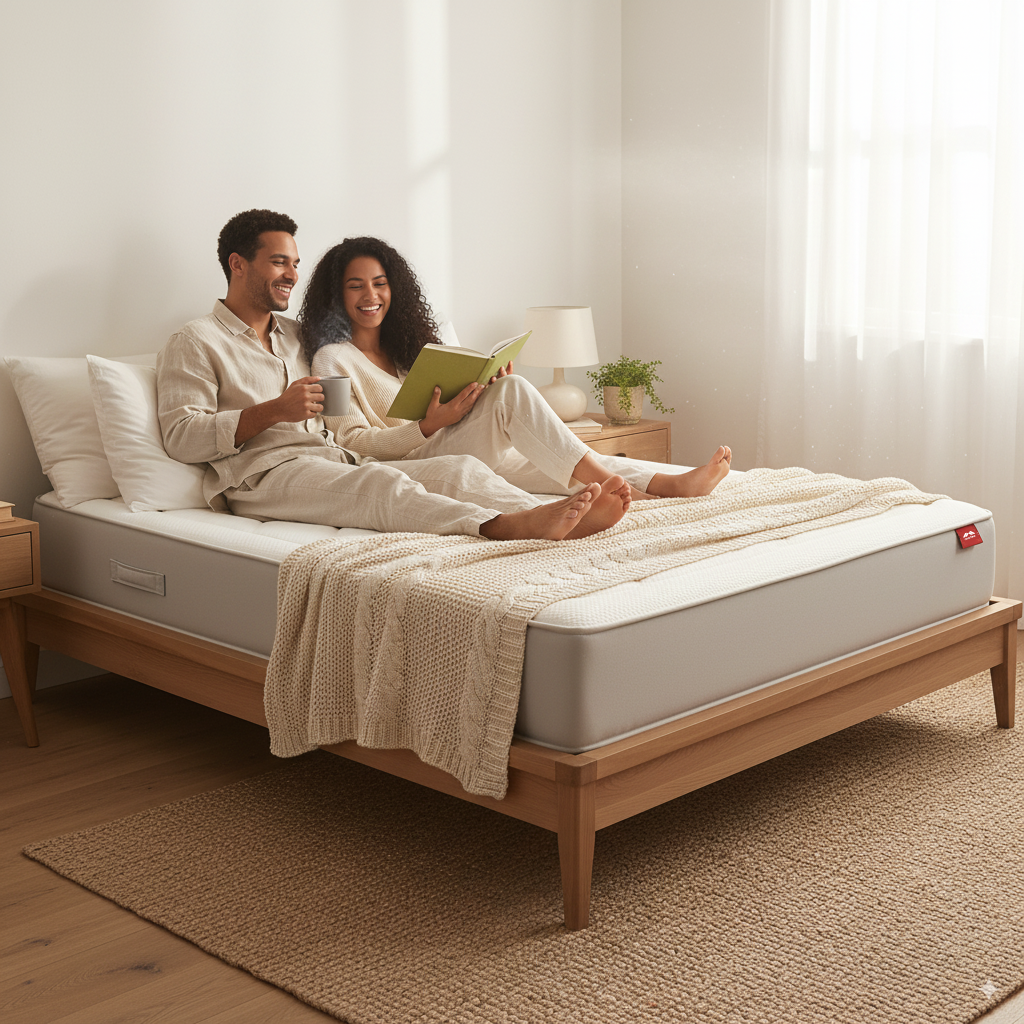

Guide to Stop Sleeping on Your Stomach and Improve Your Rest
Let's be honest: although for many people it is the most comfortable posture that exists, sleeping face down is one of the least recommended by sleep experts. It is one of those habits that seem harmless, but that in reality subject your spine and your neck to significant tension, night after night.
Momentary pleasure or long-term risk?
If you are one of those who can only conceive of falling asleep face down, know that you are not alone. Although most people prefer other postures, many people share this habit.
But why so much debate about this posture? Imagine it this way: would you spend hours and hours during the day with your neck completely turned, looking over your shoulder? Probably not, but that is exactly what you ask your body to do every night when you sleep in this position.
This posture forces your spine to lose its natural alignment. This creates pressure points that, over time, can end up becoming chronic problems. It is not just a matter of comfort, it is a matter of postural health.
To make it better understood, we are going to compare the advantages attributed to it with the disadvantages it really has.
Quick analysis of sleeping face down
Here you have a direct comparison so you can see at a glance why this posture generates so much controversy.
| Advantages (Pros) | Disadvantages (Cons) |
|---|---|
| In some cases it can help reduce snoring. | It causes a very prolonged cervical torsion. |
| It provides a feeling of security or an "embrace". | It flattens the natural curvature of the lumbar area. |
| It is a very ingrained habit and feels familiar. | It can cause neck, shoulder, and back pain. |
| It limits the expansion of the diaphragm and breathing. | |
| It increases the risk of numbness and tingling. | |
| It can contribute to the appearance of facial wrinkles. |
As you can see, the balance clearly tips toward the risks. Although that feeling of immediate comfort is very tempting, the negative consequences that accumulate are too significant to ignore.
This article is not only going to explain the dangers of maintaining this habit. We want to give you a complete and practical guide so you can change it. We will show you everything from how to use pillows strategically to the importance of having a good mattress, helping you make the transition to healthier postures. If you want to get one step ahead, you can check out our guide on what is the best position to sleep.
The real impact on your spine and neck
When you choose to sleep face down, it is not just a matter of preference. Without realizing it, you are forcing your body to spend hours in a posture that, from a biomechanical point of view, is simply incorrect. It is not an opinion, it is pure body physics. And the consequences of that nighttime tension accumulate silently, until one day those pains and discomforts appear that steal your quality of life.
Think of it this way: your spine should be like a straight and well-aligned line when you rest. But by sleeping on your stomach, it is as if you were bending and twisting it at several points. The pressure is no longer distributed evenly, and that puts the health of your back, and especially your neck, at risk.
The forced torsion of the neck
The most obvious and direct problem jumps out: the position of the neck. To be able to breathe, you have no choice but to turn your head almost 90 degrees to one side. And keep it that way for most of the night. This extreme rotation subjects the cervical vertebrae, muscles, and nerves to constant tension for which, simply, they are not prepared.
Imagine you try to watch a movie keeping that same posture on the couch. It would be unbearable, right? Well, doing it for hours while you sleep can cause:
- Neck pain upon waking: That annoying morning stiffness that can accompany you all day.
- Frequent torticollis: The classic "stuck" neck, which is nothing more than the result of an overly long muscle contraction.
- Tension headaches: Headaches that stem from the tension that accumulates in the muscles of the neck and nape.
This image summarizes it perfectly, showing the contrast between the comfort you feel and the real risk to your neck and spine.

As you see in the diagram, a single posture is affecting two of the most delicate areas of our body.
The flattening of your lumbar curvature
But it does not end with the neck. The second major victim is the lower back area. When you lie face down, the pelvis tends to sink into the mattress, especially if it is very soft. This sinking flattens the natural lumbar curve, that soft "S" shape we all have (known as lordosis), and places unnecessary pressure on the intervertebral discs in that area.
Over time, this constant and silent pressure can end up contributing to chronic lower back pain, sciatica problems, or worsening injuries you already had. It is a subtle but persistent wear and tear, night after night. If you already usually have discomfort, it will be good for you to know more about the relationship between rest and neck and back pain.
The spine is designed to function as a system of connected curves that absorb impacts and distribute weight. Sleeping face down breaks this alignment: it forces the lower back to flatten and the neck to turn extremely. A double attack on your postural health.
Less room to breathe
And if that were not enough, there is one last point that we often forget: breathing. By lying on your abdomen, your rib cage and your diaphragm cannot expand freely. This prevents you from performing a deep diaphragmatic breathing, which is essential to properly oxygenate the body and enter the most restorative sleep phases.
This shallower breathing can make your rest less efficient. The result? You get up feeling tired, even if you have slept the required hours. In short, sleeping face down can not only damage your bone and muscle structure, but it can also sabotage the quality of your sleep from the inside.
Why do we insist on sleeping face down?

With all the inconveniences it has for the back and neck, it seems unbelievable that so many people still prefer to sleep face down. If it is so bad, why do we like it so much? The answer has nothing to do with postural logic, but with a mix of psychology, habits we have carried for years, and a feeling of physical comfort that is hard to match.
For many, this posture is more than a simple habit; it is almost an emotional refuge. The soft and constant pressure on the chest and abdomen can create a feeling of security and calm. It is as if you were receiving an embrace that does not stop, something that helps relax the nervous system and facilitates sleep, especially for people who tend toward anxiety.
Furthermore, this preference usually starts in childhood. What starts as a comfortable position for a baby can become such an ingrained sleep pattern that it accompanies us into adulthood, almost like a signature at the time of sleep.
The psychological factor: an embrace you give yourself
That feeling of protection is one of the most powerful reasons. By sleeping face down, we are covering our vital organs, a gesture that the brain instinctively interprets as a safe, defensive posture. This body "shield" is especially comforting after a day of stress or if we feel vulnerable.
This psychological component is so strong that, for many people, trying to change posture causes them a feeling of helplessness or "emptiness" that prevents them from falling asleep. That is why the change is not just a challenge for the body, but also for the mind.
The preference for sleeping face down is often linked to the need for security and comfort. The pressure on the torso simulates an embrace, which can calm anxiety and facilitate sleep, turning a posturally incorrect habit into an emotional tool for rest.
How our posture changes with age and weight
Curiously, this preference is not forever. Factors such as age and changes in our body have a lot to say about how we sleep at night. It seems that, with the years, the body develops a kind of internal wisdom to find the posture that suits it best.
In fact, the tendency to sleep face down usually decreases with age. The body instinctively seeks the side position, which distributes pressure better over the spine and usually facilitates breathing.
As we get older, or if our weight changes, the body tends to "choose" the side position more naturally and frequently.
Special situations: pregnancy and other conditions
There are times when sleeping face down goes from being a bad idea to being totally contraindicated. The clearest case is pregnancy, especially from the second trimester onward.
At this stage, the pressure on the abdomen is not only uncomfortable, but it also ends up making the posture unfeasible. The usual thing is to switch to sleeping on your side, and in the third trimester, pregnancy monitoring guidelines advise it (many midwives suggest the left side). In case of any doubt, consult your midwife or gynecologist.
There are other situations in which it is better to avoid this posture:
- After certain surgeries: After chest surgery or abdominal surgery, it is crucial not to apply pressure to the area so that healing is correct.
- Chronic respiratory problems: People with sleep apnea or asthma may notice that their symptoms worsen, since this posture restricts the movement of the diaphragm.
- Chronic back or neck pain: If you already suffer from herniated discs or cervicalgia, sleeping face down will only add more tension and pain to the equation.
Practical strategies to change your sleeping posture
Giving up a habit as deeply rooted in us as sleeping face down is not achieved with willpower alone. You need a good plan. Changing the way you sleep is like retraining your body, and the key is not to suffer, but that the transition is so comfortable that your body accepts it without issue.
The goal is to switch to the side posture, which is the one experts recommend most to keep the spine well-aligned. Fortunately, there are several strategies you can start trying this very night to achieve it little by little.
Try the pillow barrier method
One of the simplest ways to prevent you from turning around without realizing it and ending up in your usual posture is to create physical barriers. Think of pillows as your allies to guide your body toward a new position almost without you realizing it.
You can try it with these options:
- The body pillow: It is that very long pillow you can hug. By putting it in front of you, it gives you that feeling of support on the chest that you seek when sleeping face down, but at the same time it prevents you from turning over completely.
- Several pillows: If you do not have a body pillow, you can achieve a similar effect by placing several large pillows behind your back and another one in front. This pillow "fortress" will keep you gently snug in the side posture.
The idea of these barriers is not that you feel trapped, but that the gesture of putting yourself face down is uncomfortable or directly impossible. Thus, your body is forced to stay on its side.
Make sleeping on your side irresistibly comfortable
Many people do not want to sleep on their side because it is uncomfortable, but that usually happens because they are not doing it right. For sleeping on your side to be truly restorative, you need to give good support to the key points of your body.
For the posture change to work, the new position must be more comfortable than the previous one. Placing a pillow between the knees aligns the hips and the spine, and hugging another pillow can replicate the feeling of security you seek when sleeping face down.
These are the small adjustments that make a big difference:
- Pillow between the knees: It is a simple gesture with a huge impact. If you put a pillow between your knees (with your legs slightly bent), you prevent the top leg from falling forward. This keeps the pelvis and the lumbar area perfectly aligned and without tension.
- Pillow to hug: As we said, a pillow to hug does not only act as a barrier. It also gives support to the arm and the shoulder that remain on top, preventing you from hunching over. Furthermore, it recreates that very pleasant pressure on the chest that is so liked by those who sleep face down.
If you are interested in delving deeper into this topic, we have a very complete article on how to gradually change the way you sleep effectively and without drama.
The classic tennis ball trick
Although it sounds a bit like an old wives' remedy, the tennis ball technique is a classic method that works through what is called aversive conditioning. The idea is very simple: you sew or tape a tennis ball to the front of your pajamas.
When you try to turn over at night to put yourself face down, the uncomfortable pressure of the ball will bother you just enough so that, instinctively, you put yourself back on your side. Over time, your brain will associate sleeping face down with that discomfort and stop trying.
This method is more direct and can be somewhat annoying at first, but it is very effective for breaking the habit in people who have a lot of difficulty with the change. The ideal is to combine it with the other comfort strategies, so that sleeping on your side is always the most appealing option for your body.
Choose your mattress and pillow for a better posture
Your mattress and your pillow can be your great allies or your worst enemies if you are trying to stop sleeping face down. It is not just a matter of willpower; if your bed does not accompany you in the process, the transition will be uphill for you and you could even aggravate the back and neck discomforts.
We are going to see how to choose the perfect sleep equipment so that your body finds, naturally, a healthier posture while you sleep.

Imagine that your mattress is the foundation of your rest. If that foundation is unstable or inadequate, everything you build on top will suffer. That is why getting the mattress right is the first step, and the most important, to correct your posture and achieve a sleep that truly recharges your batteries.
The firmness of the mattress: the key to an aligned spine
A mattress that is too soft is a trap for anyone who sleeps face down or tries to stop doing so. By being so plush, the heaviest part of your body —the pelvis— sinks without remedy. That sinking creates a forced arch in the lumbar area, as if you were sleeping in a hammock, and the tension in the lower back is served.
On the other end, a mattress hard as a board generates very uncomfortable pressure points on the shoulders and hips, which forces you to move constantly and makes it difficult for your muscles to relax.
The solution is in the middle: a mattress of medium-high firmness. This type of mattress gives you the support you need to keep the spine straight, but at the same time it is adaptable enough to accommodate the natural curves of the body without creating pressure. Morfeo mattresses, in fact, are designed with this idea in mind, seeking an ergonomic support that distributes the weight evenly, something fundamental to relieve tension while you retrain your posture.
The pillow: the fine adjustment for your neck
The pillow is just as important, but its choice depends entirely on your current posture and your goal. It is not the same to look for a pillow if you still sleep face down as if you have already managed to switch to the side.
-
If you still sleep on your stomach: In this case, it is best to use a very low and soft pillow, such as the Calma Pillow (the lowest of Morfeo), or none at all. The goal is simple: minimize neck torsion. A high pillow would only force your neck into an unnatural and highly damaging angle.
-
If you already sleep on your side (your new goal!): Here the story changes completely. You need a pillow with just the right height and firmness to fill the gap between your ear and your shoulder. If it is too low, your head will drop; if it is too high, your neck will bend upwards. In both cases, goodbye to alignment.
Think of the side-sleeping pillow as perfect support that keeps your head and neck in line with the rest of your spine. It is one of the best ways to avoid waking up with a stiff neck.
To make the transition more comfortable, choose a high pillow designed for side sleeping, such as the AirHigh Pillow (18 cm), which fills the gap between your shoulder and neck. Its special shape offers better support and helps the posture feel more natural from day one.
Sleep equipment guide for your transition
Choosing well can seem confusing, but don't worry. We have prepared this table so you can clearly see what you need at each stage.
| Sleeping position | Recommended mattress firmness | Pillow type and height |
|---|---|---|
| On your stomach (to be avoided) | Medium-firm to prevent the pelvis from sinking. | Very low and soft, or none at all, to avoid straining the neck. |
| On your side (recommended) | Medium or medium-firm with good adaptability. | Medium-high, filling the space between your ear and shoulder. |
| On your back | Medium-firm for proper lumbar support. | Thin or medium height, so it does not raise the head too much. |
| Transition (semi-prone) | Medium-firm to maintain overall alignment. | A thin pillow for the head and another to hug and provide support. |
Investing in good sleep equipment, such as Morfeo's pillows and mattresses, is not a luxury: it will make it easier to leave bad habits behind and rest more comfortably every night.
Morfeo's recommendation
If you sleep on your stomach, a high pillow is your worst enemy
When sleeping on your stomach, your neck is already turned ninety degrees. If the pillow raises your head on top of that, your cervical spine works under strain all night. What you need is the opposite: low height and a soft feel that gives way.


100-night mattress trial · Pillows in 3-4 business days · Made in Spain
We answer your questions about sleeping posture
We know that changing a habit as personal as your sleeping posture can raise many questions. That is normal. That is why we have gathered here the most common questions we receive from people who, like you, are thinking about stopping sleeping on their stomach. We will answer them clearly and simply so you can take the step with complete confidence.
Is it true that sleeping on your stomach causes wrinkles?
Yes, it is not a myth. It is one of the most direct and proven aesthetic effects. Think about how your face presses against the pillow for hours every night. That constant compression can end up forming so-called "sleep wrinkles". Unlike those caused by facial expressions, these are vertical lines that appear on the forehead or cheeks simply from the skin being flattened.
But that is not all. This posture prevents the skin on your face from breathing properly. When it is pressed against the fabric, oils, sweat, and bacteria accumulate, which can complicate problems such as acne. Although back health is the most important thing, the aesthetic factor is another good reason to make the change.
If it does not hurt me, should I still be concerned?
The short answer is: yes, without a doubt. Not feeling pain today does not mean your body is not suffering. The effects of a bad sleeping posture are cumulative, a constant drip that gradually wears down your spine.
Every time you sleep with your neck turned and your lower back arched, you subject your neck and back to strain that is repeated night after night. Over time, this can lead to discomforts such as:
- Neck stiffness or pain upon waking
- Discomfort in the lower back
If the pain persists, consult your doctor or physical therapist.
Changing your posture now is one of the best things you can do for your long-term back health. Do not wait until pain comes knocking before you take action.
The absence of pain does not mean there is no damage. The effects of sleeping on your stomach accumulate over time. Changing your posture is a preventive investment in your spinal health, avoiding problems that can take years to manifest.
I have heard of the semi-prone posture; is it a good alternative?
It is a fantastic strategy! The semi-prone posture, which some call "the runner's posture," is the perfect intermediate step if you find it extremely difficult to go from sleeping on your stomach directly to sleeping on your side.
Imagine it: you lie down almost on your side, but let your top leg and arm fall forward, as if you were about to start crawling. This hybrid position gives you the best of both worlds.
- It greatly reduces neck torsion: Your head is no longer turned 90 degrees.
- It relieves pressure on your lower back: Your pelvis becomes much better aligned.
- It maintains the feeling of contact: You still feel that pressure on your chest that gives many people a sense of security.
To do it properly, use a low pillow for your head and hug another large pillow with the arm and leg that remain on top. It is a very comfortable way to retrain your body without making the change too abrupt.
Is there any case in which it is good to sleep on your stomach?
If we are talking about nighttime rest for most people, the answer is a resounding no. The risks to the back and neck are too high for it to be worth it.
Now, there are very specific medical situations, always under professional supervision, where this posture is used. For example, in ICUs, patients with severe respiratory problems are placed on their stomachs because it helps improve oxygenation.
It is also recommended in pediatrics to place babies on their stomachs, but only for short periods, while awake and always supervised. This helps them strengthen their neck muscles and release gas (the famous tummy time). What should never, ever be done is leaving a baby sleeping in that position due to the risk of sudden infant death.
Except in these very specific clinical cases, for a healthy adult, the drawbacks of sleeping on your stomach are too significant to maintain it as a habit.
With the right information and the right tools, such as good sleep equipment, leaving this habit behind is within your reach. At Morfeo, we manufacture mattresses and pillows in Spain to help you find the comfort you need. Discover Morfeo mattresses and try them at home for 100 nights.