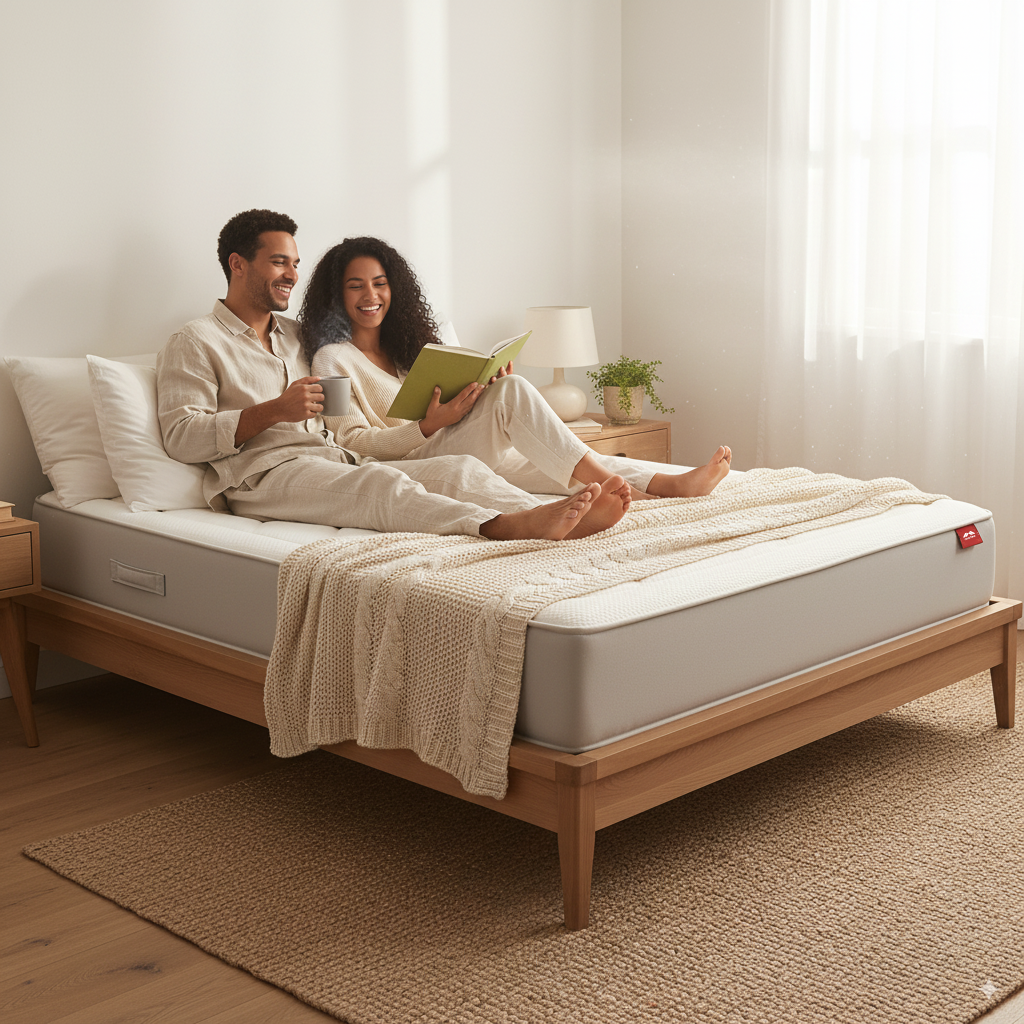

The best mattress for hip pain: sleep without discomfort
You wake up, put your foot on the floor, and feel that twinge in your hip that has become all too familiar. It might ease during the day, but it returns at night. You switch sides, cross one leg over the other, drag the pillow, and try sleeping on your back. Nothing seems to fit.
Many people experience the same thing. They look for a mattress for hip pain thinking that everything depends on buying “the right model,” when in fact, rest works more like a complete system. The mattress matters a lot, yes, but posture, the pillow, and the way your body distributes weight over hours also play a role.
At Morfeo, we explain it like this. The mattress is the foundation of the house, not the entire house. If the foundation fails, everything gets out of alignment. But if the foundation is good and the rest of the system is poorly assembled, the problem won't completely disappear either.
Why a good mattress is key
The hip is one of the areas that suffers most when sleeping, especially if you sleep on your side. In that position, a specific part of the body bears a lot of weight for several hours in a row. If the mattress doesn't accommodate that pressure, the tissue is compressed, the pelvis becomes unbalanced, and the back tries to compensate.
The result is usually felt upon waking. Stiffness, pain on one side, the feeling of having slept “crooked,” or the need to change positions several times during the night. Sometimes the problem seems to come from the hip, but in reality, it starts with poor alignment between the shoulders, pelvis, and spine.
The mattress doesn't work alone
Thinking only about firmness leads to many mistakes. A very firm mattress may seem like a logical solution if there is pain, but it doesn't always help. One that is too soft doesn't either. What the hip needs is a balance between comfort and support.
A good night's sleep doesn't consist of sinking or floating rigidly on top of the mattress. It consists of the body remaining stable and aligned.
That is why, when we talk about a good mattress for hip pain, we are not just talking about materials. We are talking about how the mattress responds to your weight, whether it allows the hip to settle without falling, and whether the pillow completes that alignment or breaks it.
What you will notice when the system works
There are very clear signs that your rest is improving:
- Less pressure when lying on your side. The hip stops being the point that “digs in.”
- Fewer nighttime turns. The body moves less when it finds stable support.
- A better feeling when you get up. Everything doesn't disappear by magic, but waking up is usually gentler.
- More body symmetry. You notice less tension accumulated on one side.
That is the useful approach. Not looking for a miracle product, but understanding how to create a rest environment that truly helps.
Understanding the origin of nighttime hip pain
Nighttime hip pain usually worsens for a very specific reason. You spend hours in a row with the same area bearing pressure, and if the body is poorly positioned, that pressure is not distributed well.
The hip is in a central position within rest. It connects the legs, pelvis, and spine. If during the night it is too sunken or too high, the surrounding muscles and tissues spend hours trying to compensate for that bad posture. That is why sometimes the pain seems to be “in the hip,” but in reality, the pelvis, lumbar area, and even how you rest your head on the pillow also play a role.

What happens if the mattress is too firm
When sleeping on your side, the body does not rest in a straight line. The shoulder and hip protrude more. If the mattress is very hard, those areas cannot sink into the surface a little and receive almost all the load.
The result is similar to lying on a surface that pushes back instead of adapting. The hip is compressed, the waist loses support, and the spine tends to deviate. The body responds with small changes in posture during the night. Sometimes you don't even remember them, but they interrupt your rest.
What happens if the mattress is too soft
A soft mattress can feel pleasant at first because it reduces immediate pressure. The problem appears after a while. The pelvis sinks lower than it should and drags the posture of the rest of the body.
Here it is useful to separate two ideas that many people mix up. Softness is not the same as support. A surface can feel cozy to the touch and, even so, support well. It can also seem comfortable when you lie down and fail after an hour on top of it. In that case, the hip rotates, the spine curves, and the tissues work all night to stabilize you.
Practical rule: if you feel relief when lying down but get up with more stiffness or pain concentrated on one side, the problem is usually in how the support is distributed, not just in firmness.
Why the pain is felt more at night
During the day you move constantly. You walk, change positions, sit down, and get up. That movement distributes loads and prevents the same structure from bearing tension for so long.
At night the opposite happens. If you sleep on the painful side, the pressure is maintained. If you sleep on the opposite side but the pelvis remains twisted, the joint can also become irritated. And if the pillow is too high or too low, the entire spine loses alignment, which changes the way the hip rests. That is why it is not enough to look only at the mattress. You have to understand the complete rest system.
How to know if your mattress is part of the problem
These signs usually point to a nighttime support problem:
- The pain is worse upon waking and improves when you start moving.
- It bothers you more on the side you sleep on or changes when you switch sides.
- You feel very localized pressure on the outer part of the hip.
- You wake up to reposition yourself several times, even if you don't always remember it clearly.
- You notice tension in a chain, from the hip toward the lumbar area or the shoulder.
If you recognize yourself in several of these situations, it is worth reviewing the whole set: mattress, pillow, and sleeping posture. The hip rarely complains in isolation. Many times it is warning you that the entire body is not finding a stable base to rest.
Features of an ideal mattress for the hip
A good mattress for the hip works as a well-calibrated base. It must give in the points where the body protrudes and hold where stability is needed. If one of those two things fails, the pelvis loses its natural position and the pressure concentrates right where it bothers most when sleeping.

Medium firmness so the hip does not collide or sink
The ideal firmness is usually at an intermediate point. If the mattress is too hard, the outer part of the hip receives too much pressure. If it is too soft, the pelvis sinks lower than it should and drags the lumbar area.
The easiest way to understand it is to think of a road. If there is a pothole, the car falls. If there is a hard bump, it hits. The hip needs a surface more like regular asphalt. There is support, but without impact.
That is why, for many people with nighttime hip pain, a medium firmness sensation with good surface adaptation usually works better, like that of the Nature Mattress from Morfeo.
Comfort layer that distributes weight
The top layer matters a lot because it is the first one to receive the body's pressure. When that layer adapts well, the weight stops concentrating on a small point and is distributed over a larger surface. That reduces the feeling of a “nail” or hard contact on the side of the hip.
Memory foam and latex usually fulfill that function well if they are well integrated into the whole. If you want to better understand how this material responds, here you can read a guide on what a memory foam mattress is.
The important thing is not just that the mattress is soft to the touch. The important thing is that that initial comfort does not break the deep support.
Zoned support to keep the pelvis in line
The hip does not rest alone. It works as a team with the shoulders, waist, and spine. That is why a uniform mattress sometimes feels comfortable at first and problematic after several hours.
Zoned support gives different responses depending on the area of the body. The shoulder and hip area can allow a little more adaptation, while the central part maintains a more stable base. That combination helps the pelvis remain aligned instead of twisted, elevated, or sunken.
In Morfeo's hybrid mattresses, that role is played by pocketed springs: each one works independently, so they give more under the shoulder and hip and continue to support the waist.
Adaptation with stability, not a pit effect
There are mattresses that relieve pressure at first but create a feeling of being trapped as the night goes on. That can make changing positions harder, something inconvenient if there is already sensitivity in the hip.
It is worth looking for progressive comfort. The body feels comfort on the surface, but continues to find a firm base underneath. That combination usually gives better results than a very rigid mattress or an excessively enveloping one.
A simple detail helps detect it. When lying on your side, the hip should feel cradled, not buried.
Breathability to avoid micro-awakenings and more changes in posture
Heat is usually not the origin of hip pain, but it can make the night worse. If the mattress accumulates temperature, sleep becomes more restless and more changes in posture appear. Each readjustment adds friction to an already sensitive joint.
That is why it is worth considering materials and constructions that ventilate well, especially if you sleep with memory foam or tend to get hot.
What is worth checking before choosing
Look at these four signs:
- The hip adapts without sinking excessively.
- The waist and pelvis remain aligned when lying on your side.
- The surface distributes pressure and does not leave a hard point.
- The mattress allows you to move easily during the night.
Here appears the idea that many guides overlook. The mattress is the foundation, but the real improvement usually comes when that foundation works well with the pillow and your usual sleeping posture. The hip rests better when the entire system supports it, not just a layer of the mattress.
Mattresses for those who sleep on their side
So the hip can rest without digging in or sinking
Medium or medium-high firmness on pocketed springs: they give under the shoulder and hip and support the waist. Complete the support with a high pillow for the neck.
 Nature Mattress
Medium firmness, with natural latex and organic cotton on pocketed springs: elastic comfort for the hip without a pit effect.
View the Nature Altus Mattress
Medium-high firmness on more than 2,000 pocketed micro-springs, with linen fabric: one more point of support for the pelvis.
View the Altus AirHigh Pillow
18 cm, the tallest in the range: fills the gap between the shoulder and neck so the spine does not twist when sleeping on your side.
View the AirHighIt is not a treatment: if hip pain persists, consult your doctor or physical therapist.
100-night trial on mattresses · 10-year warranty · free shipping in the peninsula · made in Spain
Technology comparison: memory foam, hybrids, springs, and latex
Not all mattresses respond the same when the main problem is pressure on the hip. Two models may seem comfortable in a quick test and, yet, behave very differently after several hours of sleep.
The key is how each technology combines three things. Pressure relief, spine support, and stability as the night goes on.
Quick comparison table
| Technology | Pressure relief | Spine support | Ideal for hip pain |
|---|---|---|---|
| Memory foam | Very good when the top layer adapts well | Good if the base prevents sinking | Yes, especially with zoned support |
| Hybrids | Good or very good depending on comfort layers | Very good due to the combined structure | Yes, it is usually a balanced option |
| Traditional springs | More limited if there is little padding | Variable | Less recommended if it creates pressure points |
| Latex | Good, with a more elastic feel | Good and stable | Can work if the comfort is sufficient |
Memory foam: when the priority is to relieve the hip
Memory foam stands out for its ability to adapt to the body's contour. That usually benefits those who notice pain from localized pressure, because the surface distributes contact better and avoids that feeling of “hitting” the mattress.
A high foam density maintains support better with use, and memory foam mattresses with zoned support help distribute pressure on the hip. In the Morfeo range, support is guaranteed up to 95 kg per person; above that weight, the indicated model is the Morfeo XL Mattress, of reinforced high firmness.
That does not mean that any memory foam will do. If the base is weak or the sensation is too soft, the pelvis can end up sinking lower than it should.
Hybrids: when you are looking for balance
Hybrid mattresses mix foam layers with a spring base, normally pocketed. They are usually liked by those who want adaptability on the top but prefer a more dynamic feel than that of a very enveloping foam.
For hip pain, this combination can work well because it combines two useful behaviors. The foam helps relieve pressure and the lower structure supports the pelvis with more firmness. If there are also differentiated zones, the result is usually more precise.
To understand the practical differences between both constructions, this comparison on memory foam or pocketed springs mattress clarifies very well what changes in feel and support.
Traditional springs and latex
Traditional springs can fall short for this problem if they do not have a well-designed padding. They convey a feeling of bounce or less uniform support points to many people, something not very friendly with a sensitive hip.
Latex, on the other hand, offers an elastic and stable welcome. It doesn't embrace you like memory foam, but it can be very comfortable if you are looking for adaptability with a slightly livelier response. It usually fits people who do not like the feeling of sinking.
If your pain appears due to localized pressure, the priority is usually how the top layer adapts. If it appears due to sinking and twisting, the solidity of the deep support matters more.
The final decision does not depend only on the material. It depends on how the whole thing is built.
Posture and accessories: the complete rest system
Here is the point that many guides overlook. You can buy an excellent mattress and still wake up with a strained hip if your nighttime posture continues to strain the pelvis. Rest improves when the mattress, pillow, and position work together.

Sleeping on your side, yes, but well aligned
Sleeping on your side is not the problem itself. The problem appears when the upper leg falls forward, the pelvis rotates, and the hip "pulls" the lumbar area. That small torsion maintained for hours takes its toll.
That is why it is usually recommended to combine a suitable mattress with the correct position: on your side with a pillow between your knees. That pillow must be high enough so that the top leg is at the level of the hip and the pelvis does not rotate.
The pillow between your legs is not a minor detail
Many people place a small cushion only between their knees. Sometimes it helps, but sometimes it falls short. If the pillow does not properly support the entire leg, the hip continues to turn.
What we are looking for is for the upper leg to rest in a neutral position, without dragging the pelvis forward. That is why a more consistent and sufficiently high pillow usually works better.
- If you sleep on your side almost all night. Prioritize a stable pillow, not a cushion that quickly flattens.
- If your mattress gives quite a bit. You may prefer less height, because your body already sinks more.
- If you are tall or have long legs. A longer pillow usually works better to properly support the entire length.
To delve deeper into this specific solution, you can check this guide on using a pillow between your legs while sleeping.
Here you have a visual resource with examples of placement and posture:
Postures that usually help more
The most comfortable posture for many people with hip pain is being well supported on their side. Within that position, the fetal position can also be a useful option, with the knees directed toward the chest to open the joint and relieve pressure.
It is advisable to avoid sleeping on your stomach if you already notice tension in your hip and lumbar area. That posture usually strains the pelvis and complicates natural alignment.
Do not think of the pillow as a decorative accessory. Think of it as an alignment wedge.
If you cannot change your mattress yet
Sometimes the current mattress cannot be replaced immediately. In that case, an adaptable topper can serve as a temporary measure if the main problem is excessive surface hardness. It does not correct a sunken base, but it can soften the initial pressure on the hip.
If the problem is a worn-out mattress or one with clear deformation in the central area, the topper usually does not solve the real cause. It only masks the sensation for a while.
Guide to testing your new mattress at home
Testing a mattress for a few minutes in a store says very little about how it will respond after several nights. The real test happens at home, in your usual posture and with your normal routine. That is where you should observe methodically, not impulsively.
At Morfeo, the 100-night trial allows you to make that evaluation calmly. The best way to make the most of it is to treat the process as a small personal experiment.
First adaptation phase
The first few days can be strange even when the mattress fits. Your body is used to another support, sometimes for years, and needs to readjust tensions. Judging the result on the first night usually leads to hasty conclusions.
During that phase, pay attention to concrete sensations:
- How your hip feels in the morning. Not only if it hurts, but if there is less stiffness.
- How much you move. If you need to reposition yourself less, it is a good sign.
- How your pelvis feels when you lie on your side. It should feel stable, not strained.
How to record changes without getting confused
You do not need a clinical sheet. A brief note every morning for several days is enough.
You can assess simple issues like these:
- Pain when getting up
- Ease of finding a posture
- Number of awakenings due to discomfort
- General feeling of rest
What signs indicate you are on the right track
Do not look for immediate perfection. Look for a trend. If after several nights you notice less pressure when supporting your hip, less need to turn over, and a more natural posture, the mattress is probably working in your favor.
If, on the contrary, you feel that you always fall toward the center, that your pelvis rotates, or that the pain intensifies night after night, it is advisable to review the complete combination. Sometimes it is not just the mattress that fails. The pillow or posture can also be influencing.
The useful test does not answer “Do I like it?” but “Does my body rest better here than before?”
Frequently asked questions about mattresses and hip pain
How long does it take for the body to get used to a new mattress?
Usually, you need between 2 and 4 weeks to clearly notice if the change really helps you. The first night says little. Your body takes time to memorize a form of support, just like a door that has been misaligned for years and needs several adjustments to close properly.
Where you come from also influences. If your previous mattress was sunken or very hard, the difference is more noticeable and the adaptation can be more evident during the first few days. If, on the other hand, the change is small, the sensation is usually more gradual.
There is a useful clue. If morning stiffness decreases as the days go by, you settle in sooner when lying down, and you wake up less due to pressure on the hip, the rest system is heading in the right direction.
If the pain remains the same, when is it advisable to consult a professional?
It is advisable to consult if the pain does not change after several weeks, if it worsens night after night, or if it no longer appears only when sleeping. When it bothers you while walking, climbing stairs, sitting, or getting up from a chair, the problem may go beyond the surface of rest.
There is a common confusion here. A mattress does not correct bursitis, osteoarthritis, tendon inflammation, or lower back pain that reflects in the hip. It can reduce load and improve posture while you sleep, but it does not replace a medical or physical therapy assessment.
Seek help sooner if the pain always wakes you up at the same point, if you notice tingling, loss of strength, or pain that goes down your leg. Those signs deserve professional review.
Can a topper replace a new mattress?
Sometimes yes, but only in one specific case. It works when the mattress still maintains a stable base and the problem is in the surface layer, for example if you notice too much pressure when supporting the side of the hip.
A topper acts as a cushioning layer. It can distribute weight better and soften contact, just as a comfortable insole improves your step but does not fix a crooked shoe. If the mattress is worn out, creates a valley in the center, or lets the pelvis sink, the topper does not correct that mechanics.
That is why it is advisable to ask yourself two questions before buying it. Does the surface bother you, but the mattress remains firm and uniform? Or is the whole thing already noticeably unstable? In the first case, it can make sense. In the second, it is usually a short-lived patch.
What posture is usually more recommended?
Sleeping on your side usually works well if the hip remains aligned with the pelvis and the spine does not twist. The key is not just the posture. It is how the mattress and pillow support it.
This is where the approach that many overlook comes in. The hip rests better when the whole system works together. The mattress must give enough to welcome the shoulder and hip, the pillow must fill the space between the neck and the mattress, and a pillow between the knees can prevent the upper leg from dragging the pelvis forward.
Sleeping on your back can also provide relief in some cases, especially if you place a pillow under your knees to unload the lumbar area and reduce tension in the pelvis. Sleeping on your stomach usually causes more problems because it forces you to turn your neck and hip for hours.
Can a pillow influence hip pain?
Yes, more than it seems. If the pillow is too high or too low, the spine stops being in line and that torsion goes down to the pelvis. The result is similar to supporting a table on uneven ground. Although the leg you see is the hip, the imbalance starts above.
That is why choosing a good mattress is not enough. If you sleep on your side, the pillow must fill the gap between the shoulder and neck without pushing the head up or letting it fall.
How to know if the mattress fails or if the whole set fails?
There is a simple test. If the pain changes a lot depending on the posture, improves by placing a pillow between your legs, or you notice relief by adjusting the cervical pillow, it is not always just the mattress that fails. Many times the problem is in the combination.
When the mattress is the main culprit, more constant signs usually appear. Sinking in the central area, the sensation of falling to one side, very localized pressure, or difficulty maintaining the pelvis stable even if you change the accessory.
If you are looking for a mattress for hip pain with an ergonomic approach, try a model that combines support, adaptability, and real adaptation time at home. At Morfeo, you can find pocket-sprung mattresses with medium to high firmness, made in Spain, along with 100 nights of trial, to calmly check how your body responds in your own bedroom.