
Best Posture for Lower Back Pain: A Practical 2026 Guide
The worst advice for lower back pain is the most common: “sit up straight” or “sleep on your side and that’s it.” That sounds good, but it oversimplifies a problem that depends on when it hurts, what posture makes it worse, and how long you’ve been motionless. The best posture for lower back pain is not a magic posture; it is a combination of support, neutrality, and frequent changes.
Why there is no single perfect posture
The spine tolerates immobility poorly, even if the posture seems “correct.” Spanish clinical guidelines insist on something more useful than pursuing a perfect posture: maintain the greatest tolerable activity during the day and avoid staying in the same position for too long, without resorting to bed rest (Clinical Practice Guideline on lower back pain from the Basque Country). The conclusion completely changes the way we understand lower back pain: what matters is not just how you position yourself, but also how long you hold that position.

The posture that protects the most is the one that distributes the load
Nachemson’s classic biomechanics make it quite clear. Standing relaxed is taken as the reference at 100%, sitting without back support increases to 140%, sitting leaning forward can reach 185%, and sitting with good lumbar support drops to 90-110% (lumbar ergonomics and pain when working seated). That does not mean you have to stay stiff or seek artificial rigidity. It means that lumbar support and a slight recline protect more than sitting “completely straight”.
Practical rule: if a posture forces you to hold yourself with tension, it is already losing. The best posture is the one that lets you breathe, support yourself, and change without pain.
That idea fits with what applied ergonomics recommends. People get worse not because of an isolated posture, but by adding hours of sustained load on the same tissues. That is why it is better to think about postural variability than an ideal pose.
What you should take away from this today
If you have lower back pain, do not chase the “perfectly straight.” Look for a neutral, comfortable position supported by real support, and change before the lower back area complains. Sitting, lying down, or standing for a while can be fine, but staying still for too long is usually the real enemy. If you obsess over a fixed posture, you will be too late.
To fine-tune that posture in bed or on the sofa, it is also worth reviewing how to position your back for sleeping without loading the lower back according to your specific case.
Sleeping postures that relieve lower back pain
Sleeping with lower back pain does not consist of copying the “correct” posture from a photo. What matters is something else: that the spine remains aligned, that the pelvis does not rotate, and that the lower back does not spend hours under tension. That is why the two options that best fit the clinical recommendations are lying on your back with a pillow under your knees and lying on your side with a pillow between your legs, as mentioned earlier in the Clinical Practice Guideline on lower back pain from the Basque Country.

If the pain worsens when extending the back
Start by sleeping on your back. Place a pillow under your knees to unload the lower back and prevent the lower back from arching too much. Recent evidence from a systematic review on sleep posture and lower back pain found that the supine position promotes spinal alignment and is associated with less lower back pain, while sleeping on your stomach adds load to the lower back.
If you still feel uncomfortable when lying on your back, adjust the height of the head pillow until your neck and torso are aligned; lying on your back usually requires a medium height, such as that of the SojaVisco Pillow (13 cm). Also keep your knees slightly elevated. The goal is not to stay rigid, but to reduce lumbar lordosis without losing a neutral posture.
If the pain improves when flexing or you feel better on your side
In that scenario, the side posture with support usually works better. Bend your legs slightly and place a pillow between them so the pelvis does not rotate. That alignment matches what is described in a study in SciELO, where the side posture appeared frequently in students with lower back pain and the supine position showed lower incidence.
Do not sleep on your stomach if you have lower back pain. That posture forces you to turn your neck and usually increases the load on the lower back. If you find it hard to break that habit, change gradually, first spending more time on your side and using a body pillow or one between your knees to gain stability.
The side posture requires an absence of torsion. The supine position, on the other hand, needs support under the knees to be effective.
If you want to better adjust the bed and the resting environment, review this guide on sleeping posture. If you are looking for a simple rule for tonight, stick with this: side with a pillow between your legs if you feel relief when flexing, on your back with a pillow under your knees if you need to unload the lower back.
How to sit and stand without punishing your back
Sitting “straight” is not the goal. What matters is sitting with real support and not forcing the lower back to hold all the weight on its own. Nachemson’s biomechanical reference already makes it clear in the disc load data presented earlier: lumbar support and a slight recline reduce pressure compared to a rigid, vertical posture. That applies both in the office and at home.
What you should do when sitting
Choose a chair that allows you to support your entire back, not just the middle part. Your feet must be well supported and the pelvis must remain stable, because when your feet dangle or your hips are forced, the lower back compensates immediately. The screen also counts, because if it forces you to lean your head forward, the tension goes up through the entire posterior chain and ends up loading the lower back more.
You do not need to reproduce the entire table here to draw the useful conclusion. The disc load data already cited show that sitting without back support or with the torso leaning very far forward punishes the lower back more, while good lumbar support lowers the pressure below standing or leaves it in a very similar range.
That is the practical rule. If you work sitting down, the problem is not just the chair, but the lack of lumbar support, the forward trunk lean, and the consecutive hours without changing posture. That is why a slight recline, between 95° and 110°, is better than seeking a rigid verticality that usually increases tension and causes fatigue sooner.
How to stand without overloading the lower back
You can also punish your back when standing if you lock your knees, stick your chest out excessively, or leave all the weight on one leg. Distribute the weight between both feet, maintain a slight bend in your knees, and change your support when you notice fatigue. If you are going to cook, iron, or wait for a long time, alternate small breaks in movement with stable support.
Ergonomics key: feet supported, stable pelvis, and a non-rigid spine. If one of those pieces fails, the lower back feels it.
You do not need to buy the perfect chair to start improving. You can use a lumbar cushion, move the table closer so you do not lean forward, and place an improvised footrest if your feet do not reach the floor well. The important thing is to break the continuous load, not to chase a catalog posture.
Everyday scenarios where posture matters more than you think
Real lower back pain almost never appears in an ideal office. It appears on the sofa, in bed, in the car, during a poorly made nap, or when you turn over in the middle of the night. That is where the best posture for lower back pain stops being theory and becomes domestic logistics.

Remote work from the sofa or bed
If you work with the laptop sunken into the sofa, the pelvis goes back and the lower back collapses. That position usually worsens exactly what it is best to protect, so change the angle with a firm pillow behind your back and raise the computer so you do not have to look down all the time. If you cannot set up an ideal station, make it functional, even if it is temporary.
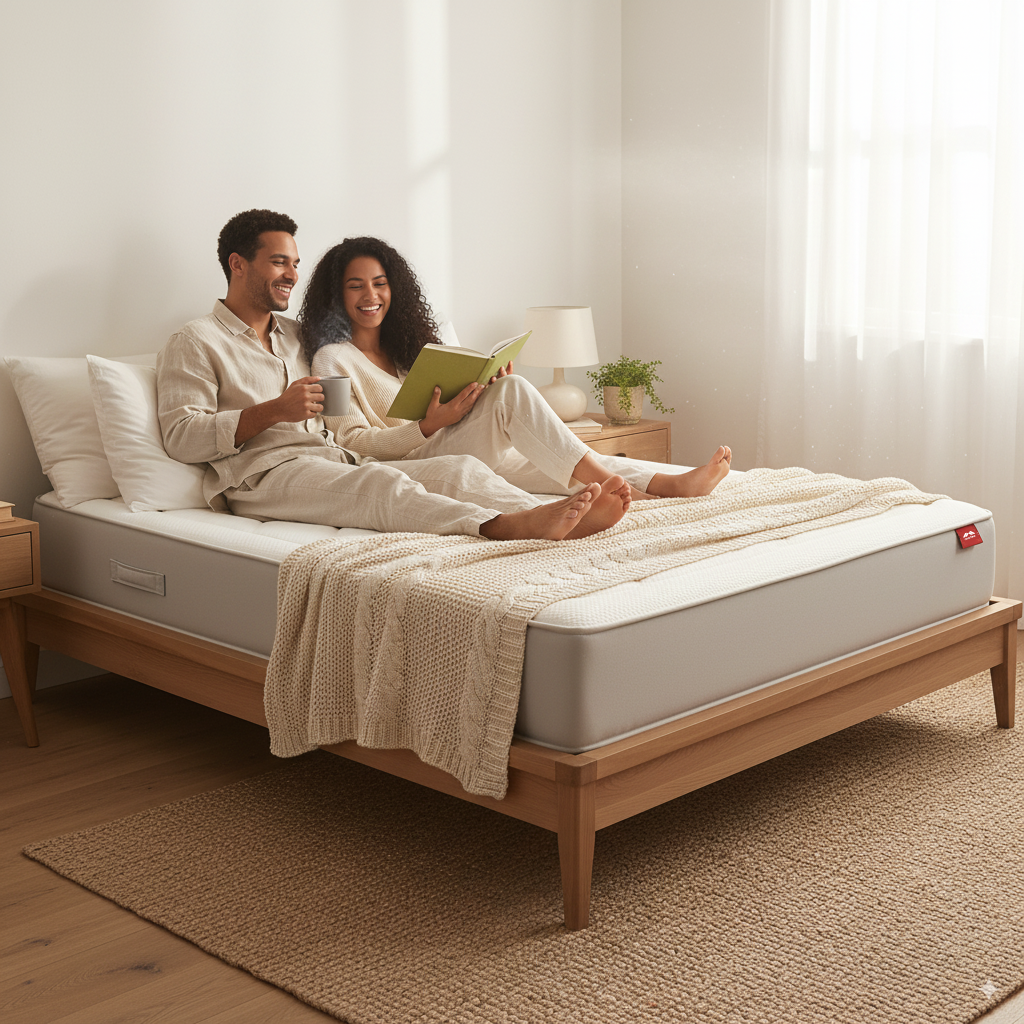
Reading in bed has a similar problem. The back rounds, the pelvis rotates, and the neck compensates. It is better to be semi-reclined with back support and a pillow under your knees if you are on your back, or sitting on your side with stable back support and legs supported symmetrically.
Naps, pregnancy, and waking up with pain
Short naps work better when you do not sink into a soft mattress or stay twisted. A pillow between your legs, even during a short nap, can reduce pelvis rotation if you sleep on your side. During pregnancy, the priority is not only to relieve the back, but to avoid uncomfortable pressure and seek a posture that allows you to rest without turning over every minute.
If the pain appears when you get up, the problem is not always the nighttime posture. Many times it is the combination of a sustained position, a mattress that does not support you, and a sudden exit from bed. Turn on your side, support yourself with your hands and legs, and get up as a whole, without suddenly flexing your torso.
There is also something very practical that almost no one explains well. When a posture is no longer enough, the solution is usually posture + support + micro-change. That applies to a nap, reading, working at home, and those nights when you wake up looking for a less aggressive position.
Exercises and stretches that complement your posture
Posture alone does not correct a back that already arrives rigid at bed or the desk. If your lower back, glutes, abdomen, and hips do not work well, any position will fall short. The solution is a short routine that relieves tension, maintains mobility, and does not punish the area.
A short routine that actually makes sense
Do it calmly, without bouncing, and without chasing pain. If a movement triggers discomfort, stop there.
- Cat-cow: move on all fours at a slow pace, 10 repetitions.
- Knees to chest: bring one leg or both toward your torso and hold for 30 seconds per side.
- Partial bridge: raise your pelvis in a controlled manner, 10 repetitions.
- Child’s pose: let your back drop and breathe, hold for 45 seconds.
If you want to expand the sequence with more variations and organize it better according to your case, consult this guide on exercises to relieve lower back pain.
These guidelines work well as a morning activation or as a release before sleeping. If you spend many hours sitting, cat-cow and the partial bridge help wake up the posterior chain without impact. If the hips are very loaded, child’s pose usually provides quick relief. And if you are coming from a bad night, starting with two gentle movements is worth more than forcing a long session.
When it is best to loosen up and when it is not
If there is acute pain, do not force intense stretches or movements that force you to arch your back excessively. In a sensitive phase, seek gentle mobility and breathing, not heroic sessions. The goal is for the lower back to receive safe movement, not to endure a hard routine.
Morning stiffness calls for a short sequence before sitting down. Pain after being standing for a long time responds better to hip and glute mobility. If the problem appears after hours at the computer, combine breaks, lumbar support, and some gentle extension movements. For a more complete and simple routine to apply at home, this guide on exercises to relieve lower back pain fits well with the approach of this article.
When to worry and how to choose the right mattress
There are pains that do not depend only on posture. If there is loss of strength, persistent tingling, or nighttime pain that does not improve even if you change positions, it is time to seek professional evaluation. Do not cover it with a taller pillow or another improvised gesture.
Choosing a mattress also matters, but not as a miracle solution. The mattress influences because it determines whether the spine maintains its natural alignment during the night. If the support fails, the back works when it should be resting, and that worsens the stiffness upon waking.
For lower back pain, look for a mattress that combines support and adaptation, not a sunken surface or a board. Medium firmness is usually a reasonable starting point for many people, because it helps support the pelvis and lower back without creating excessive pressure. If you want a practical reference to compare options, look at this guide on the best mattress for back pain.
Mattresses to care for the lower back
Neither a board nor a sunken surface
For the lower back, a core that supports the pelvis and a layer that allows the shoulders and hips to settle works well. Choose according to the firmness that is comfortable for you.
 Nature Mattress
Medium firmness, with natural latex and organic cotton over pocketed springs: the starting point recommended in this article.
View the Nature Altus Mattress
Medium-high firmness on more than 2,000 pocketed micro-springs and breathable linen fabric: one more point of support for the pelvis.
View the AltusIt is not a treatment: if the pain persists, consult your doctor or physical therapist.
100 nights of trial on mattresses · 10-year warranty · free shipping in the peninsula · made in Spain
What to check before buying
Check if your main posture is on your side or on your back, because that changes what you need under your shoulders and pelvis. Also evaluate breathability, since sleeping hot increases awakenings and makes it difficult to maintain a stable position. And do not ignore wear and tear, because an outdated mattress stops supporting even if it still feels acceptable to the touch.
If you want a simple rule, use this. If your back wakes up worse and improves when you move, suspect the support. If it worsens when you lie down in a certain posture, suspect the alignment. If nothing changes with basic adjustments, do not keep guessing. According to the clinical guideline cited at the beginning of the article, when the pain does not fit a simple postural overload or changes pattern, it is best to review the case with judgment and not keep improvising in bed.
What matters is that the rest system accompanies your posture, not that it forces you to adapt to it. At Morfeo, we manufacture pocketed spring mattresses in Spain with medium to high firmness, and you can try them for 100 nights at home to see if your back wakes up better.
If you want to stop winging it when it comes to your back, start by checking your sleeping posture and seating support, and try a mattress that doesn't force you to compensate with your body. In Morfeo's back mattresses, you can explore sleep options designed to better support lumbar alignment and choose more wisely what goes in your bedroom, not just what sounds good on a spec sheet.