
Sleep With or Without a Pillow? Find the Answer for Your Neck
The million-dollar question: is it better to sleep with or without a pillow? Well, the short answer is… it depends! There's no magic formula that works for everyone. The right decision is super personal and totally depends on how you sleep, how firm your mattress is, and even your neck's health.
But for most people, especially if you sleep on your side or back, a good pillow is absolutely essential to keep your spine in place.
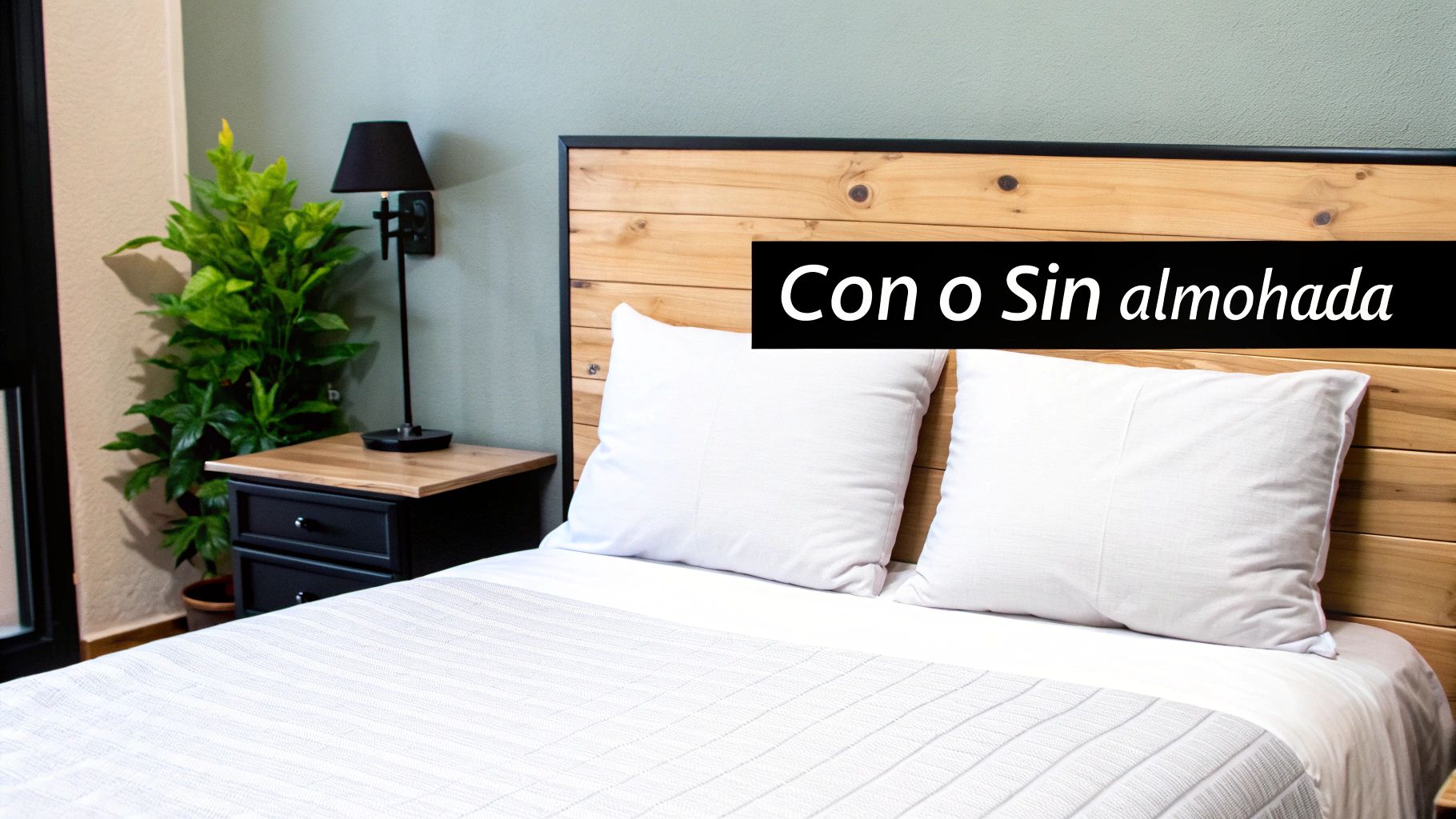
Sleep in Spain: A Personal Dilemma
Deciding whether to use a pillow or not goes way beyond just a habit or preference. It's a decision that directly affects your health and how you wake up in the morning. A poor choice could be the hidden cause of that neck pain, stiff shoulders, or even those morning headaches you can't figure out.
The main goal is always the same: to keep your spine in neutral alignment. Just imagine your head and neck should follow the straight line of your back, without forcing any weird curves.
Think of your spine like a perfectly straight road. A pillow that's too high, or too low for that matter, creates a sharp detour in your neck, causing tension for hours. And for many, sleeping without a pillow is like letting your head hang in a pothole all night long.
The Importance of Choosing Well
In Spain, getting enough rest is still a challenge. Recent data shows that almost half of Spaniards aren't getting the sleep they need. A 2023 Conforama survey made it clear: the 44.8% of Spaniards report not sleeping well, averaging less than 7 hours a day.
This info is super important because your pillow —or not having one— directly affects those tiny wake-ups and your overall sleep quality. To get a clearer picture, you can read more about sleep habits in Spain.
The right pillow (or no pillow at all) isn't just a whim; it's a crucial tool for your posture. Its only job is to fill the gap between your head and the mattress so your neck muscles can finally relax.
To make it easy, we've put together a summary table that will give you a super clear idea of which option might work best for you based on your usual sleeping position.
Quick Summary: Pillow, Yes or No?
Here's a visual guide to help you understand which option might be best depending on your main sleeping position.
| Sleeping Position | General Recommendation | Main Goal |
|---|---|---|
| On your side | Use a medium-to-high pillow. | Fill the space between your ear and shoulder, keeping your neck straight. |
| Back sleeper | Use a low pillow or a cervical contour pillow. | Support the natural curve of your neck without pushing your head forward. |
| Stomach sleeper | Sleep without a pillow or with an extremely thin one. | Avoid excessive and dangerous neck twisting. |
As you can see, every sleeping position has its own rules. What's a lifesaver for one person could be the cause of a stiff neck for another.
Sure, here's the section rewritten with a completely human and natural tone, following the style of the examples provided.
The Benefits and Risks of Sleeping Without a Pillow
Thinking about whether to sleep with or without a pillow is a bit like debating if it's better to run in high-tech sneakers or barefoot. For some, feeling the ground directly can be liberating and even beneficial. For others, it's a direct invitation to pain and injuries. Something similar happens with pillows: there are advocates and detractors, and the funny thing is, both can be right.
The key to all this is to stop seeing your pillow as just a comfy cushion. It's actually a tool that helps us keep the right posture while we sleep. Think of your spine like a straight, well-aligned bridge. The pillow acts as that pillar, stopping your neck area – the most delicate part – from sinking or rising awkwardly. Taking away that support can sometimes help everything get back into place, but other times, it can lead to a real posture disaster.
When might it be a good idea to sleep without a pillow?
Even though most of us need one, there are very specific situations where ditching your pillow could actually have benefits. Almost always, it comes down to one thing: how you sleep.
If you're someone who sleeps on your stomach, you probably know all about waking up with a stiff neck. In that position, even the thinnest pillow forces you to twist your head and keep it at a super awkward angle for hours. By taking it away, your head can lie much flatter and more aligned with your back, which really helps relieve tension in your neck.
Another less-known benefit is that it can reduce pressure on your face. When you sleep on your side or stomach, you squish your face against the pillow, and night after night, that can lead to those famous "sleep wrinkles." By sleeping on your back without a pillow, you get rid of that pressure. Plus, let's not forget that pillows are a magnet for skin oils, dust mites, and bacteria. Avoiding that direct contact can be a real relief for anyone with sensitive or acne-prone skin.
The risks of leaving your neck unsupported
Okay, so despite those possible perks, for the vast majority of people, the risks of sleeping without a pillow far outweigh the benefits. This is especially true if you sleep on your side or back. Taking away that support is really taking a chance.
The main problem is pure physics: without a pillow, your head tends to drop below the line of your spine. This creates constant tension in your neck and shoulder muscles and ligaments. The result? That super unpleasant morning stiffness, muscle knots, and even headaches.
For side sleepers, it's even worse. The gap between your head and the mattress is as wide as your shoulder. If you don't put a pillow there to fill it, your head just hangs, forcing a sideways curve in your neck that's really bad in the long run. Not only does it cause pain, but it can also compress nerves and, of course, totally mess up your sleep quality.
Sleep experts in Spain agree that this practice isn't for everyone. In fact, for side sleepers — which is about 75% of adults — a pillow is absolutely essential for keeping your spine straight. If you want to dive deeper, you can read more about why neck support is key for good rest.
Here's a quick rundown of the main dangers:
- Neck and shoulder tension: The number one risk, especially if you sleep on your side and leave your neck "hanging."
- Poor spinal alignment: Whether you're on your side or back, your head ends up in an unnatural position.
- Worsening of snoring and apnea: If you sleep on your back without a pillow, your tongue can fall backward and partially block your airway.
- Increased head pressure: Lying completely flat can make it harder for fluids to drain, leaving you feeling congested or heavy-headed when you wake up.
So, deciding whether to use a pillow or not is no small thing. While a small group of people (almost always stomach sleepers) might find some relief, for most of us, a pillow is still an essential piece for taking care of our neck and back health.
How Your Sleeping Position Decides If You Need a Pillow
The age-old question of whether it's better to sleep with or without a pillow doesn't have a universal answer, but there's one fundamental key to solving it: your sleeping position. Think of your spine, from the base of your skull to your tailbone, as a straight line that needs to stay aligned all night long. Any deviation, no matter how small, will end up creating tension.
Your pillow isn't just a comfort accessory; its real job is to act as a support, filling the space between your head and the mattress, making sure that straight line doesn't break. That's why what's ideal for one person can be a direct ticket to neck pain for another. It all depends on how you position yourself when you sleep.
This infographic sums it up really well visually, showing the two paths you can take and highlighting both the possible benefits and risks associated with each choice.
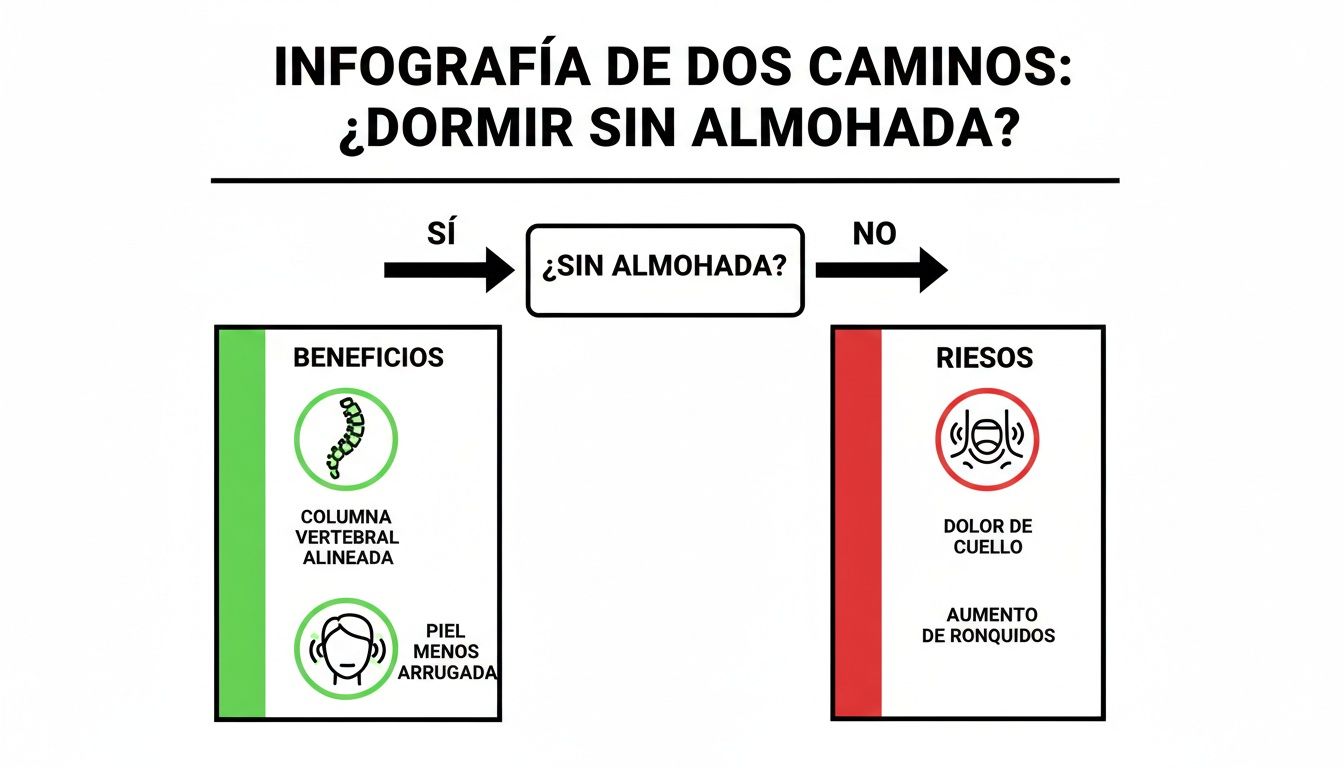
As you can see, the decision directly affects your spine's alignment and neck tension. The truth is, for most sleeping positions, the risks of not using one far outweigh the benefits.
If You Sleep on Your Side
This is the most common sleeping position, adopted by about 75% of adults. If you're one of them, a pillow isn't an option; it's an absolute necessity. Think about the gap that forms between your ear and your shoulder when you lie down. Without good support, your head would just plummet, forcing a sideways tilt that's really harmful for your neck.
Here, the goal is super clear: you need a pillow that's tall and firm enough to completely fill that space and keep your head perfectly aligned with your spine.
- Recommended height: Medium to high. The perfect height should match the distance between your ear and the edge of your shoulder.
- Ideal firmness: Medium to firm. It needs to be able to support the weight of your head without sinking too much.
A pillow that's too low will make your head hang, and one that's too high will push it upwards. Either way, you'll end up with poor alignment and muscle tension that turns into neck and shoulder pain.
If you sleep on your back
Sleeping on your back, or in a supine position, is considered one of the healthiest postures for your spine, but it still needs the right support. Here, your pillow's job is a bit more subtle: it should support the natural curve of your neck (that's your cervical lordosis!) without pushing your head forward.
If your pillow is too high, your chin will tilt towards your chest, creating a forced posture that causes tension in your neck and can even make it harder to breathe.
- Recommended height: Low. You need something that barely lifts your head, just enough to keep it aligned with your back.
- Ideal firmness: Medium. Pillows with a cervical contour or made from adaptive materials like memory foam are an excellent choice.
Going without a pillow in this position might work for some folks, but only if their mattress is soft enough for their head to sink slightly and maintain that neutral alignment. For most, a low-profile pillow is your best friend.
If you sleep on your stomach
Now, this is where things get really interesting. Sleeping on your stomach is, by far, the least recommended position by physical therapists and sleep experts. It forces you to turn your neck at an extreme angle for hours, which is pretty much a guaranteed recipe for neck pain and tension throughout your entire spine.
In this scenario, sleeping without a pillow is almost always the best option.
Even a super thin pillow just makes things worse by forcing your neck into an even more twisted position. By ditching it completely, your head can stay more aligned with your spine, which helps minimize some of the damage.
- Alternative: If the idea of having nothing feels weird, try an extremely thin, soft, almost flat pillow. Some people also place a thin pillow under their stomach or pelvis to ease pressure on their lower back, which can really help improve overall alignment.
No matter how you sleep, it's super important to listen to your body. If you want to dive deeper into optimizing your sleep position, you can check out our guide on how to improve your sleeping posture for optimal rest. Ultimately, choosing whether to sleep with or without a pillow comes down to this very personal analysis.
How to pick the perfect pillow for you
If, after thinking it over, you've decided that for you, it's better to sleep with a pillow, congrats! You're about to give your sleep quality an amazing boost. But now comes the fun part (and sometimes, a little tricky): finding that perfect pillow in a sea of options.
Forget about just picking one because it feels soft when you squeeze it in the store. The ideal pillow is a precision tool, almost custom-made for your body and your sleep style. There are three key things you can't ignore: the material, the firmness, and the height. These three elements work together as a team to keep your neck and spine aligned and happy all night long.
Materials: the foundation of your comfort
The filling is the heart and soul of your pillow. It determines how well it adapts to you, how cool it keeps you, and how long it'll last. Each material offers a totally different feel, so getting to know them is the first step to making the right choice.
Here are the main players:
- Memory Foam: This is the queen of adaptability! This material is amazing because it reacts to your body's heat and pressure, creating a perfect mold of your head and neck. It offers support that feels like a hug, with no pressure points, making it ideal for anyone who needs to relieve tension in their neck area.
- Latex: This is all about natural elasticity and firmness. Unlike memory foam, latex offers more 'responsive' support, bouncing back to its shape instantly. Plus, it's super breathable and a terrible spot for dust mites and mold, making it a fantastic option if you get hot at night or have allergies.
- Fiber (Polyester): These are your classic, everyday pillows and usually the most budget-friendly. They give you that soft, fluffy feel, pretty similar to down, but with the bonus of being hypoallergenic and super easy to wash. Their weak spot? Over time, they tend to flatten out and lose their fluff.
Firmness and height: the perfect match
Firmness and height go hand-in-hand, so you've got to pick them together since one really depends on the other. And what's the deciding factor? Your sleeping position and your mattress's firmness. They'll tell you what the winning combo is for you.
Keep this in mind: your pillow's firmness should balance out how much your body sinks into the mattress. The ultimate goal is for your head to be neither higher nor lower than your back.
For example, if you've got a super soft mattress where you sink in quite a bit, chances are you'll need a fairly low and less firm pillow so you don't strain your neck upwards. On the other hand, with a firm mattress that barely gives, you'll need a taller pillow to properly fill that gap between your neck and the mattress.
If you want to dive deeper into this topic, we've got some tips for buying a pillow and finding the perfect one for optimal rest that will come in super handy.
Pillow Material Comparison
To make everything super clear, here's a table that sums up the essentials. Think of it as a cheat sheet to quickly figure out which material best suits what you're looking for in your nightly sleep.
| Material | Key Benefits | Drawbacks | Ideal for |
|---|---|---|---|
| Memory Foam | Excellent adaptability, relieves pressure points, great durability. | Can retain heat (look for models with gel or perforations), slow recovery. | People with neck pain, those who sleep on their back or side. |
| Latex | Very breathable, elastic and responsive, hypoallergenic and anti-dust mite. | Tends to be heavier and have a higher price. | People who sleep hot, allergy sufferers, and those looking for firm but flexible support. |
| Fiber | Soft and plush, economical, hypoallergenic, and easy to wash. | Lose volume and support over time, require frequent fluffing. | Those who sleep on their stomach (thin models), people on a tight budget. |
Choosing the right pillow is definitely an investment in your health. Don't rush it. Think about how you sleep, what your mattress is like, and most importantly, listen to what your body is telling you. A good choice won't just clear up whether to sleep with or without a pillow, it's going to completely transform the quality of your rest.
Your Guide to Safely Trying to Sleep Without a Pillow
If you've made it this far, the idea of sleeping without a pillow is probably on your mind, especially if you're a stomach sleeper. But hold on! After years of using a pillow, suddenly ditching it can be a real shock to your body. That's why the smartest thing to do is treat it as a transition, not a radical change.
Think of it like starting to run barefoot: you wouldn't jump into a marathon on day one, right? It's the same with your neck. It needs time to get used to this new position. A sudden change can bring more problems than solutions, like stiffness, muscle aches, or even an unexpected knot.
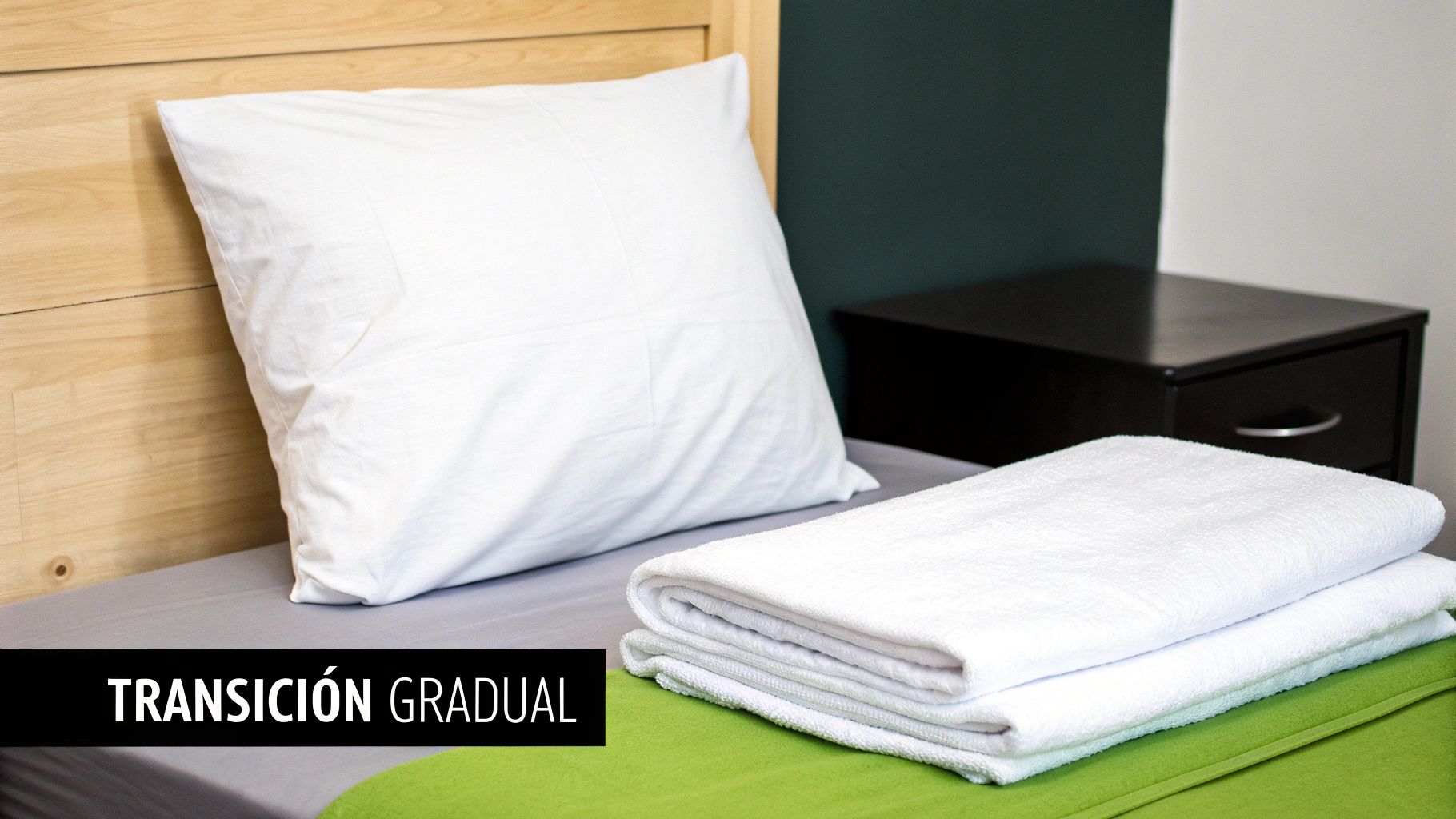
Your three-step transition plan
To help your body get used to it smoothly, we've got a step-by-step method for you. This plan will let your neck and back muscles adapt gradually, so you'll minimize any discomfort. Just follow these steps, and most importantly, really listen to what your body tells you.
-
Gradually lower the height. Don't just ditch your regular pillow and go straight to the mattress. Your first move is to swap it for a much lower, softer pillow. A super flat fiber pillow or a low-profile memory foam one would be perfect for this stage. Give it a try for a week or two.
-
Go for minimal, temporary support. Once you're comfy with the low pillow, it's time for the next step. Swap it out for something super simple, like a folded bath towel or a t-shirt. This makeshift support will give you just a tiny bit of lift, but it'll be enough to make the change less drastic. Adjust it until your head feels almost level with your mattress.
-
Try sleeping with no support at all. After a few days with the towel, go for it and try a whole night with nothing under your head. This is the ultimate goal, but only move to this step if the previous stages felt comfortable and didn't cause you any pain.
The whole point of this transition isn't to force your body into anything, but to gently encourage it to adapt. If you ever feel pain or ongoing discomfort, that's a clear sign to hit pause or even go back to the previous step.
Listen to Your Body: The Warning Signs
Throughout this whole experiment, your body is going to be your best guide. You really need to pay attention to how you feel each morning. Those first few hours of the day will give you the most reliable clues about whether this is working for you or not. And it's not just about not having pain; aim for an overall feeling of well-being.
Keep a close eye on these warning signs, because they're telling you that sleeping without a pillow might not be the best fit for you:
- Morning neck pain or stiffness: This is the clearest sign. If you wake up with a stiff neck or a new pain you didn't have before, it means your spine isn't properly aligned.
- Headaches: Often, tension building up in your neck muscles can spread to your head, leading to those annoying tension headaches right when you wake up.
- More snoring: If you or your partner notice you're snoring more, it might be because your new sleeping position is partly blocking your airways.
- Shoulder or back discomfort: When your neck isn't aligned properly, it can create a domino effect, impacting your shoulders and upper back too.
If you keep noticing any of these symptoms, don't push it. Go back to using a pillow that gives you the support you need. And hey, if you've got a history of neck issues, injuries, or herniated discs, always chat with a physical therapist or your doctor before making such a big change to your sleep. Your health is super important!
The Final Key: Create Your Own Sleep Guide
So, by now, the big question of whether it's better to sleep with or without a pillow probably doesn't seem so tricky anymore, right? The takeaway is clear and, honestly, pretty freeing: there's no single golden rule that works for absolutely everyone. It's a super personal decision, like a custom-made suit tailored to your sleeping position, your mattress's firmness, and most importantly, the signals your own body sends you.
The real goal here is for you to become the ultimate expert on your own sleep. Think of this guide's info not as a strict instruction manual, but more like a map to help you explore and experiment safely. The final destination of this journey should always be the same: to achieve neutral spinal alignment, that imaginary straight line that lets your muscles completely loosen up and relax.
The right choice isn't necessarily what everyone else is doing; it's the one that helps your body wake up feeling relaxed, refreshed, and totally ready to conquer the day.
Your Personal Map to Better Sleep
To make sure you don't get lost on your journey, here are some key ideas to remember:
- Your sleeping position is key. If you're a side sleeper, a pillow is pretty much a must-have. If you sleep on your back, aim for something with low support. And if you're a stomach sleeper, it usually makes the most sense to skip the pillow altogether.
- Listen to your body – it's your best informant. Neck pain, stiffness when you wake up, or those morning headaches are clear signs that something's off. Don't ignore them!
- Experiment, but be smart about it. If you're keen to try sleeping without a pillow, take it slow. A gradual transition is super important to avoid muscle knots and give your body the time it needs to get used to the change.
Taking charge of your sleep is one of the best investments you can make for your long-term well-being. When you make informed choices, you're not just picking out a bed accessory; you're actively protecting your back's health. Your neck and spine will definitely thank you for it every single morning!
Let's tackle your questions about sleeping with or without a pillow
The age-old debate about whether it's better to sleep with or without a pillow always sparks a bunch of questions. To help you make the best choice for your rest, we've rounded up the most common ones and we're answering them right here, no fuss.
Will getting rid of my pillow actually cure my neck pain?
Wish it were that easy, but nope, it's not a magic fix. In fact, for most folks, ditching your pillow can actually make things worse. Neck pain often pops up due to bad alignment, and if you're a side or back sleeper, a pillow is exactly what you need to keep your neck nice and neutral, free from tension.
The only exception? Stomach sleepers! If that's you, going without a pillow might help ease that awkward neck twist and, fingers crossed, relieve some pain. For everyone else, the real issue is usually a pillow that's just not right (either too high or too low), not the pillow itself.
If I decide to go pillow-free, how long will it take to get used to it?
This is super personal! Getting used to it can take anywhere from a couple of days to a couple of weeks. The key is to transition slowly, just like we talked about: start with a flatter pillow or even a folded towel.
If after two weeks you're still waking up stiff, uncomfortable, or with a headache, that's a super clear sign your body needs that support. Don't push it! Your comfort and being pain-free are the best clues that you're on the right path.
So, what if I'm a super restless sleeper? Which pillow should I use?
If you're someone who tosses and turns all night, you need a pillow that can keep up – a real all-rounder! Memory foam or medium-height latex pillows are awesome for this. Their material reacts perfectly to pressure changes, giving you great support whether you roll onto your side or end up on your back.
Look for models with medium firmness that can properly fill the gap at your shoulder without lifting your head too much when you're lying on your back.
When's a good age for kids to start using a pillow?
Pediatricians are super clear on this: babies under two years old should never use a pillow. The main reason is the risk of suffocation and Sudden Infant Death Syndrome (SIDS). Their head and neck proportions are totally different from an adult's, so a flat surface is the safest bet for them.
Once they're around 2 or 3 years old, and their shoulders are wider than their head, you can start introducing a very, very thin and firm pillow, specifically designed for kids.
Keeping any pillow clean is super important, but even more so for the little ones! If you want to make sure you're doing it right, check out our tips on how to wash a pillow to keep it free of dust mites and allergens.
Here at Morfeo, we get that everyone's unique and needs sleep that's just right for them. That's why we've created a range of products designed to give you ultimate comfort and support that truly adapts to you. Find out how our Morfeo Mattress can totally transform your nights and give you the rest you totally deserve. Pop over to our online store and start sleeping like never before!